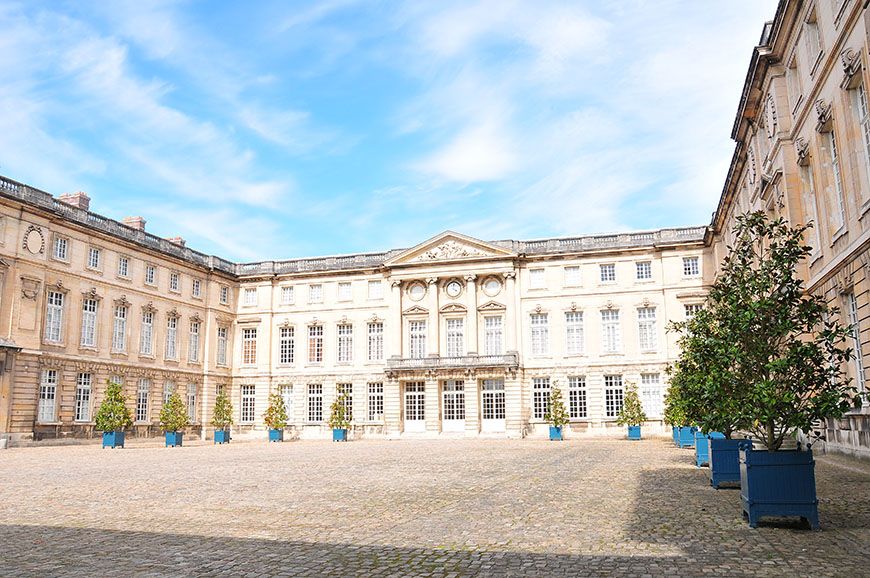
Updated in August 2026. From the outside, the Château de Compiègne, in the Oise, looks almost restrained, with its long pale façades and neoclassical architecture. Yet once you step through its doors, the scene changes completely: imperial apartments, gilding, wall hangings, painted ceilings and monumental galleries bear witness to the splendour that once reigned in this former royal and imperial residence.
I already knew the château, having visited it as a child, before going back one Wednesday afternoon with my mother. I was quite struck by the contrast between the sober façades and the richness of the interiors. The rooms follow one another almost like a maze, each revealing a new atmosphere, new furniture and a new chapter of French history.
A favourite residence of Louis XV, refurbished by Napoleon I and then much loved by Napoleon III and Empress Eugénie, the Château de Compiègne is one of France’s great royal and imperial palaces. Yet it is far less well known than Versailles or Fontainebleau, which makes discovering it all the more enjoyable. And it’s an easy day trip from Paris, less than an hour and a half by train from the Gare du Nord.
In this guide, I share everything you need to know to visit the Château de Compiègne: its history, the apartments and museums not to miss, my practical tips, my review and a few ideas for extending your day in the Oise.
More châteaux to discover in the Hauts-de-France
🌿 This visit fits perfectly into a weekend in the Oise
The Château de Compiègne is one of the département’s must-see sights. Make the most of your stay to also discover Pierrefonds, Saint-Jean-aux-Bois, Senlis, Chantilly, Gerberoy and the Oise’s many natural areas.
.
Why visit the Château de Compiègne?
First and foremost, the Château de Compiègne is worth visiting for its historical importance. This is no ordinary aristocratic house, but a former royal and imperial residence used by a succession of French rulers. Louis XV was particularly fond of Compiègne, Napoleon I had many of its apartments refurbished, and Napoleon III made it one of the great social hubs of the Second Empire.
What I loved most was the contrast between the relatively plain appearance of the building and the richness of its interiors. Behind the long classical façades lie colourful drawing rooms, imperial bedchambers, galleries lined with paintings, precious furniture and a wealth of decorative detail. Gilding, wall hangings, medallions, trompe-l’œil and painted ceilings reveal themselves as you go round.
The château also lets you travel through several periods in a single visit. Some rooms still evoke the 18th century, while others have been restored to how they looked under the First or Second Empire. You move from the apartments of Napoleon I and Marie-Louise to the rooms used by Napoleon III and Empress Eugénie.
Finally, the visit isn’t limited to the historic apartments. The estate is also home to a Second Empire Museum, a museum devoted to Empress Eugénie, the surprising National Car Museum and a vast park opening onto the Forest of Compiègne. You can easily spend several hours there, or even most of the day.

A brief history of the Château de Compiègne
A royal residence on the edge of the forest
French monarchs have stayed at Compiègne since the Middle Ages, largely because of its immense forest, which was particularly prized for hunting. Charles V had a castle built here in the 14th century, but it was gradually altered and eventually no longer met the needs of the Court.
Louis XV’s grand project
Louis XV, who was very attached to Compiègne, wanted a larger and more modern residence. He entrusted the project to his chief architect, Ange-Jacques Gabriel, who also worked at Versailles and designed the Place de la Concorde in Paris.
The plans for the new château were approved in 1751. The irregular shape of the site and the old ramparts led the architect to design a triangular building, an unusual feature you wouldn’t necessarily guess when looking at the monument from the square.
Work continued under Louis XVI, notably with the fitting out of the king’s and queen’s apartments, the reception rooms and the wing facing the park.
Napoleon I’s palace
The Revolution led to most of the furniture being dispersed. A few years later, Napoleon I decided to restore the château to its role as a sovereign residence and ordered its renovation in 1807.
The apartments were then restored and redecorated in the First Empire style. The emperor also had the gardens transformed and laid out the long Beaux-Monts avenue, which symbolically links the château to the Forest of Compiègne.
Napoleon III and the famous Séries de Compiègne
However, it was under the Second Empire that the château enjoyed one of its liveliest periods. Napoleon III and Empress Eugénie stayed here regularly in autumn and hosted the famous Séries de Compiègne.
Over several weeks, around a hundred guests at a time took turns to enjoy stays combining hunting, walks, concerts, shows, games and conversation. Writers, artists, diplomats, scientists and foreign royals were welcomed in a more relaxed atmosphere than at the Tuileries.
Prosper Mérimée, Théophile Gautier, Eugène Delacroix and Giuseppe Verdi all passed through the château’s doors. I really loved this anecdote during my visit: it’s rather fun to imagine all these figures chatting or playing billiards in the very rooms you walk through today.

From imperial palace to museum
After the fall of the Second Empire in 1870, the château lost its role as a sovereign residence for good. It gradually became a heritage site and museum. Its apartments were restored and refurnished to recreate several periods of its history, while various collections were added to enrich the visit.
Today, the Château de Compiègne therefore lets you discover nearly five centuries of royal and imperial presence, from Charles V’s castle to the splendour of the Second Empire.

What to see at the Château de Compiègne: the highlights
| Not to be missed | Why linger there? |
|---|---|
| ✨ The Apollo staircase | It marks the entrance to the historic apartments, with its wrought-iron banister, gilding and elegant architecture. |
| 👑 The Emperor’s apartment | To see the dining room, the Salon des Cartes, the Council Chamber, the imperial bedchamber and the library. |
| 🌸 The Empress’s apartment | For its refined drawing rooms, fabrics and colours, and the more intimate atmosphere associated with Marie-Louise and later Eugénie. |
| 🗺️ The Salon des Cartes | An iconic room of court life under Napoleon III, where guests would gather, notably around the billiard table. |
| 🎨 The Natoire Gallery | For its impressive series of paintings depicting the adventures of Don Quixote. |
| 🎭 The reception rooms | They let you imagine the splendour of the receptions and the Séries de Compiègne held under the Second Empire. |
| 🚗 The National Car Museum | An unusual collection of horse-drawn carriages, bicycles, sleighs, sedan chairs, motorbikes and vintage cars. |
| 🏛️ The Second Empire Museum | To delve deeper into this period through paintings, sculptures, decorative objects and reminders of imperial life. |
| 🌳 The park and the Beaux-Monts avenue | To round off your visit with a free stroll among gardens, statues and tall trees, with a vista opening towards the forest. |

—
The different areas of the château
👑 The Emperor’s apartments
Napoleon I’s apartments are one of the highlights of the visit. The dining room, the Salon des Cartes, the Council Chamber and the imperial bedchamber help you picture the emperor’s daily life when he stayed at Compiègne. I particularly appreciated the richness of the decoration, woodwork and furniture, which reflect the splendour of the imperial era.
You reach the historic apartments via the Apollo staircase, adorned with a wrought-iron banister and gilding… before making your way in turn through the Emperor’s Dining Room, the Salon des Cartes and its surprising billiard table, a favourite pastime under Napoleon III, the Family Drawing Room, the Council Chamber, the Emperor’s Bedchamber, the Empress’s apartments, the Music Room…
There are so many rooms in this maze that the visit seems never-ending, and in every one of them, splendour and luxury seem to have been the watchwords! Fabrics, medallions, gilding, hangings (admirable in the Hunting Gallery), decorative paintings and painted ceilings all bear witness to it! (So much for the plain exterior façades!)
Extravagance and elegance enhance this sublime interior.


 In case you had any doubt about who slept in this room, the bed is topped with a few clues…


.
The Ballroom
It’s impossible to remain unmoved when you enter the Ballroom. With its huge crystal chandeliers, gilding, high ceilings and large windows, it is undoubtedly one of the most spectacular rooms in the château.
Built under Napoleon III, it hosted the grand balls, concerts and receptions held during the famous Séries de Compiègne. I found it quite fascinating to imagine this room lit by hundreds of candles, filled with evening gowns, uniforms and music, at a time when the imperial court would gather here to dance late into the night.
It’s also one of the most photogenic rooms on the tour. Take the time to look up: between the monumental chandeliers, the carved decoration and the play of light, every detail adds to the elegance of the place.
💗 My favourite
This is probably the room that impressed me most during the visit. Its size, its brightness and its huge crystal chandeliers give it a truly grand atmosphere. I found it very hard to leave, I was so keen to admire every detail.


—
The park of the Château de Compiègne
Entry to the château park is free and therefore open to everyone, and it’s very popular with walkers. That afternoon, lots of young people had gathered there to enjoy the mild weather. Statues and small pavilions frame the colourful, flower-lined paths designed by Ange-Jacques Gabriel. Five terraces and ornamental pools were originally planned when this French formal garden was designed, but it was never completed. What a shame!
The palace park is divided into several smaller areas: the Rose Garden (open during the last four weeks of spring from 2.30pm to 6pm), the Petit Parc and the Grand Parc, better known as the “Trouée des Beaux-Monts”, which stretches for almost 5 km and links the garden to the forest. The walk may be less impressive than at Versailles, but it’s no less interesting, and very pleasant in spring!
Personally, I love wandering around this haven of peace when the sun starts to peep out again!


The Chloé statue and the fountain

👑 Pierrefonds or Compiègne: which château to choose?
The two châteaux are very different and complement each other perfectly.
💚 My verdict
The Château de Compiègne won me over more with its interiors than its exterior architecture. While Pierrefonds impresses at first sight, Compiègne reveals all its charm once you step inside. I particularly loved the richness of the imperial apartments and the Ballroom, which is absolutely magnificent. If you enjoy French history and royal palaces, I wholeheartedly recommend this visit, especially as it combines perfectly with Pierrefonds and the Forest of Compiègne.
Here’s which one to choose depending on what you like.
| If you like… | I recommend… |
|---|---|
| Fortresses and fairy-tale settings | Pierrefonds |
| Royal palaces and historic apartments | Compiègne |
| The Middle Ages, ramparts and fantastical creatures | Pierrefonds |
| Napoleon I, Napoleon III and the Second Empire | Compiègne |
| Visits with children | Pierrefonds, which is usually more spectacular at first sight |
| Museums and collections | Compiègne |
| Outdoor photography | Pierrefonds |
| A long walk in a park | Compiègne |
💚 My verdict: if your schedule allows, don’t choose! The two monuments are only a short drive apart through the Forest of Compiègne and make for a wonderful day exploring two completely different periods of history.
🧳 Fancy extending your trip in the Hauts-de-France?
Compiègne and Pierrefonds fit easily into a weekend in the Oise. For more trip ideas combining heritage, coastline, historic towns and nature, take a look at my selection of weekends in the Hauts-de-France.
Practical information for visiting the Château de Compiègne
| 📍 Information | Details |
|---|---|
| ⏱️ Time needed | Allow around 2 hours for the historic apartments. Plan on half a day if you want to visit several museums and walk in the park. |
| 💶 Price | Adults: €10; reduced rate: €8. A supplement may apply during some temporary exhibitions. Free entry notably for EU residents under 26, and for everyone on the first Sunday of the month, subject to current conditions. |
| 🕙 Château opening hours | The apartments are open from 10am to 6pm. The château is closed on Tuesdays and on 1 January, 1 May and 25 December. |
| 🏛️ Museum opening times | The Second Empire Museum and the Empress Museum are generally open on Wednesdays, Thursdays, Saturdays and Sundays from 10am to 12pm. The National Car Museum opens on the same days from 2pm to 6pm. |
| 🎧 Audio guide | Audio guides are available and included in the entrance ticket. Activity booklets are also offered to children, subject to availability. |
| 🚗 Parking | There’s a free car park on Place du Général-de-Gaulle, opposite the château. Other free car parks are available near the park, about a five-minute walk away. They can get very busy at weekends. |
| 🚆 Getting there by train | Trains run from Paris Gare du Nord (also the Eurostar terminal) to Compiègne in around 40 minutes to 1 hour 20 minutes. The château is about a ten-minute walk from the station. |
| ♿ Accessibility | The château offers a range of facilities for disabled visitors. A wheelchair and a few lightweight pushchairs can be borrowed free of charge on site, subject to availability. |
| 🌳 Park | Entry to the park is free. Opening hours vary with the season, with closing times ranging from 5pm in winter to 7pm in high summer. |
| 📍 Address | Place du Général-de-Gaulle, 60200 Compiègne, France. |
As museum opening times and prices may change, remember to check the château’s official website before your visit.
❓ FAQ – Visiting the Château de Compiègne
How long should you allow to visit the Château de Compiègne?
Allow around two hours to explore the historic apartments at a leisurely pace. If you’d also like to visit the various museums and walk in the park, plan on half a day instead.
Is the Château de Compiègne worth visiting?
Yes, especially if you enjoy French history, royal apartments and the First or Second Empire. Behind its relatively plain façades, the château has particularly rich interiors and several unusual collections.
Which museum should you see at the Château de Compiègne?
The National Car Museum is probably the most unusual, with its horse-drawn carriages, bicycles and vintage cars. The Second Empire Museum is the perfect complement to the apartments if you want to learn more about that period.
Can you visit the Château de Compiègne with children?
Yes. Activity booklets and family events are regularly offered. The apartments may feel long for younger children, though: the National Car Museum is often the part they enjoy most.
Is the Château de Compiègne park free?
Yes, entry to the park is free. So you can simply come for a stroll in the gardens, admire the Beaux-Monts vista or round off a visit to the town centre.
Where can you park to visit the Château de Compiègne?
There’s a free car park on Place du Général-de-Gaulle, right in front of the château. Other free parking is available near the park, but it can fill up quickly at weekends and during events.
Can you get to the Château de Compiègne by train from Paris?
Yes. Direct trains run from Paris Gare du Nord and the journey usually takes between 40 minutes and 1 hour 20 minutes. The château is then about a ten-minute walk from Compiègne station.
Compiègne or Pierrefonds: which château should you choose?
Choose Pierrefonds if you dream of towers, ramparts and a fairy-tale castle. Go for Compiègne if you prefer palaces, imperial apartments and Napoleonic history. As the two are close together, the best option is to combine them on the same trip.
When is the best time to visit the Château de Compiègne?
Spring and autumn are particularly pleasant for enjoying the park and the forest as well. To see the various museums, check their opening days and times carefully, as they aren’t all open every day.
What to do around the Château de Compiègne
The château is right in the heart of town and makes an excellent starting point for exploring Compiègne and the surrounding area. Several visits can easily be combined over a day or a weekend:
- Wander through Compiègne’s historic centre, around the town hall, the shopping streets and the old houses.
- Explore the château park and the Beaux-Monts avenue, which stretches towards the Forest of Compiègne.
- Visit the Glade of the Armistice, where the armistices of 1918 and 1940 were signed.
- Discover Saint-Jean-aux-Bois, a tiny flower-filled village tucked away in the heart of the forest, ideal for a break or a picnic.
- Visit the Château de Pierrefonds, whose towers and ramparts look as if they’ve come straight out of a fairy tale.
- Discover the Cité des Bateliers in Longueil-Annel, devoted to the history of inland waterways and the life of the bargemen.
- Explore the Oise’s other must-sees, from Chantilly to Gerberoy via Senlis and Beauvais.
More châteaux to discover in the Hauts-de-France
💚 My idea for a day around Compiègne
Start the morning with a visit to the Château de Compiègne, then have lunch in the town centre. In the afternoon, head to Saint-Jean-aux-Bois before ending the day at the Château de Pierrefonds. The drives are short and this loop lets you combine an imperial palace, a forest village and a fairy-tale fortress without spending the day in the car.
If you enjoyed this article, you’ll also find it on Pinterest: