A quick reminder: at the end of October, I set off aboard a little boat on the canals of Alsacefor a river cruise… An unforgettable experience! 🙂
In my previous post, I explained that this kind of cruise is for everyone, whether or not you have a boating licence.
Here are a few more details to help you organise your trip if you decide to take the plunge.
1/ Where to go?
We went to Alsace, but most of France’s canals (and those of some other European countries) are open to pleasure boats! A cruise on the Loire, in the south of France, in Brittany or in Burgundy wouldn’t have displeased us either!
And above all, wherever you go, book well in advance. By early March, almost all the company’s boats had been booked, and the only cruise available was in Alsace-Lorraine…

2/ Logistics
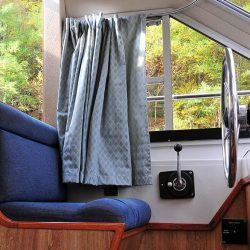
We sailed on a Crusader (11.90 m) designed for 6 people (3 cabins, each with its own bathroom).
The fittings (on a boat, the French say “emménagements” rather than “aménagements”!) are similar to a camper van’s: it feels like a little house with all the essentials for your comfort – fridge, table, oven, gas, heaters, crockery, fire extinguishers, fire blankets, car radio.


The company also provides sheets and blankets, towels, a small first-aid kit (plasters, disinfectant…) and a few household items (broom, bucket, dustpan and brush…)
So remember to bring:
- Food and drink, if you plan to eat on board
- Matches, for the gas
- Cleaning products (washing-up liquid, sponge, floor cleaner)
- Your toiletries
- Toilet paper
- A cigarette-lighter charging cable (very handy for charging our phones)

3/ Sailing
Pleasure boats can’t go faster than 8 km/h, and their engines are speed-limited anyway.
Sailing wasn’t very complicated in itself , as you just go from lock to lock! As with cars, you keep to the right. By day or by night (moored), you’re not shaken about at all, so don’t worry about seasickness.
The longest and trickiest part is going through the locks. They allow rivers and canals to follow the lie of the land and regulate the water level (to prevent flooding), and therefore navigation.

There are different types of lock, but broadly they all work the same way. Most are automatic and are triggered when you pass a sensor or enter a chain of locks. Sometimes, though, you have to pull a “pole” (actually a dangling cord), a bit like grabbing the tassel on a fairground ride, to announce your arrival, or announce yourself over an intercom.

When the lock cycle starts, the water inside rises or falls to your level, and the gates open.

Once inside, you moor up and pull up a “bar” that sets off the change in water level.

The gates open again, and off you go! 🙂
/!\ Unless you’re a professional, you need at least 2 people to go through a lock.
4/ Stopovers
In theory, you can stop more or less anywhere, as long as you find bollards to moor to and respect the waterway signs.
In practice, too.
We did quite a lot of this kind of wild camping to save money, and it wasn’t really a hassle… In our case, the water tank was heated when the engine was running, and we didn’t particularly need electricity, as the oven and hob ran on gas. (Weaning myself off my hair straighteners was hard!)
We did, however, stop for 2 days at the harbour office in Strasbourg’s marina to refill the water tank, which isn’t unlimited, plug into 220V mains power, which isn’t available on board, and clean the boat…


Stopping in a port and using its facilities does cost money, though, and prices vary from town to town. For example, we paid €41 for 2 nights in Strasbourg (at the time)…
5/ And what about the cost?
As I’ve already explained, I won this cruise in a competition run by Infotourisme, so I didn’t have to pay for the boat hire, which at Le Boat ranged from €1,400 to €2,000 at the time, depending on the cruise location, the dates and the type of boat. (The price is fixed, however many people come aboard.)
You can compare different licence-free boat hire websites to get an idea.
On top of that, there are extras, which we did have to pay:
- Getting to the departure base, 4.5 hours from home
- Fuel (about €7.50 an hour)
- Insurance, almost compulsory – otherwise you’ll be asked for a deposit of more than €1,000 (€130 for us)
- Mooring fees, mentioned above, to spend the night in a port
- Miscellaneous spending on activities!
… and possibly:
- A “late return” option, to return the boat at the end of the day rather than at 9am (€85)
- An option to have your car brought back if you don’t return the boat to the departure base, which lets you go further on your cruise rather than just doing a there-and-back. We were offered this one free of charge, as a barge accident had blocked the waterways on part of our route.
Inevitably, the bill adds up quickly.
It’s a shame, because it means this kind of cruise isn’t very accessible on a tight budget, but it’s fairly good value if you go as a group and share the costs. (In any case, many package holidays and ocean cruises cost much more, even if the destinations are further afield…)
Like every kind of holiday, this one has its pros and cons.
If you’re interested in the adventure, keep an eye out for last-minute deals ! 😉