Pretty names for a district that more than lives up to them… At the risk of killing the romance, you should know that it owes its name to the hospice for syphilis sufferers built under Francis I to take in civilians and soldiers suffering from syphilis, also known as the “French disease”.
Back then, who’d have thought Petite France would one day be such a hit with visitors from all over the world and with the people of Strasbourg…

I’d never heard of Petite France until a year or two ago, in a conversation with friends… Out of curiosity, I’d had a look at the photos online illustrating the district, and only had a few images in my head of colourful, flower-filled waterside streets lined with half-timbered houses. I didn’t think about it again until my parents and I set foot in Petite France during our stop in Strasbourg.

To be honest, I hadn’t really had time to plan our weekend in Strasbourg before we left, as I was already struggling during those first weeks of the school year to juggle work, my social life and my hobby, blogging… I thought I’d have time to look into it all on board, and in the end… no. Steering a boat takes a bit of commitment, after all, and we spent most of our days on deck, keen not to miss a crumb of the scenery we were passing through. (Except for the heavy showers that more than once drove my mum and me back to our “quarters”.) Our evenings were quieter, but sadly I didn’t have enough signal for anything but my emails… (Those of you who follow me on Facebook have no idea how much time and patience it took to post a few photos each day!)
Anyway, this lack of organisation wasn’t much of a handicap in Strasbourg, a city that reveals itself as you walk, without your having to think too much about which way to go… Almost the whole city is easy to explore on foot: for example, Petite France is about fifteen minutes from the cathedral…

Today, a little research into this picturesque district, part of a UNESCO World Heritage Site , has given me more concrete information than the version invented by my fanciful imagination, and helped me understand why, when we were there, the district reminded me so much of the Saint-Leu district in Amiens.
As some of the street names show, fishermen, millers and tanners once lived and worked in this district (now, that vaguely reminds me of Saint-Leu, remember 😉 …)


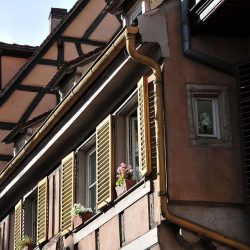
The magnificent half-timbered houses date from the 16th and 17th centuries. Their steep roofs open onto lofts where hides were once hung to dry… As for the “flower-filled” side, at the end of October you can forget it! The ivy saves the day…


Several bridges let you cross from one bank of the Ill – the river that runs through Strasbourg and the district – to the other. The most famous are the Ponts Couverts (Covered Bridges), originally built of wood with a roof. You can see three towers from the city’s old fortifications there…


A few metres from the Ponts Couverts, the Vauban Dam, another example of Strasbourg’s defensive architecture, was designed to close its sluice gates in the event of an attack, raising the level of the Ill to flood all the land south of the city and make it impassable to the enemy.


Further information:
* You may have noticed tour boats in some of my photos. Cruises run on the canals… another way to discover the city and Petite France.
* Read: a tour of the district and of Strasbourg by my dad here.