
The calendar has thrown up a coincidence nobody will have missed this year: Monday is the 11 November Armistice Day commemoration… (and this long weekend will do us all good!).
Next year will also mark the centenary of the First World War, and on this occasion many historians are debating the idea of remembrance tourism and the renewed interest in “places of memory”. Far be it from me to write an essay on the subject – my years studying history at university are long behind me and plenty of newspaper articles have already been written about it… But my passion and curiosity for the past haven’t faded! The First World War, and the events of the 20th century more generally, have always fascinated me, because of the impact they had and still have on our society…

On our way back from Alsace last week, we made a little detour to Verdun, a real gateway into this bloody (and barbaric…) period of French history, just over 2.5 hours from Paris. If your memories of history lessons are a bit hazy, the Battle of Verdun was the longest and one of the most devastating battles of the First World War (and in the history of warfare), ending in a French defensive victory.
An inhuman battle, in which 80% of the casualties were caused by artillery. The German army wanted to inflict such losses on France that it could never recover… and you only have to walk across this ground, completely devastated by shell explosions and pitted with craters… to imagine for a few moments the hell of this merciless war.
The toll : 300 days and 300 nights of relentless fighting, some 300,000 dead and missing, 400,000 French and German wounded… 22 million shells, at least a quarter of which didn’t explode (which is still a problem today…).
The Verdun area was reduced to ruins. Almost nothing remains of the destroyed villages. At the end of the day, we also made a little detour to visit the town’s cathedral, itself almost entirely rebuilt after the war…
While the Battle of Verdun symbolises all the resistance, patriotism, self-sacrifice and courage of the poilus (French soldiers), it also stands as a real testament to the madness and atrocity of this first modern war and to mass violence, which in one way or another involved millions of men and women all over the world.
A “walk” across this battlefield, or this hill now dotted with memorials, is moving and harrowing… and invites reflection… while reminding us how important it is to remember.


Verdun, “world capital of peace”, is a real history lesson, whatever our age (well, I don’t mean the very youngest…) – a reminder and a warning… Today, the trees have grown back, pretty neighbourhoods have sprung up, the network of “Venetian” canals has developed harmoniously and the cathedral has been restored, but the scars of war haven’t disappeared.
 The Douaumont cemetery, with around 16,000 graves


 Machine-gun turret
 Fort de Vaux



 A machine-gun casemate (160° field of fire)

 Rails for bringing ammunition into the fort….

 Fort de Souville, besieged for several weeks
 A tribute to the garrisons who fought…
 The Douaumont Ossuary, which holds the remains of some 130,000 unknown soldiers. It’s topped by a 46 m tower shaped like a sword plunged into the ground up to its hilt…


 The Underground Citadel

Key sites:
* The Douaumont Ossuary (paid visit), where you can watch a film about the fighting in the trenches.
* The various forts, especially Fort de Vaux
* The destroyed village of Fleury, of which only a chapel remains (we drove past but didn’t stop)
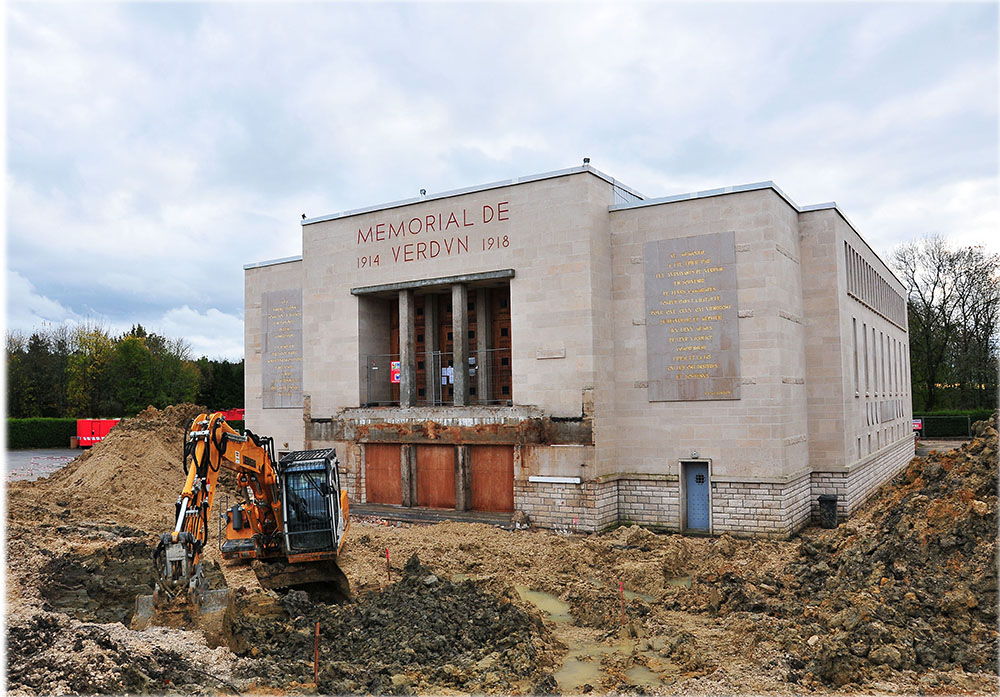
* The Memorial (under renovation at the time)
* The Underground Citadel (paid visit)
[EDIT] I’ve also been advised to add to this list…
* the Bois des Caures, where the battle began
* the Trench of Bayonets
* the World Centre for Peace, Freedom and Human Rights (next to Verdun Cathedral)
* the Meuse-Argonne American Cemetery at Romagne-sous-Montfaucon (about 45 km from Verdun)
* the Fort de Fermont on the Maginot Line (which played a role in the Second World War, about 50 km from Verdun)


