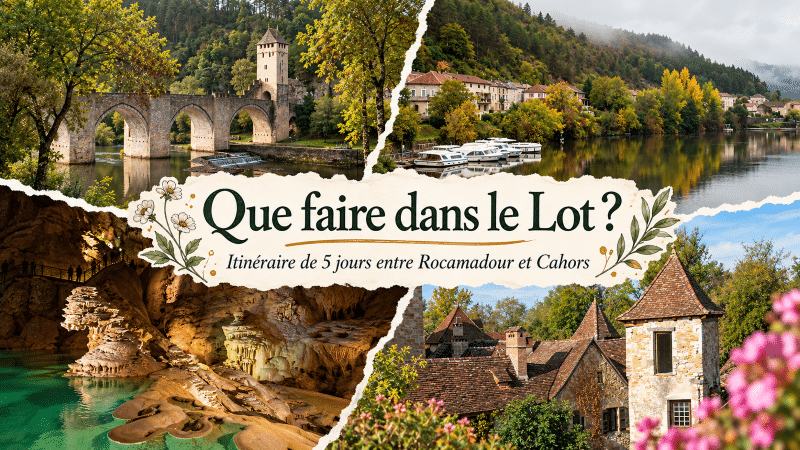
Five days to discover the Lot, from Rocamadour to Cahors, by way of stone villages, prehistoric caves and wild valleys: that’s the road trip we followed during the October half-term holidays.
I knew little about this corner of Occitanie beforehand, and the Lot was a real surprise. In just a few days, we passed through Carennac, Autoire and Loubressac, explored the Gouffre de Padirac and the Cougnac caves, and hiked in the Ouysse and Alzou valleys.
Shaped by its rivers and carved into wild, unspoilt valleys, the Lot won us over straight away. Timeless, welcoming, cultured and foodie, it’s a place where medieval history sits alongside timeless landscapes, and where even the food on your plate tells a story.
Here’s our complete itinerary, with visits, favourite addresses and our tips for planning your road trip.
Fancy discovering another side of the Lot?
I went back to explore the Célé valley and the area around Figeac: stone villages, hikes and the Pech Merle cave.
[This article about our 5 days in the Lot follows a collaboration with Lot Tourisme. I’d like to thank them for their organisation and for this invitation, which in no way affects my editorial freedom.]
| Our road trip in the Lot | |
|---|---|
| ⏱️ Duration | 5 days / 4 nights |
| 🚗 Transport | A car is essential for this itinerary |
| 📍 Start | Brive-la-Gaillarde |
| 🏁 Finish | Cahors |
| 🗺️ Main stages | Dordogne valley – Rocamadour – Gourdon – Lot valley – Cahors |
| ⭐ Our favourites | Carennac, Rocamadour, Padirac, the Ouysse and Alzou valleys |
| 🍂 When we went | October half-term (All Saints’ holidays) |
More information on the Lot Tourist Office website
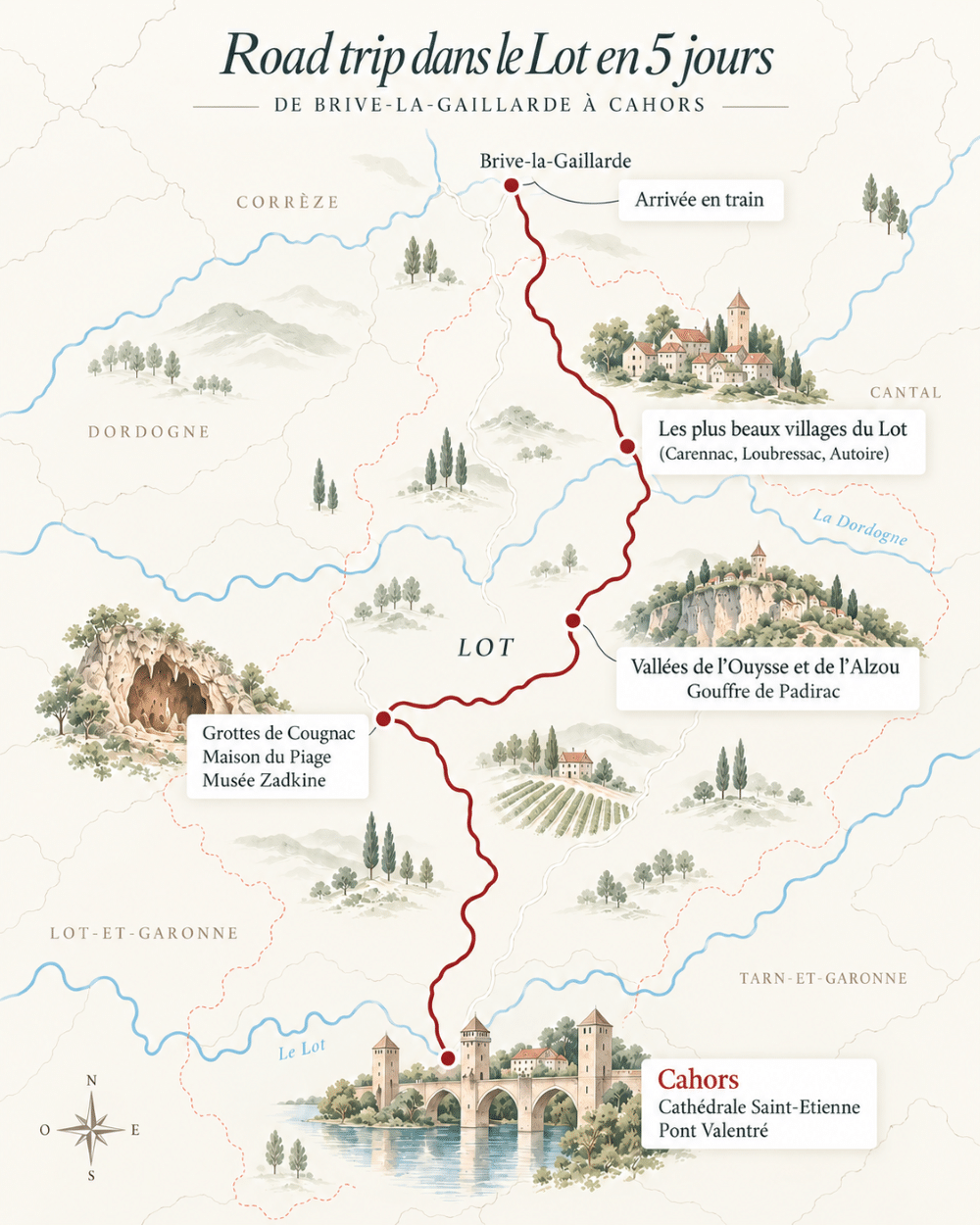
Itinerary: an overview of our 5-day road trip in the Lot
A romantic itinerary from the Dordogne valley to Cahors, taking in villages, heritage, hikes and great places to eat and stay.
Day 1 – Arrival in Brive and villages of the Dordogne valley
Our visits: Carennac, Loubressac and Autoire
Where we slept: Cabane de Cantecor, Alvignac
Dinner: L’Estanquet, Rocamadour
Day 2 – Around Rocamadour
Our visits: Gouffre de Padirac, Rocamadour and a hike in the Ouysse and Alzou valleys
Lunch: a picnic with produce from La Borie d’Imbert farm
Night & dinner: Manoir des Tuileries, Rouffilhac
Day 3 – The Gourdon area
Our visits: Cougnac caves, Maison du Piage and a guided tour of Gourdon
Lunch: Auberge de la Ferme du Château Vieux
Night & dinner: Manoir des Tuileries, Rouffilhac
Day 4 – Towards Cahors, through the vineyards
Our visits: Léobard abbey and the Zadkine museum in Les Arques
Villages we passed through: Salviac, Cazals, Puy-l’Évêque, Belaye, Albas and Douelle
Lunch: Le Caillau, Vire-sur-Lot
Dinner: Le Marché restaurant, Cahors
Where we slept: Best Western Divona, Cahors
Day 5 – Visiting Cahors
Our visits: Pont Valentré, Cahors market, Saint-Étienne Cathedral, the banks of the Lot and some of the Jardins Secrets (Secret Gardens).
Getting to the Lot
There are several ways to get to the Lot:
- By car, of course, but it was quite a long drive for us!
- By plane: you can fly into Brive-la-Gaillarde (about an hour’s drive from Cahors on the motorway, or 1h30 on the main road, as a rough guide…). It’s not the most eco-friendly option, though.
- By train or TGV, to Brive or Cahors. We personally chose the train: a little longer, but more practical and affordable for us. Our return tickets cost less than €100 per person from Saint-Quentin. As a guide, the train journey between Brive and Paris takes about 4 hours.
Once we arrived at Brive-la-Gaillarde station, we picked up a car from Avis so we could explore the département freely and stress-free.

View from the heights of Rocamadour
Now that you’ve had a quick overview of our route, let’s get into the details! From the Dordogne valley to Cahors, each day had quite a different feel: stone villages, natural sites, hikes, heritage and a few excellent restaurants along the way.
The most beautiful villages in the Dordogne valley
Carennac, Loubressac and Autoire, three stone villages along the Dordogne.
Carennac, the first stop on our road trip in the Lot
Fresh off the train in Brive-la-Gaillarde, we picked up our hire car and headed for Carennac, to spend our first afternoon in the Lot discovering some of its most beautiful villages.
The first of them, Carennac, won our hearts immediately. Set in the Dordogne valley, on the Quercy side, this little village of barely more than 400 inhabitants, perched on a rocky terrace, looks as if it has come straight out of a fairy tale… Somewhat timeless, with its Renaissance houses with carved windows, brown roofs and shimmering greenery, the village is built around the Dordogne flowing below and its 11th-century former Cluniac priory.
Inside, we particularly enjoyed the Church of Saint-Pierre and its intimate atmosphere, as well as its carved capitals decorated with interlacing and fantastic creatures.
You quickly understand why Fénelon settled in Carennac after falling under its spell.
On the day we visited, the lovely autumn colours set off the village beautifully…
We only wanted one thing: to sit on a sunny terrace and enjoy the mild temperatures and the calm! Carennac is one of the most beautiful villages I have ever seen.


Loubressac and its panoramic view over the valley
We then got back behind the wheel and headed for Loubressac. Back home in Picardy, all the villages seem to end in “court”; in the Lot and Dordogne valleys, “ac” is the norm. From what I understand, these names date back to Gallo-Roman times.
I was immediately charmed by the particular layout of the villages here, which usually seem to touch the sky from their rocky outcrops. Dotted here and there, these little hilltop villages offer visitors breathtaking views down over the valleys, and sometimes the châteaux, below them. A real change of scenery and utterly enchanting!


Loubressac was no exception, and we loved getting lost in its maze of medieval houses built of ochre stone, their steep roofs piercing the landscape. Once again, the autumn colours of some of the ivy-covered buildings went straight to my heart, making me think of the Lot as a perfect destination at this time of year… We wandered aimlessly through this peaceful, romantic setting, eventually reaching the village church and château, before slowly retracing our steps and returning to the car for the last stop of the day: Autoire.

Autoire and its waterfall
We didn’t feel the same sense of wonder in Autoire as in Carennac or Loubressac. To be fair, conditions were hardly ideal for its charm to work: the sun was already setting behind the hill, and every street was undergoing roadworks! Access was blocked off by barriers almost everywhere, and needless to say we couldn’t really leave the main street.
From Autoire, a small tree-lined path leads to the highest waterfall in the Lot, but we were expected in Rocamadour before 6pm and didn’t want to risk running late. I’d still recommend it, though ^^!
More information on the Dordogne Valley Tourist Office website
🛏️ Where to stay near Rocamadour? The Cantecor cabin
The place alone is worth a weekend in the Lot… At first, the word “cabin” rather alarmed Aymeric, who’s less of a fan of unusual accommodation than I am. The surprise was all the better for him, as the cabin at the Château de Cantecor is probably one of the most pleasant places we’ve ever stayed, and a real haven of peace.

I’d compare it to a little chalet nestled among the trees, in a calm, pastoral and almost secret setting!
From its hilltop, the cabin offers a stunning view over the valley and its golden hues at the end of the day. We settled into our spacious home, which includes a lovely bathroom, a living room, a fully equipped kitchen (with even a raclette machine!) and 2 bedrooms!

The first, on the ground floor, has 2 single beds and is more suited to children; the “parents’ room” takes up the whole of the first floor. With its private terrace and soft, carefully chosen decor echoing the wood it’s built from, it felt like a cosy cocoon we never wanted to leave.

I deliberately waited to mention the highlight, the icing on the cake or the chocolate sprinkles on the cupcake – take your pick, whichever you prefer: the private jacuzzi on the terrace, once again with a unique panorama to feast your eyes on greenery and beauty…

A real bonus, which made the first day of this trip an unforgettable and perfect moment.
The cabin is also very well located, a stone’s throw from Rocamadour, the villages mentioned above and the Gouffre de Padirac. We’d like to thank Laure for her warm and thoughtful welcome.

💡 Key takeaways from day one
Carennac, Loubressac and Autoire are fairly close to each other and combine very well in a single day. Do take the time to get a little lost in their lanes, though: that’s exactly what makes them so charming.
Rocamadour, Padirac and the Ouysse and Alzou valleys
From the Gouffre de Padirac to the trails of the Ouysse and Alzou, with a stop in Rocamadour.
Visiting the Gouffre de Padirac: 103 m underground
A visit to this must-see in the Lot, and in France more generally (the Gouffre de Padirac is France’s leading underground attraction), wasn’t originally part of our plan.
However, we had to improvise when, on the morning of the 2nd day, we woke up to find ourselves wrapped in mist. Our visit to Rocamadour and our hike in the Ouysse and Alzou valleys were looking, if not compromised, at least rather uninviting in such murky conditions.
On Laure’s advice, and after a quick calculation of how to split up the day, we decided to escape the rather unwelcoming surface of the earth and take refuge 103 m below, deep inside it. In short, we went to the Gouffre de Padirac, which is also in the Dordogne valley, on the limestone plateau of the Quercy, a few kilometres from Rocamadour.

At the bottom of this huge natural chasm, 35 m in diameter, an underground world unfolds around a river, leaving you dreamy and open-mouthed.
Discovered on 9 July 1889 by Édouard-Alfred Martel (100 years and a day before I was born – good things always happen in July or in ’89… 😉), the site, or at least a tiny part of it (2.5 km), is partly explored by boat.
You can choose to be accompanied by a guide for 1h30 or by an audio guide… I generally prefer people to technology, but the guided tour was at 11am and we didn’t want to wait around in the damp, so we opted for a self-guided visit with the audio guide.

In the end, it may have been the best choice, considering how long we spent underground marvelling at every detail of this limestone wonder shaped by Nature over thousands of years.
The visit takes you in the footsteps of Édouard-Alfred Martel and highlights the different stages and difficulties of its discovery, in the conditions of the late 19th century.


Fascinating, moving and almost unreal… You feel as if you’ve been teleported into an imaginary world… (I’m rather immersed in Tolkien’s worlds at the moment, and the Gouffre de Padirac could easily be the setting for some of the scenes!)
The whole thing is fascinating. Special mention for the Salle du Grand Dôme (Great Dome Chamber) and its dozens of rock formations!


Hiking in the Ouysse and Alzou valleys
Classified as a sensitive natural area, this 7.5 km hike (about 2 hours’ walking for us, with several photo stops), accessible to everyone despite a little climbing, is a real gem. Starting from the incredible Cabouy spring, the path winds along the heights of the Alzou canyon, offering lovely views over the Lot’s karst valleys and its natural meadows, while letting you get to know the local plants (field maples and so on).

To do it, follow the yellow waymarks and wear proper footwear, as the Alzou can turn into a real torrent after heavy rain. Don’t forget to bring water either… I imagine that in summer, much of the walk is exposed to the sun! 😊


Speaking of sunshine, once again the shimmering autumn colours glowed on the surrounding vegetation, to our great delight. All that was missing was a few rays of sun to light them up!

Picnicking on good local produce: putting together a picnic basket at La Borie d’Imbert farm
Sometimes, especially when the day looks sunny or we’ve planned a hike, we prefer to take a packed lunch or a sandwich with us to make the most of the time we have.
The goat farm and cheese dairy La Borie d’Imbert has come up with a great idea: putting together a variety of baskets to enjoy on site or take away, made with local produce made on the farm or nearby. Handmade crisps, charcuterie, craft drinks, walnut cake, Rocamadour cheese… Everything you need for a simple, local lunch, and a chance to discover some of the region’s specialities too! We loved it and wholeheartedly recommend it.

Discovering Rocamadour: medieval town and sanctuaries
Clearly we hadn’t yet reached our quota of walking that day, as we used up the rest of our energy in Rocamadour. The beautiful medieval town clinging to its cliff is simply breathtaking when you admire it from the outside… by day and by night!
Its main streets, although rooted in another era, actually reminded me a little of Mont-Saint-Michel, and impressed me less, because of their commercial feel, accentuated by dozens of shops. It has to be said that this major pilgrimage site draws the crowds!

In autumn, though, we didn’t really suffer from large numbers of visitors. And credit where credit’s due: the Notre-Dame sanctuary is a little gem, both for its architecture and its sacred atmosphere.
Since the 12th century, the “citadel of faith” has welcomed a diverse crowd of believers who come to pray to the Black Virgin housed in the Chapelle Saint-Michel and to venerate the tomb of Saint Amadour… on the first level of the town, the esplanade of the sanctuaries.


From there, you can take a small Way of the Cross path up to the palace of the Bishops of Tulle. (You can also get there using a paid lift that runs between the different levels of the town.)
As you’ll have gathered, I have mixed memories of Rocamadour, torn between fascination and disappointment.

Where to have dinner in Rocamadour?
On the first evening, we had dinner at “ L’Estanquet“, a welcoming restaurant-bistro that combines traditional cooking with reinvented dishes, always homemade. The food is as indulgent as it is tasty, and of real quality! I recommend the pulled beef and the banana and speculoos tiramisu. The service is friendly and quick, but I’d still advise booking if you want to try it, as it seemed very popular (which is a good sign!).
Good to know: it’s very well located, at the entrance to Rocamadour and a stone’s throw from a car park that’s free in the evening.

Gourdon and the Cougnac caves
Gourdon, its surroundings and several visits focused on prehistory and art.
Visiting the little town of Gourdon
A small medieval town overlooking the valleys of the Bouriane from its hilltop, Gourdon is well worth a short detour to explore…
The feudal town was very influential in the Middle Ages thanks to a strong trading tradition. Stalls and small shops thrived within its fortified walls. Although these and the castle were destroyed in the following centuries, the old town has kept its medieval character… Its winding lanes form a bewildering maze around a timeless central square, home to the Hôtel des Consuls and the majestic Church of Saint-Pierre. This southern Gothic church, flanked by two bell towers, feels vast and spacious. Its choir, decorated with a Baroque ensemble of six large painted and carved wooden panels by the Tournié brothers, who worked extensively in the region’s churches, is sumptuous!
Even in the rain, the little town has real charm, and I loved getting lost with our lively, passionate guide, who’s clearly in love with her town… thank you, Elisa!


From the fortified gate on the Rue du Majou, and after a short stop in the chapel of the same name to see more woodwork by the Tournié brothers, we made our way up to Gourdon’s viewpoint indicator, passing some façades as beautiful as they are unusual, most dating from the 17th and 18th centuries and reflecting the wealth of the town’s inhabitants during the Renaissance.
I particularly liked the Jardins du Sénéchal, an unusual and clever way of showcasing heritage by planting medieval gardens in old ruined buildings, giving them a second life!
In short, we really enjoyed Gourdon and recommend spending a good part of a day there during a stay in the Lot.


(We also bought some lovely foodie souvenirs made in the region there, such as walnut oil and walnut spread.)
What to see in Gourdon, in no particular order: the Chapelle du Majou, the Maison du Sénéchal, which hosts temporary exhibitions, the town hall, the Church of Saint-Pierre, Rue Sourde (a typical medieval street), the Jardins du Sénéchal on Rue Zig Zag, the gate of the Hôtel d’Anglars, the viewpoint indicator, the Maison Cavaignac…


Church of Saint-Pierre
Visiting the Cougnac caves in Payrignac
During our stay, someone asked me what my favourite had been, and I must admit it wasn’t an easy question to answer, as we visited so many unique and varied places, fascinating and presented by passionate people with eyes sparkling with enthusiasm, whose words really struck a chord with us.
But if I really had to pick one, my favourite was undoubtedly the cave, or rather the caves, of Cougnac.
The site actually has two caves: one “classic” cave, a little gem whose rock formations are delicately highlighted by soft, discreet lighting; the other decorated with traces left by our Upper Palaeolithic ancestors – not just cave paintings, but also signs, broken stalagmites to open up a passage and, above all, questions, shivers and a certain sense of awe.

The visit is intimate: you move carefully through a space left just as it was tens of thousands of years ago. You discover, you analyse, and you gain a better understanding of the features of a cave art far more sophisticated than you might have imagined.
And you’re overwhelmed, feeling lucky to travel back through time at such dizzying speed and to see with your own eyes these images discovered only in 1952 – a miracle that has survived thousands of years and the risk of damage. Because here, unlike at Lascaux, you really are walking in the footsteps of the first humans, in the same conditions (darkness, geological obstacles and uneven ground), and not in a replica…
Back to the subject at hand: at Cougnac, you won’t find large frescoes as such, but signs and drawings of animals (deer, mammoths, ibex…) of impressive size, as well as humans, sometimes realistic, sometimes verging on the abstract. They don’t all date from the same period, but they stir up a jumble of emotions in visitors.
I came out of this fascinating visit pensive and amazed – it’s one you really mustn’t miss!

Visiting the Maison du Piage in Fajoles
The museum in Fajoles is surprising at first because of its small size… But don’t be fooled by appearances… Just like an excavation site – which is fitting, as it’s in a way an extension of the one at Le Piage, a few kilometres away – it packs an endless wealth of secrets and surprises into a small space.
Le Piage, which has been excavated since the 1960s, is in fact known worldwide for having shown that Neanderthals and Cro-Magnons coexisted!
Through various objects found at the site, the museum helps you understand the way of life and daily routine of the hunter-gatherers of the time.

With our excellent guide, an archaeologist passionate about prehistory, we learnt to read, understand and listen to the stories behind the objects and tools on display… sometimes far less ordinary than they might seem… and some of them dated to tens of thousands of years ago… (Others are, of course, replicas.) Magical… The guide will explain how they came to be here, and also why you’re allowed to handle these traces of the past! Hand axes, teeth, human bones and pieces of prehistoric jewellery help you better understand the cultures of Cro-Magnon and Neanderthal man, and see the latter from a less biased angle than the one we’re used to.

We didn’t notice the time (or the thousands of years) go by, and I sincerely recommend discovering the site on a guided tour.
Fun, high-quality workshops are also offered to children in a realistic, adaptable reconstructed setting! (And having covered the subject with one of my classes, I can assure you it captivates them.)
A site off the beaten track that will delight young and old alike!


Discovering the Zadkine Museum in Les Arques
During our stay in the Lot, I also really enjoyed our somewhat brief visit, in the rain, to the village of Les Arques and the Zadkine Museum. Being very easily influenced, all I need is a guide as passionate as they are fascinating to get completely into the subject. ^^

Yet before coming to Les Arques, I knew nothing about Zadkine, a great 20th-century Russian-born sculptor who won the prize for best sculpture at the Venice Biennale in 1950. I loved learning about the story of this man who became a sculptor by accident, his sources of inspiration (femininity, mythology, music, Nature…), his style (concave forms, Cubist elements…)… and his works!


A friend of the greats (Chagall, Amédée Ozenfant, Guillaume Apollinaire…) and married to an artist who was herself a painter and poet, Zadkine created nearly 600 sculptures in stone or wood (a third of them) over the course of his life.


The museum holds a number of them, spread over 2 floors… but you can also see others, such as “La France en cage” or “L’Arlequin“, in the lanes of Les Arques, or in its main building! A monumental, reinvented Christ and Pietà stand in the heart of the village’s beautiful Romanesque church.
If he interests you and you’d like to find out more, there’s currently an exhibition devoted to him at the Musée Zadkine on Rue d’Assas in Paris.

A visit to the Saint-André frescoes, as an extension of the visit
🛏️ Where to stay in the Gourdon area?
Le Manoir des Tuileries, in Rouffilhac
While in the Gourdon area, we spent two nights at the Manoir des Tuileries in Rouffilhac. I’d find it very hard to rank the three places we stayed during our trip to the Lot: they were all as amazing as they were different.
This building has a soul that can’t fail to carry you away. Its façade is as beautiful as its interior, which came back to life when Noëlla and Patrick, a Belgian couple, moved in and completely renovated it. The house has been redesigned without losing what made it unique, with decor that’s as cosy, elegant and romantic as you could wish.

Special mention for the bathroom, as spacious as the bedroom, and its unique, glittering princess bathtub. Between the corridors, the beautiful rooms and the slightly timeless atmosphere, I almost felt as if I were staying in an enchanted castle.
And yet, despite the setting, the welcome was anything but stuffy. Noëlla and Patrick received us with great warmth and simplicity. As a little anecdote, I was even wandering around the house in my Harry Potter slippers… so it’s fair to say I felt right at home!
We also had dinner there two evenings in a row at their table d’hôtes. Everything was homemade and seasonal, using local produce and vegetables from the garden. The meals were as generous as they were delicious, not to mention the homemade breakfasts.

My verdict: a charming place, very well located for exploring Gourdon and the surrounding sites, and above all somewhere I have very fond memories of.
🍽️ Where to eat in the Gourdon area?
L’Auberge à la Ferme du Château Vieux, in Milhac
Between Quercy and Périgord, this restaurant is somewhat off the beaten track, hidden away like a well-kept secret. Vegetarians beware… but if you love hearty local cooking, get there as fast as you can!
It’s very popular with locals, which is always a good sign. Rustic country decor, a pastoral setting, a simple, warm welcome and a family atmosphere: everything here breathes the authentic, epicurean, foodie and welcoming Lot.
We resisted the full set menu, which would probably have knocked us out for the afternoon! The dishes are as generous as they are tasty, and made with fresh, local produce.
My verdict: a really good place if you like generous, no-frills farm restaurants. I definitely wouldn’t miss it on a trip to the area.

The Lot valley and its vineyards all the way to Cahors
From the wine villages of the Lot valley to the lanes of Cahors.
The Lot vineyards: from Puy-l’Évêque to Cahors
The Lot is also a wine-growing region, shaped by the Lot river and its meanders. The road from Gourdon to Cahors takes you across the hillsides and through some of the most beautiful scenery in the département, even in a downpour ^^!
The route offers a long parade of vines in blazing autumn colours and takes you through some of the prettiest villages in the Lot, such as Puy-l’Évêque, Belaye, Albas and Douelle (with its Chamizo mural).


The rain was far too heavy for us to linger – next time!
More information on the Lot Valley and Vineyard Tourist Office website


🍽️ Where to eat on the Lot wine route?
Le Caillau, in Vire-sur-Lot
After our visit to the Zadkine Museum in Les Arques, we stopped among the vines at Le Caillau restaurant in Vire-sur-Lot.
The setting is pastoral and peaceful… and the building, a former wine store converted into a restaurant, is superb. The interior, all wood and stone, is just as rustic, and I absolutely loved the beautiful stone fireplace, which must make the atmosphere even cosier when it’s lit!
Run by a lovely English couple, the restaurant combines several culinary influences and serves dishes that are as original as they are tasty, delicate and refined, made with quality produce. You really do eat well in the Lot!

Vegetarian dishes are also available – I actually ordered one. I’m not vegetarian, but I really like having alternatives to meat.
My stomach is still pining for the Trianon, with its hazelnut dacquoise base, praline crunch, chocolate mousse and hazelnut whipped cream. A dessert made for me, if ever there was one!

Visiting the town of Cahors
We set aside a good half-day to discover Cahors. The “capital” of the Lot and a designated Town of Art and History, Cahors blends eras and influences around a rich historical heritage. It’s lovely to wander through the lively town centre, especially on market day.


At the foot of Saint-Étienne Cathedral, stalls, local producers and treats then share Place Chapou in a cheerful hubbub, offering visitors aromas, flavours and conviviality. We took the opportunity to stock up on artisan honey for the winter, before stepping inside Saint-Étienne Cathedral for a few moments; it celebrates its 900th anniversary this year and is a UNESCO World Heritage Site. Its nave, topped by two pendentive domes rising to 32 m, is one of the largest in France. Impressive! The paintings in the choir and the western dome (8 giant figures of the prophets) are just as surprising… and a pleasure to look at!

Saint-Étienne Cathedral
Its cloister, a masterpiece of Flamboyant Gothic art, is home to one of the town’s 25 secret gardens… The garden trail leads you through the medieval centre past the main monuments, while you come across these little patches of greenery, inspired by the gardens once found in abbeys and castles, as you wander the streets.


In Cahors, don’t miss a walk across the Pont Valentré, which we could see from our hotel window! Open to pedestrians, the Devil’s Bridge spans the Lot to the west of Cahors and, along its 172 m, tells visitors its story: its slow construction, which supposedly led the master builder to make a pact with Satan, and its defensive role with its 3 towers, 2 of which were fortified with machicolations…
The site, the emblem of Cahors, is also a UNESCO World Heritage Site, and we loved admiring it up close from every angle. Once again, in Cahors as in the rest of the Lot, we travelled back through the centuries to the Middle Ages.
📍 Things to see and do in Cahors
- The Pont Valentré
- Saint-Étienne Cathedral
- The Jardins Secrets (Secret Gardens)
- A stroll along the banks of the Lot
- Cahors market
- The panoramic view from Mont Saint-Cyr
- Getting lost in the lanes of the historic centre
To find out more: you’ll find more ideas and practical information on the Cahors Tourist Office website

Pont Valentré
🍽️ Where to eat in Cahors?
Le Marché
The name (meaning “The Market”) says it all, promising fresh, healthy, local and seasonal food! The welcome is as warm as at the market stalls. The atmosphere of this little restaurant, which you could almost miss on its little square, is both elegant and intimate without losing its friendliness… Smiles all round!
The menu is mouth-watering and, above all, original. The chef is bold with combinations of tastes, textures, flavours and colours… for an indulgent and surprising result that lived up to our expectations. We were won over.

Le Dousil
A friendly wine bar right in the heart of the old town, Le Dousil also serves a good range of hearty, comforting hot dishes on rainy days… but not only then! If you fancy a cassoulet, generous open sandwiches or, like me, a good aligot, this is the place.
Whether you’re a little or very hungry, the service is quick, the atmosphere is relaxed and prices were very reasonable when we visited.
And of course I couldn’t resist the chocolate fondant for dessert… which I highly recommend!
🛏️ Where to stay in Cahors?
Best Western Plus Hotel Divona Cahors
During our stay in Cahors, we stayed at the Best Western Divona.
Once again, we had a wonderful time!

The hotel, a clever blend of comfort and modernity, is on the banks of the Lot, so every room has a superb view of the Pont Valentré. Our room was spacious, bright and spotless, with high-quality bedding. The mattress was so light I felt as if I were sleeping on a cloud ^^! As you’ll have gathered, my temperamental back gave it full marks!
The staff are lovely, warm and attentive. The indoor pool is superb and breakfast is fresh and varied…
In short, as you’ll have gathered, it was faultless for us and we can recommend it without hesitation.

Practical info: the hotel is about ten minutes’ walk from old Cahors and had free parking when we stayed.
FAQ – Planning 5 days in the Lot
What to do in the Lot in 5 days?
In five days, you can combine the villages of the Dordogne valley, Rocamadour, the Gouffre de Padirac, Gourdon, the Lot valley and Cahors. That’s the pace we followed on our trip.
How many days do you need to visit the Lot?
Five days already let you discover several must-sees without rushing too much.
A week gives you more time for hikes, villages and leisurely meals.
Do you need a car to visit the Lot?
To follow this itinerary, yes. The villages, caves, hikes and natural sites are quite spread out, and a car makes it much easier to get from one stop to the next.
Where to stay when visiting the Lot?
We chose several bases to avoid too much driving: Alvignac near Rocamadour, Rouffilhac in the Gourdon area, then Cahors. This split works very well for a five-day itinerary.
When is the best time to visit the Lot?
We discovered the Lot in autumn and loved it at this time of year for its colours and more peaceful atmosphere. Spring and early summer are also lovely seasons to enjoy the villages and hikes.
What are the must-sees in the Lot?
My must-sees include Rocamadour, the Gouffre de Padirac, Carennac, Loubressac, Autoire, Gourdon, the Lot valley and Cahors with its famous Pont Valentré.
🌿 Continue your trip in Occitanie