

Visiting the D-Day beaches in 2 days is already enough to discover several of the major D-Day sites in Normandy, from Omaha Beach to Sainte-Mère-Église, via the military cemeteries, the German batteries and the many museums devoted to the Normandy Landings.
We chose to spend a weekend there at the beginning of June, during the D-Day commemorations. The wind was blowing hard on the Normandy beaches that weekend. Between the Allied flags hanging from the buildings, the military Jeeps driving through the villages and the thousands of visitors who had come for the D-Day commemorations, the whole of Normandy seemed to be living to the rhythm of D-Day.
In this article, I share our 2-day itinerary along the D-Day beaches, the sites we visited, my practical tips and, since our stay coincided with the commemorations, everything you need to know if you’d like to experience them for yourself.
A D-Day investigation booklet for children
For young history buffs, I’ve created a free 13-page booklet for ages 10 and up (in French): find the five D-Day beaches, recognise 1944 vehicles, discover the Airborne Museum, solve puzzles and observe the memorial sites.
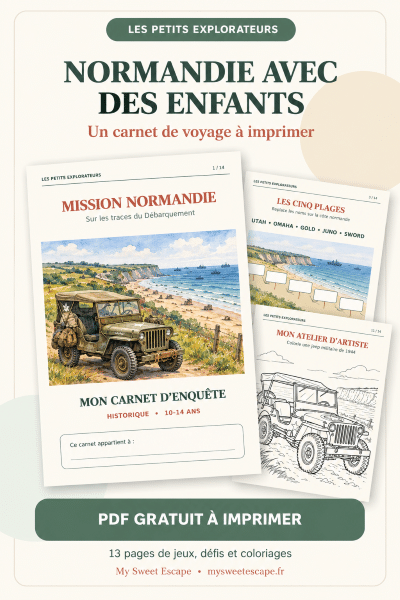 Download the booklet for free (PDF, in French)
A5 format · 13 pages · ages 10–14
🗺️ My 2-day itinerary along the D-Day beaches
Day 1 – Between Ouistreham and Omaha Beach
We started the day around Ouistreham and Lion-sur-Mer, where several temporary exhibitions had been set up for the commemorations, including a rare and superb Spitfire and various vintage vehicles (Jeeps and so on).
We then headed to Omaha Beach for lunch facing the sea before visiting a reconstructed American military camp.
Ideally, we would then have gone straight on to the American Cemetery at Colleville-sur-Mer if the crowds had remained reasonable. In our case, the traffic jams were so bad that we arrived after closing time.
So we ended the day at the Longues-sur-Mer battery. A little tip: the site is beautiful at the end of the day, when the light turns golden over the cliffs and bunkers.
We then spent the evening in Bayeux.
Day 2 – The great memorial sites
The next morning, we went back to the American Cemetery at Colleville-sur-Mer as soon as it opened. I really recommend going early: the atmosphere is much calmer and the car park fills up extremely quickly as the morning goes on.
We then visited the German Cemetery at La Cambe, whose atmosphere is very different and much more sombre.
The day ended at the Airborne Museum in Sainte-Mère-Église, which was one of the best surprises of the weekend thanks to its many reconstructions and its highly immersive feel.

🛏️ Where to stay to visit the D-Day beaches
For a 2-day weekend, I recommend choosing accommodation that is fairly central to the various D-Day sites, so you don’t spend too much time on the road.
We chose to stay near Bayeux, and I find it a particularly convenient base for exploring. From there you can easily reach Omaha Beach, the American Cemetery at Colleville-sur-Mer, the Longues-sur-Mer battery and Arromanches, while enjoying a pleasant town centre in the evening, with restaurants and pretty streets to wander through.
If you’d like to be as close to the beaches as possible, you can also look around Arromanches-les-Bains or Colleville-sur-Mer.
For an itinerary focused more on Utah Beach and Sainte-Mère-Église, it’s better to choose accommodation further west.
📅 During the commemorations: around 6 June, the best-located accommodation is in very high demand. It’s best to book as early as possible.


A reconstructed American camp
Attending the D-Day commemorations
.
We chose to discover the D-Day beaches at the beginning of June, during the D-Day commemorations, and the experience is inevitably very different from the rest of the year.
For a few days, this whole part of Normandy seems to slip back into the atmosphere of the 1940s. We came across Jeeps and vintage military vehicles, discovered several reconstructed camps, watched vintage aircraft fly overhead and enjoyed the many events organised in the villages. In some places, locals and visitors also play along by dressing in period costume.
I really loved this special atmosphere, which adds yet another dimension to discovering these places. The commemorations also give you the chance to attend ceremonies and events that only take place at this time of year.
📅 Good to know if you’re coming during the commemorations
The downside, of course, is the crowds. Around 6 June, some sites are very busy and the roads can quickly become gridlocked. We found that out first-hand as we approached the American Cemetery at Colleville-sur-Mer! So allow extra time for getting around and arrive early at the best-known sites.
The programme changes every year and brings together a huge number of events across the region. I therefore recommend checking the official commemorations programme before you set off, while staying flexible: we also came across several events simply along our route.
💬 3 questions about the D-Day commemorations
❤️ Which places moved me the most?
I’d say there were two. The first, without hesitation, is the American Cemetery at Colleville-sur-Mer.
The number of graves is hard to grasp until you’ve seen it with your own eyes.
Everything is perfectly aligned facing the sea, in a rather striking silence.
The second was a real surprise: the Airborne Museum in Sainte-Mère-Église.
I had never heard of it before that weekend, and yet it’s probably one of the best museums we visited there.
Reconstructions, vehicles, period objects and immersive displays
help you understand the role of the paratroopers and air forces during the Landings.
🎖️ Do you need to be passionate about military history?
Personally, the Second World War is a subject I’m passionate about,
so this trip was bound to be for me.
The experience will certainly be more meaningful if you have at least some interest in the subject,
but the commemorations go far beyond museums and historic sites: decorated beaches, vintage vehicles, aircraft, concerts, reconstructed camps and many
events create a very special atmosphere throughout the region.
📅 Where can you find the commemorations programme?
The programme changes every year and includes a great many events around 6 June: ceremonies, re-enactments, vehicle gatherings, concerts and air displays.
I recommend checking the official programme before you go, while keeping some flexibility in your itinerary: we also stumbled on several events completely by chance!
What to see on the D-Day beaches: our visits
Lion-sur-Mer: a festive arrival on the D-Day beaches
Sunshine and countless flags and banners in the colours of the Allied nations greeted us as soon as we arrived in Lion-sur-Mer. The atmosphere was instantly lively, almost festive, with many visitors who had come for the D-Day commemorations.

As we reached the seafront, we came across several temporary exhibitions of vintage military vehicles: American Jeeps, period cars… but above all an impressive Spitfire on display right in the middle of the square.

The Spitfire is probably one of the most famous British aircraft of the Second World War. Flown by the Royal Air Force, notably during the Battle of Britain, it became one of the great symbols of Allied aviation during the conflict. Today, it’s relatively rare to see one in France, even at historical events.

Seeing it on display just a few metres from the beach set the tone for the weekend. Of course, it would have been incredible to see it flying over the Normandy coast, but that wasn’t on the programme.
Even so, this first stop immediately immersed us in the very special atmosphere of the commemorations: a rather surprising blend of historical remembrance and an almost festive mood on the D-Day beaches.

.
The reconstructed military camps
Reconstructed military camps usually play a major part in the D-Day commemorations every year (and even during the 8 May VE Day ceremonies). Several temporary camps are set up in Normandy villages or along the beaches, generally signposted at the roadside.
Most are run by history enthusiasts, who recreate the daily life of American, British or German soldiers during the Second World War. We visited the American camp at Omaha Beach, run by enthusiasts who offered several short theatrical scenes and various activities for adults and children alike.

One of the ones that struck me most was a demonstration of how medical instruments were sterilised in the tents used by army medics.
On site, you could also see reconstructed tents, period equipment, military vehicles, tanks riddled with shell holes, uniforms and scenes of daily life recreated by the volunteers.


The immersion becomes even more striking – it feels like going back a few decades in time, minus the crushing anxiety – when various aircraft regularly fly over the camps and beaches during the day.

.
The Longues-sur-Mer battery
I had already discovered the Longues-sur-Mer battery a few years ago during a weekend around Bayeux.
Read my guide to things to do around Bayeux (in French)
This German coastal battery played a strategic role during the June 1944 Landings thanks to its position between Omaha Beach and Gold Beach. The site had several gun positions (four, if I remember correctly) designed to defend the Normandy coast.

The site is now free to visit and, on my first visit, I was lucky enough to join a particularly fascinating guided tour, which made me feel as if I’d been plunged into the heart of the events of June 1944. I was even able to go inside a casemate that had survived the bombing. This time, unfortunately, access was closed during our visit.

We arrived at the end of the day, with beautiful golden light over the cliffs and bunkers. Probably a slightly less immersive experience than my first guided tour, but I took more time to look at the impact marks, the gutted structures and the remains still visible today… realising just how much the scars of D-Day are still visible at some sites in Normandy, even more than 80 years later.
Standing in front of these destroyed bunkers and this coastline that is so peaceful today, it’s hard not to feel a lump in your throat as you try to imagine the onslaught of violence, chaos and suffering that 6 June 1944 represented.


The American Cemetery at Colleville-sur-Mer
I had never visited the Normandy American Cemetery at Colleville-sur-Mer , not even on my first trip to Normandy a few years ago, which is rather surprising given how emblematic it is of the D-Day beaches.
Overlooking Omaha Beach, the cemetery is the resting place of more than 9,000 American soldiers who died during the Battle of Normandy and the D-Day operations of June 1944. The vast rows of white crosses are perfectly aligned facing the sea, as if turned towards their homeland for all eternity.

The almost endless, almost unreal lines of graves make you realise the human scale of D-Day. Beyond the historical image and the ceremonies, you above all realise what a true slaughter 6 June 1944 was.

Since this trip, I’ve finally watched Saving Private Ryan, which I probably should have seen before going to Normandy. The film plunges you straight into the chaos, violence and confusion experienced by the American soldiers landing on Omaha Beach.
I now better understand why so many Americans still cross the Atlantic today to pay their respects here: beyond its historical symbolism, this place remains deeply charged with memory and emotion.

.
The German Cemetery at La Cambe


The Airborne Museum in Sainte-Mère-Église
In my view, you can’t explore the D-Day beaches in Normandy without stopping in Sainte-Mère-Église, famous around the world for the paratrooper left hanging from its church steeple, and also as one of the first towns liberated during the D-Day Landings of 6 June 1944.
On the night of 5 to 6 June 1944, nearly 14,000 paratroopers from the American 82nd and 101st Airborne Divisions were dropped around Sainte-Mère-Église, Sainte-Marie-du-Mont and Carentan. Their mission was perilous: to secure several strategic points before the troops landed on the beaches.

The drops took place in particularly difficult conditions: at night, under German fire, sometimes over flooded areas… Many soldiers ended up scattered far from their objectives, and many paratroopers lost their lives in the very first hours of the operation.
Today the village is home to a little gem: the Airborne Museum, which traces the role of the paratroopers and aircraft during D-Day through particularly immersive, modern displays combining period objects, vehicles, aircraft, life-size reconstructions and very well-designed immersive spaces. Some rooms almost make you feel as if you’re in the middle of the airborne operations of 6 June 1944… especially when you climb aboard the plane alongside the paratroopers…


If you have more time: other D-Day sites
📍 More visits to add to your itinerary
👉 Arromanches-les-Bains and the remains of the Mulberry artificial harbour
👉 The D-Day Museum in Arromanches
👉 The Juno Beach Centre, devoted in particular to the role of the Canadians during D-Day
👉 The Omaha Beach Memorial Museum
👉 Utah Beach and its museum, if your itinerary takes you towards Sainte-Mère-Église
👉 For British visitors, Pegasus Bridge and the British Normandy Memorial at Ver-sur-Mer, overlooking Gold Beach
Arromanches 360: a very immersive experience
On a previous trip to Normandy, I had also discovered the Arromanches 360 circular cinema. I watched a film about D-Day made up of archive footage from France, Canada, the United States and Great Britain.
The images are projected all around you on several screens, creating a particularly immersive experience. I did come away with rather mixed feelings, though: I was trying so hard to watch what was happening on all the screens at once that I sometimes struggled to follow! A rather disconcerting experience, then… but one I’d be curious to try again today.
💡 My tip
If you have 3 days to visit the D-Day beaches, I’d happily spend the extra day in Arromanches and at the sites you couldn’t fit into the first two days. The region has so many places linked to D-Day that it’s impossible to see everything in a single weekend.
🏰 Extend your weekend in Caen
If you have a little more time in the Calvados, make the most of it to discover
Caen. Its castle, abbeys, the Vaugueux quarter, the
Colline aux Oiseaux park and the Caen Memorial can easily fill
one or two extra days.


An evening in Bayeux…
FAQ – Visiting the D-Day beaches in Normandy
⏱️ How many days do you need to visit the D-Day beaches?
Two days are already enough to discover several major sites, such as Omaha Beach, Colleville-sur-Mer, Longues-sur-Mer and Sainte-Mère-Église.
If you can, allow 3 days to add Arromanches and other museums,
and to take your time.
🌊 Which D-Day beaches should you visit first?
If you have to choose, Omaha Beach is a must and easily combined with a visit to the American Cemetery at Colleville-sur-Mer.
Utah Beach can be paired with Sainte-Mère-Église.
Juno, Gold and Sword Beach can round off the itinerary depending on how much time you have.
🛏️ Where should you stay to visit the D-Day beaches?
Bayeux is a particularly convenient base for exploring
Omaha Beach, Colleville-sur-Mer, Longues-sur-Mer and Arromanches.
To explore Utah Beach and Sainte-Mère-Église more fully, you can choose
accommodation further west.
🚗 Can you visit the D-Day beaches without a car?
It’s possible for some sites, but a car is by far the most practical option
for a 2-day itinerary. The beaches, cemeteries, batteries and museums are spread over a large stretch of the Normandy coast.
🇫🇷 When do the D-Day commemorations take place?
The main commemorations take place around 6 June, the anniversary of the 1944 Landings. Many events, ceremonies,
re-enactments and gatherings are held in the days around that date.
The programme changes every year, so remember to check it before your trip.
👥 Is it very busy during the commemorations?
Yes, but the crowds are spread across a great many events.
The iconic sites, on the other hand, can be very busy.
We ran into heavy traffic around Colleville-sur-Mer.
My tip: arrive early and leave some slack in your schedule.
Discover the area around Bayeux
D-Day beaches, Port-en-Bessin, Normandy specialities and ideas in the Bessin.
 An evening in Bayeux…


