Planning a weekend or a week on the Île d’Oléron and wondering what to see and do? In this complete guide, I share the must-sees of the Île d’Oléron, my favourite spots, an itinerary, the most beautiful beaches, the villages not to miss, where to stay, where to eat and all my tips for planning your trip.
Between the Chassiron lighthouse, the oyster huts, the wild beaches, the salt marshes and the colourful villages, Oléron, off France’s Atlantic coast, is an ideal destination for lovers of nature and the great outdoors.
We spent a long weekend there in spring. This article is regularly updated to bring you the best visit ideas and the most useful practical information.
This article about Oléron follows an invitation from Charentes Tourisme and the Île d’Oléron and Marennes Basin Tourist Office. I thank them for this invitation and for a programme drawn up around our wishes, which in no way affects my editorial freedom.
My verdict on the Île d’Oléron: a nature-filled, family-friendly destination
We’d been talking about going to Oléron for years, ever since a first trip to the Charente-Maritime, in La Tremblade (in French). We’d fallen in love with the area, and it has been on our shortlist for weekends away more than once since! The opportunity finally came this spring: we made the most of the April school holidays to head off and join our friend Mathilde there. (By the way, her blog is great and really comprehensive – do go and read it, if you read French!) As this trip was more about reporting and discovering than relaxing, Elena didn’t come with us, but we’ll definitely go back with her when she’s a little older, as the destination is very family-oriented and kid-friendly, as I’ll explain later in the article!
As for us, I knew Oléron’s natural side would be a real breath of fresh air, and that the island also known as “La Lumineuse” (the Luminous One) would guide us, like a lighthouse, to its wonders and secrets.

Chenal de la Baudissière
Visiting the Île d’Oléron: at a glance
- 📅 Ideal length: 3 days to see the must-sees, a week to explore the island at a leisurely pace
- 🚗 Getting around: by car to cover the whole island, or by bike to enjoy the scenery
- 🚲 By bike: the island has an extensive network of cycle paths linking the beaches, villages and marshes
- 🌿 Not to be missed: the Chassiron lighthouse, Château-d’Oléron, La Cotinière, Fort Royer and the oyster huts
- ❤️ My favourites: the colourful huts of Château-d’Oléron and the Chenal de la Baudissière
- 🏖️ For beaches: head for the west coast, wilder and exposed to the ocean
- 🦪 Specialities: Marennes-Oléron oysters, seafood, mussel “éclades” and local produce
- ☀️ Best time to go: May to September, or spring for a quieter atmosphere
Oléron is a microcosm of Mother Nature. It’s amazing to think that such a small area – though it’s France’s second-largest island after Corsica – can be home to such a diversity of landscapes. Embraced by the sea, beaches, cliffs and dunes sit alongside forests, marshes, channels, vineyards and nature reserves… Wildlife and plants thrive in this timeless little corner of the world, the domain of storks and other migratory birds that I must admit I couldn’t identify. The figures are astonishing and revealing: 175 km², 84% of it protected, 40% marshland, 2,700 hectares of dunes wooded with oaks and pines, 100 km of coastline…

Here, colour reigns supreme: Oléron glows, radiates serenity and inspires happiness. Greens and blues blend and shade into one another like the finest colour charts, with the colourful roofs of the huts standing out against the golden sand on the horizon. A living Impressionist painting, with clouds drifting overhead during our visit. Unluckily, after a summery weekend, we had to put up with a few showers… Fortunately, the weather changes quickly by the sea, and Oléron generally gets plenty of sunshine 😉!
I also discovered a warm, foodie place rich in age-old traditions that are still celebrated today. A proud, authentic little patch of land that will win over young and old…
Extend your trip in the Charente-Maritime
What to do in La RochelleDiscover La Tremblade and Royan (in French)
The Île d’Oléron’s must-sees at a glance
Between oyster villages, wild beaches, fishing ports and marshland, the Île d’Oléron offers plenty to see. Here are the places I recommend visiting first.
| Place | Time needed | Why go? | My verdict |
|---|---|---|---|
| Chassiron lighthouse | 1.5 hrs | For the panorama over the ocean and the island’s northern tip | A must-see |
| Château-d’Oléron | 2 to 3 hrs | For its citadel, its port and its colourful designer huts | A real favourite ❤️ |
| La Cotinière port | 1 to 2 hrs | To soak up the atmosphere of the island’s main fishing port | Best at the end of the day |
| Fort Royer | 1.5 to 2 hrs | To learn about oyster farming and discover a traditional village | Very interesting |
| Chenal de la Baudissière | 1 hr | For its colourful oyster huts and peaceful atmosphere | Very photogenic |
| Saint-Trojan-les-Bains | 2 to 3 hrs | For its village, forest and long beaches | Ideal for a stroll |
| Boyardville | 1 to 2 hrs | For its port and views of Fort Boyard | Combine with a boat trip |
| West coast beaches | Half a day | For the ocean, the dunes and the wild scenery | Perfect at sunset |
| Marais aux Oiseaux | 1.5 to 2 hrs | To see the local wildlife and another side of the island | A lovely family outing |
How to get to the Île d’Oléron: access and practical tips
All roads lead to Oléron! To reach the island, you have several options: car, plane, bus, train, boat… Whether or not you’re driving, you’ll find a solution.
By car, simply leave the A10 or A83 motorway at Saintes or La Rochelle, follow signs for Oléron and cross the bridge to the island, which is toll-free. Allow 5.5 hours from Paris, 3 hours 20 from Tours, 2.5 hours from Bordeaux… From the UK, the ferry ports of Brittany (Saint-Malo, Roscoff) or Normandy are a good starting point for a road trip down the Atlantic coast.
If you can’t come by car, no problem: like us, you can arrive in La Rochelle by plane or train, or in Surgères or Rochefort (by train only). The TGV is quick (2 hours 40 between Paris and La Rochelle). The Nouvelle-Aquitaine regional buses can then take over 😉! Oléron is linked to Rochefort by line 6, to Surgères by line 6E, to La Rochelle by line 7 and to Saintes-Marennes by line 8.
For a more holiday feel, there are also ferry services between the Île d’Oléron and La Rochelle, providing an alternative to the car. We took it in the other direction, reaching La Rochelle in about fifty minutes. We boarded at Boyardville (Parking du Chenal pier), and the crossing takes you fairly close to a famous fort – Fort Boyard, of TV game show fame, home of the riddle-setting Père Fouras… The Croisières Inter-Iles and St Denis Croisières companies serve Saint-Denis-d’Oléron. (Website)

Ferry between La Rochelle and Oléron, Boyardville beach
Getting around Oléron: car, bike and alternatives
The Île d’Oléron stretches 30 kilometres from north to south and is bigger than it looks.
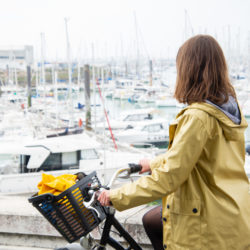
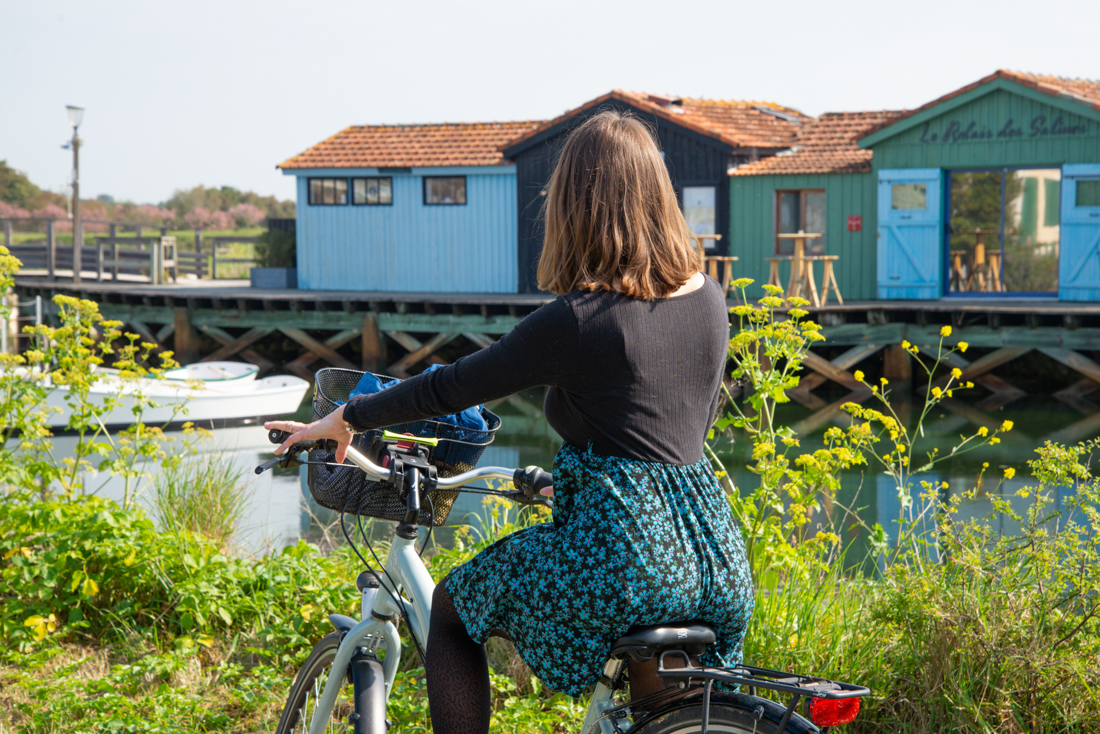
Depending on your itinerary, you could combine car/bus and bike like we did! With the population sometimes reaching 600,000 in summer, you’ll certainly appreciate the 160 km of perfectly signposted cycle routes that criss-cross the island and let you leave the car behind! The paths are flat, with no hills, so they require no real effort, and above all they’re separate from the road, which feels very safe. Even though we hardly ever cycle, we didn’t struggle at all covering around fifteen kilometres a day. You can hire bikes everywhere, as cycling is so popular on the island.
(A map of the cycle network is available from the Île d’Oléron and Marennes Basin Tourist Offices and as a free download HERE.)
I also noticed that free shuttle buses run around the island in summer to ease traffic and reduce pollution – you’ll find more information here (in French). It’s a really handy and great idea!

A few cycle paths
Where to stay on the Île d’Oléron: our hotel in Saint-Trojan
There’s plenty of choice between gîtes, houses, campsites and hotels. During our long weekend on the Île d’Oléron, we stayed at the Hôtel Les Cleunes ***, in Saint-Trojan-les-Bains. Besides its excellent location, facing the sea and a few minutes from the beach, we really appreciated the hotel’s various services, including bike hire for getting around freely without a car, the outdoor pool, which we obviously didn’t dive into so early in the year, and the balneotherapy area, free on request, with a lovely pool, light therapy, a spa and a hammam… We loved taking refuge there on a rainy morning!
(Bike hire prices: €15 a day, with lower rates for longer rentals – a week costs €45, for example.)
By the way – and it’s increasingly important to point this out – the hotel is committed to environmental sustainability, with various eco-friendly initiatives on waste management (recycling, a water fountain at reception for refilling the glass bottles in the rooms…) and energy saving (solar panels, LED bulbs, mulching the plants…). The breakfast, delicious and very complete, only offers seasonal fruit… and any unused bread and pastries are turned into bread pudding!

Hôtel Les Cleunes ***, Saint-Trojan-les-Bains
What to do on the Île d’Oléron: 11 things to discover between ports, beaches and villages
As I said above, Oléron is big and full of natural curiosities, sights and activities! I think you’ll need at least a good week to take in the whole island at a relaxed pace, but its residents and loyal visitors who’ve been more than once (because Oléron wins hearts for good) will tell you that every stay manages to surprise you with new discoveries!
Visiting the Île d’Oléron in 3 days: my itinerary
Day 1: the south of the island
- Discover Château-d’Oléron and its citadel
- Stroll past the designer huts
- Walk around Saint-Trojan-les-Bains
- End the day on a beach in the south of the island
Day 2: the west coast and La Cotinière
- Morning on one of the west coast beaches
- Lunch or a stroll at the port of La Cotinière
- Explore the coastal villages and scenery
- Sunset over the ocean
Day 3: the north and the oyster villages
- Visit the Chassiron lighthouse
- Explore the north of the island and Saint-Denis-d’Oléron
- Stop at Fort Royer or the Chenal de la Baudissière
- End the day in Boyardville with a view of Fort Boyard
Staying a week? Add a boat trip around Fort Boyard, a day on the bike, a visit to the Marais aux Oiseaux and more time on the beaches.
Visiting Oléron in one day: what to prioritise
If you only have one day on the Île d’Oléron, focus on a few iconic places rather than trying to cover the whole island.
- 🌈 Château-d’Oléron and its colourful designer huts
- 🦪 The Chenal de la Baudissière or the oyster village of Fort Royer
- ⚓ La Cotinière, to soak up the atmosphere of the fishing port
- 🌊 A west coast beach for a walk by the ocean
- 💡 The Chassiron lighthouse, if you have time to get to the north of the island
My tip: don’t underestimate the distances. Even though Oléron looks small on a map, traffic can be heavy in high season.
Visit the Chassiron lighthouse: panorama and museum
I loved this place, which we discovered on our first day… A good warm-up in every sense, as you’ll need to climb 224 steps to reach the prize: the panorama from the top of the lighthouse, one of the places that struck me most on Oléron and certainly one of the island’s emblems! Located at the “end of the world”, as the islanders say, it’s of great importance on the island, both for its history and for its role for fishermen and sailors.
Standing here since the 19th century (replacing a first fire tower built by Colbert in 1685), the Chassiron lighthouse is recognisable by its 3 black bands, painted in 1926 to distinguish it from the Phare des Baleines on the Île de Ré. From the top, the view over the north of Oléron, the Antioche beacon, La Rochelle, the Île de Ré and the ocean is breathtaking – perhaps even more so when the wind whips up the waves and the fish traps at its foot.
The museum inside the rotunda lets you better appreciate this unique, age-old fishing tradition practised at low tide – the stone fish traps known as “écluses à poissons” – and learn about life on the coast, through a surprising and nicely staged visit. I admit I found the technique a bit brutal, haha, but it catches fish while also reducing coastal erosion on the cliffs and beaches.
Prices: lighthouse climb + exhibition = €4.60 (adults) / €2 to €3 (children).


Admire the colourful beach huts of the Plage de la Boirie
Next to the port of Saint-Denis, Oléron’s largest marina with 750 berths, the little Plage de la Boirie is one of the most beautiful spots on the island, with its hundreds of metres of white sand… and its dozens of beach huts in a row, each painted by its owner! Unusual, isn’t it? Each has its own style and a story to tell! So cute – needless to say, the walk will put a smile on your face!
It was here that we discovered, painted on many huts, the IØ logo, the symbol of the Île d’Oléron, which once appeared on fishing boats at the start of their registration number.


Walk along the Plage des Huttes
On the other side of the island (west), we stopped at the Plage des Huttes, a magnificent strip of fine sand stretching for more than 5 km. This side of the island faces only the ocean, so it’s the windiest, which gives its beaches a wild feel… and delights fans of water sports such as surfing, kitesurfing, catamaran sailing and bodyboarding… In April, you come here to breathe, walk and admire the brave athletes taking on the swell!
Swimming is supervised in summer, and I imagine it’s busier then, but with no risk of being packed in like sardines.
(Note: free parking, lifeguards in July and August)
Discover oyster farming at the village of Fort Royer
Oléron (and more generally the Marennes-Oléron area) means oyster farming, with oysters known all over the world, which have a very special place on the island… Between 45,000 and 60,000 tonnes of oysters are sold and shipped from here every year – that’s 50% of France’s oyster production!
We’d already visited a small oyster farm a few years ago near La Tremblade (see my article on La Tremblade, in French) and learnt about the different stages of oyster farming, which takes much longer than you’d think: 3 to 4 years of rearing and work by the oyster farmers are needed before the oysters reach your plate at Christmas, if you’re a fan… But we still had (and have) a lot to learn about the subject, there’s so much to it!

Long established, the oyster-farming tradition of Oléron and the Marennes basin is practised in vast oyster beds, mostly on the island’s east side… Several varieties are farmed: fine de claire, spéciale de claire, fine de claire verte and pousse en claire. This tradition and know-how are an integral part of Oléron’s history and culture: from the 19th century onwards, oyster farming gradually replaced the declining salt industry and reshaped the landscape in a very distinctive way, giving new life to the old salt pans.
The guided tour of Fort Royer is fascinating, and led by real enthusiasts… which perhaps explains it! It helped us learn more about the history of oyster farming on Oléron, how oysters are reared and what an oyster farmer’s job involves. This (genuine) oyster-farming site in the Moëze-Oléron Nature Reserve, where pretty traditional wooden huts are quietly ageing, is still worked by 8 oyster farmers today, and is full of interest… and charm.
The site welcomes visitors of all ages. At the start of the tour, we were split into two groups: adults on one side and children on the other! Surprising, but very interesting and sensible in the end: special workshops are offered for younger visitors, so that everyone can discover the site comfortably, interactively and at their own level! Lots of other activities are also available, from storytelling walks to treasure hunts and hikes. (Tours are in French.)

La Perrotine – BP 43, 17310 SAINT-PIERRE-D’OLÉRON
Wander among the huts and workshops of the Chenal de la Baudissière
This site showcases another Oléron initiative to keep its oyster-farming heritage alive and breathe new life into maritime huts that had been partly abandoned, often because of new regulations… Like Couleurs Cabanes, they’ve been converted and restored as artists’ workshops!

That said, the two villages complement each other and have quite distinct personalities. Craftspeople and designers have set up shop along this charming channel bordering the muddy foreshore, to draw inspiration or serve up some tasty treats… All the products are original and high quality, along a barely developed road whose raw feel smacks of authenticity!


Chenal de la Baudissière – 17550 Dolus-d’Oléron

Discover the port of La Cotinière and its fish auction
In the municipality of Saint-Pierre-d’Oléron, the port of La Cotinière is the leading small-scale fishing port in Nouvelle-Aquitaine and ranks 7th in France! Nearly 5,000 tonnes of fish and shellfish pass through its fish auction (the “criée”) every year, with around 90 species! The choice is huge, as you can tell just from reading the menus of Oléron’s restaurants!
The place is a must on the island, both for tourists who love strolling along the jetty and watching the comings and goings of the brightly coloured boats (more than 95 vessels use the port) and for locals who regularly come to follow the business of the auction or soak up the buzz of a port that never stops. I can understand it – it’s exactly the kind of thing Aymeric loves!
When we visited, we were able to admire its brand-new incarnation, in new buildings with clean lines overlooking a 1.5 km promenade above the quays, offering a view over the charming port. It had opened 3 weeks earlier and will soon, if it hasn’t already, be complemented by a discovery trail with information panels on the fishing techniques of Oléron’s sailors. A glass window lets you look down on the auction.
Times: auctions take place at 6am and 4pm, except on Sundays. Guided tours are available through the Tourist Office.


We carried on walking through the seaside resort of La Cotinière itself, along the seafront, which is lovely for a stroll! On either side, cafés, fishmongers and market halls liven up the walk, while letting you stock up on good seafood.


What souvenirs and specialities to bring back from Oléron?
You’ll find soups, rillettes, terrines, mousses… from the La Lumineuse cannery, made without colourings or preservatives and partly with ingredients from the port of La Cotinière and the Île d’Oléron.
The island shops:
🐟 12 bis Rue du Port, La Cotinière, 17310 Saint-Pierre-d’Oléron
🐟 37 Rue de la République, 17130 Saint-Pierre-d’Oléron

Visit the Port des Salines and discover the salt marshes
I loved discovering the Port des Salines and the history of Oléron’s salt marshes on a guided tour and a visit to the adjoining eco-museum! I had some basic knowledge of “white gold” production, picked up on a trip to Sicily what feels like light years ago! I mentioned it during the tour, and a lady came over to say hello and tell us she was actually from the Trapani area!
The tour of the Port des Salines with a guide as fascinating as she was passionate immersed us for an hour in the world of salt farming, once a mainstay of the island’s economy! We learnt loads of anecdotes about salt, how it’s harvested, and the wildlife and plants of the salt marshes…


The tour is very interesting and covers the conditions needed to produce salt: impermeable (clay) soil in a warm, windy area. All these conditions come together on Oléron, where salt farming has shaped the landscape more than you’d imagine! Until the 19th century, a quarter of the island was covered in salt marshes, with 85,000 salt pans. With the rise of the railways, however, the Mediterranean salt trade grew at the expense of Atlantic salt, which couldn’t compete. Then refrigerators, which made salt less essential for preserving food, more or less sounded the death knell for salt farming on Oléron… And the salt pans were converted… into oyster beds! On Oléron, everything gets recycled!


The museum
The last salt harvest took place in the 1980s… But the story doesn’t end there: the Port des Salines was restored to preserve its memory and traditions, and a first new harvest took place in 1995. Today, a dozen salt farmers work here, and the salt they produce is sold directly in the island’s salt store: the Salorge. We stocked up there, as there are lots of varieties to adapt and fine-tune your recipes!
(You can also take a little boat trip on site.)
Rue des Anciennes Salines – 17370 Le Grand-Village-Plage
Discover the Chenal d’Ors and its scenery
A stone’s throw from the village of the same name, the Chenal d’Ors and its many huts run down to the Pertuis de Maumusson strait, near the viaduct linking Oléron to the mainland. At 1.5 km long, it’s the longest oyster channel on the Île d’Oléron… and one of the most beautiful! We passed it by bike on our way to Château-d’Oléron, and you can’t miss it, with its brightly coloured oyster huts, its bustling activity that ebbs and flows with the tides, and the oyster bags lining the quays… A lovely spot for a photo!


Visit Château-d’Oléron: the citadel and colourful huts
The citadel of Château-d’Oléron stands in the town of the same name, which is very charming, with its white-fronted houses with blue and green shutters…


Built on a strategic promontory, the citadel offers a lovely walk along its ramparts with views of the mainland coast and the ocean, as well as exhibitions and guided tours… led by “Vauban” himself on summer evenings! Entry is free and it makes a nice idea for an after-dinner stroll! (The light must be really soft there at the end of the day!)


We then headed back down towards the port, which catches your eye from the ramparts with its colourful oyster huts converted into artists’ workshops and shops in every colour imaginable! Adorable, picturesque… and cheering! I’m a fan, and this was undoubtedly one of my favourite places on the island! The whole place is super photogenic and clearly invites you to linger for a while!
You get lost in this maze of huts full of surprises, where everyone displays their creations – wooden toys here, jewellery there, a boat being restored… Divided into make-believe streets with quirky names and fun puns, this part of town, Couleurs Cabanes, also has a funny bridge with magical powers: the bridge of dreams, where you write wishes on oyster shells… which supposedly come true when they fall into the sea! All you need is for the wind to be on your side…
I also loved the mechanical carousel, powered by arm strength… No excuse about having no change to refuse your little ones a ride, haha!


Admire the Belle Époque villas of Saint-Trojan-les-Bains
Nature and well-being often go hand in hand with Saint-Trojan-les-Bains, which became an official seaside resort at the very end of the 19th century, at the very start of the era of holidays and sea bathing. Very typical of that period, sublime Belle Époque villas line the seafront, reminders of a glorious past, when Saint-Trojan was a very upmarket and sought-after destination for holidaymakers. It’s all very well laid out and almost makes you want to join the joggers!


The centre of the little town is very pleasant too, with little shops dotted around, brightly painted huts still used by oyster farmers, a sundial, and beaches fringed by pine forest… I’m thinking in particular of the lovely Plage de Gatseau, the first place we set foot on the island – a perfect start, as it just breathes holidays and relaxation. I don’t know why, but pine trees always have that effect on me!
We stayed here at the Hôtel Les Cleunes and found the town a good base for a stay on the Île d’Oléron.
Note: every year, like the towns of the south of France, Saint-Trojan holds a mimosa festival!


Enjoy the Plage de Gatseau: paddleboarding and surfing
We were originally supposed to have a paddleboarding lesson in the Baie de Gatseau, but the fickle April weather decided otherwise! A shame, I think! We could have swapped our lesson for a surfing one on the last day, which was milder, but I admit I’m not psychologically ready yet. Surfing scares me a bit, even though everyone loves it, as I’m not confident enough in the water! We were due to meet Baptiste Dalmon from the Moana surf school, a school focused on safety and the environment; Baptiste is a local representative of the environmental association Surfrider Foundation and also works with Surfer Solidaire.
Contact: +33 6 80 14 36 57


More ideas for visits and activities on Oléron

Boyardville
- Visit Fort Louvois (Bourcefranc-Le Chapus), Fort Boyard’s little brother designed by Vauban, which can only be reached at low tide via a cobbled causeway revealed as the sea goes out… Just like in storybooks! I think I’d have loved it! On that subject, Fort Boyard itself can’t be visited, as TV shows are filmed there all year round!
- Ride the P’tit Train de Saint-Trojan-les-Bains, which winds for 12 km (round trip) through dunes and forests to the fine sandy beaches.
- Try an escape game at the Moulin des Loges (Saint-Just-Luzac), the region’s only tide mill and one of the last still working in Europe.
- In Saint-Pierre-d’Oléron, follow the trails of the Île d’Oléron Museum to learn about the different chapters of its history.
- Stop at the Citadelle de Brouage, listed among the Most Beautiful Villages of France, with its ramparts and military buildings bearing witness to a rich economic past linked to the salt trade.
- Ocean means tides, and tides mean tide-related activities! So why not try shore fishing (pêche à pied)? I tried it with pupils on a school seaside trip a few years ago, and it’s great fun, especially for children!
- Enjoy the island’s other beaches, such as Boyardville beach, which offers a lovely view of Fort Boyard.

Souvenir photo at the Port des Salines
My favourite places on the Île d’Oléron
I like this section, which I usually include in my articles to highlight the places I loved most or that made the biggest impression on our trips… It’s tough to choose this time… as I was charmed by every place we visited, each unique in its own way… But here are the ones that come straight to mind when I think back to our few days on Oléron:
🤍🤍🤍 The Chassiron lighthouse: for its incredible view, its unusual compass-rose garden and its original, surprising museum!
🤍🤍🤍 The new fish auction (and the port of La Cotinière), for its clean-lined architecture and its very special atmosphere, mixing sea air with the smell of paint from freshly repainted boats adding colour to the scene. A lively place, full of the curious, sailors and fishermen! Nearby, little markets let you stock up on seafood to enjoy during your holiday or back home!
🤍🤍🤍 The Port des Salines salt marsh, its child-friendly eco-museum and its very thorough guided tours, which cover a big part of Oléron’s history and culture… and, here too, let you stock up on (salty) souvenirs!
🤍🤍🤍 The cycle paths, all over the island, which let you explore this patchwork of natural landscapes far and wide!
🤍🤍🤍 Couleurs Cabanes, its colourful huts and the second life given to the island’s oyster-farming heritage, as they now house around thirty designers, artists and craftspeople… A beautiful place where you love to wander, and one with a story!
🤍🤍🤍 In the same way, the Plage de la Boirie, with its row of dozens of little beach huts, looked after and painted by their tenants and so completely personalised, inspires joy and good humour. It also took me back a few years, to my university halls of residence. There’d been an initiative where every student could paint and decorate their bedroom door however they liked, and I’d had a field day! That was my little moment of nostalgia.
🤍🤍🤍 Fort Royer. We couldn’t finish the tour, as we had to catch the ferry to La Rochelle, which was a real shame… OK, in reality we didn’t miss much, but the guide had really drawn me in and taught me loads of anecdotes about oysters – a whole world and culture in itself, full of secrets!
🤍🤍🤍 Oléron’s restaurants – and I couldn’t tell you which one I enjoyed most! I tell you more about them below; they all showcase local, seasonal produce and seafood, of course… Foodies will be in heaven!

Couleurs Cabanes, Château-d’Oléron
Visiting the Île d’Oléron with children: my ideas
I won’t lie: since we became parents, this point, which we never really thought about before, has become a deciding factor in choosing most of our trips!
I mentioned it above, but there are lots of activities on the island for families and children: the Port des Salines eco-museum, the Fort Royer oyster site, the sandy beaches (8 have Blue Flag status)… The destination has also held the French Famille Plus label for 15 years.
While we were there, we picked up the special Families guide published by the Tourist Office, and I was quite touched! It still feels strange to have “changed status”, and it’s nice to see tourist offices “thinking of us” by listing lots of fun activities in different areas to make family travel attractive and inspiring. We’ve been thinking about our summer holiday destination for weeks, and I’m so afraid of getting it wrong that I haven’t booked anything yet… We’re waiting to see how our first long weekend goes in two weeks’ time before deciding. By the way, I’m all ears if you have any tips! So you can imagine I find this kind of brochure rather reassuring!
It’s really well designed, with ideas for visits and nature outings on Oléron (riding centres, the Maison de la Nature, the treetop adventure park, the water games at the Ti Bato miniature port…), restaurants and hotels offering menus and services for children and even – something I loved – 20- to 60-minute walking routes suitable for pushchairs…
In short, plenty of things are listed so you can plan everything with peace of mind… It’s very tempting!

Château-d’Oléron
Where to eat on the Île d’Oléron: our favourite places
We absolutely feasted throughout our stay on Oléron, trying various places with very different atmospheres, but with one thing in common, and not the least: a desire to showcase local, seasonal produce and seafood, of course. Seafood and fish lovers will be in heaven! By the way, I noticed that vegetarian options were generally available almost everywhere.
- L’Iode, Plage de Gatseau, Saint-Trojan-les-Bains: a place not to be missed, both for its setting and its specialities! It’s actually the restaurant of the thalassotherapy centre on the Plage de Gatseau, and it’s open to everyone. A big terrace with deckchairs and very comfortable-looking seats lets you have lunch or dinner by the water, or enjoy a drink as a couple or with friends overlooking the bay and the Forêt de la Coubre after a surfing or paddleboarding session. As for the food, which matters most, the menu offers tempting, original dishes mixing flavours, textures and colours! Do order the no-bake chocolate fondant with orange marmalade for dessert – you can thank me later! But save room for it, as it’s quite generous!


- L’Hôtel-Restaurant Les Bains – 1 Rue des Quais, 17190 Boyardville, a stone’s throw from the town’s marina and the departure point for boat trips to Fort Boyard, La Rochelle… The setting is romantic, the location great and the welcome warm. After a long day – our first, for which we’d got up at 5am, haha – we were very glad to end the day gently in a friendly place, over generous, comforting plates! The cooking is traditional, made with seafood and fish from La Cotinière, seasonal vegetables and carefully selected meats… Aymeric went for a seafood choucroute and I chose a cuttlefish stew: absolutely amazing! Just mentioning it makes me want to eat it again! Generosity and indulgence are the order of the day – I think Mathilde still remembers the profiteroles she ordered, the most impressive I’ve ever seen, no contest!

- L’Estran, 4 Place de la République, 17480 Le Château-d’Oléron. On the main square of Château-d’Oléron, this restaurant serves regional cuisine based on fresh produce and a selection of seafood specialities with a little island touch… The menu is original and tempting – I remember we found it hard to choose and all three of us ended up giving in to a menu with a starter, which isn’t like us, just to taste the selection! We certainly weren’t disappointed – quite the opposite. The restaurant offers great value for money, with generous, refined and tasty dishes… Remember to book, it seems to fill up fast!

- L’Écume, 2 Rue de la République, 17370 Saint-Trojan-les-Bains. This was undoubtedly our favourite place to eat during our stay. Just a stone’s throw from our hotel, this modern, welcoming restaurant is surely one of the best on the island! On the menu: sophisticated, original and balanced dishes, delicious and beautifully presented… with a slight Asian influence that makes them truly unique! We loved, for example, a spring tartlet of seasonal vegetables with a pea and mint coulis and yuzu pearls, and a fillet of sea trout with green asparagus and a light hollandaise. Refined, delicate and melt-in-the-mouth… A romantic spot, ideal for an evening as a couple… or even with the family, after all! The more foodies, the merrier!

- Le Relais des Salines, Port des Salines, 17370 Le Grand-Village-Plage. Set in a typical hut next to the Port des Salines, this restaurant has been awarded a Michelin Bib Gourmand… The atmosphere is warm and family-like, decorated with slates and little signs bearing catchy sayings. On the menu: flavour and creativity, with a few dishes (a sign of quality) that are original and surprising, such as the beetroot spaghetti that tempted me… and that I loved! The house speciality is said to be hot oysters with leek fondue… So don’t miss them! They’d been recommended to us, but I was worried a starter would be too much… as the desserts were already far too tempting! Remember to book at this restaurant, which really stands out from the rest!

Budget for a trip to Oléron: accommodation, meals and activities
Your budget mainly depends on the season, the type of accommodation and how you get there. In July and August, prices are generally higher and accommodation needs to be booked well in advance.
| Expense | Rough budget | Tip |
|---|---|---|
| Accommodation | Varies with the season | Book early for weekends and the summer holidays |
| Restaurants | Around €20 to €40 per person | Allow more for a full seafood meal |
| Bike hire | Check with the hire company | Prices vary with the length of hire and type of bike |
| Visits | A few euros to around €20 | Many walks, beaches and sights are free |
| Boat trip | Varies with the route | Compare routes and durations before booking |
Good to know: Oléron can remain a relatively affordable destination if you favour walks, beaches, picnics and getting around by bike.
FAQ: planning your trip to the Île d’Oléron
How many days do you need to visit the Île d’Oléron?
I recommend allowing at least three days to see the island’s main must-sees. With a week, you can take your time, enjoy the beaches, explore the oyster villages, go cycling and plan a boat trip.
When is the best time to visit the Île d’Oléron?
May to September is ideal for enjoying the beaches and outdoor activities. Spring and early autumn are particularly pleasant, as the island is quieter and temperatures remain mild. In July and August, there are more visitors and more traffic.
Can you visit the Île d’Oléron without a car?
Yes, but it takes a bit of planning. Cycling is an excellent option thanks to the network of cycle paths linking the villages, beaches and marshes. To see the whole island in a few days, though, a car is more practical, especially to reach the Chassiron lighthouse and the various ports.
What to do on the Île d’Oléron in three days?
In three days, I suggest spending one day in the south of the island with Château-d’Oléron and Saint-Trojan-les-Bains, one day on the west coast and in La Cotinière, then one day in the north with the Chassiron lighthouse, Saint-Denis-d’Oléron and an oyster village such as Fort Royer.
What is the most beautiful part of the Île d’Oléron?
It depends on what you like. The west coast wins you over with its long wild beaches and sunsets, while the north offers beautiful scenery around the Chassiron lighthouse. I also fell in love with the colourful huts of Château-d’Oléron and the Chenal de la Baudissière.
What are the best beaches on the Île d’Oléron?
The west coast beaches are among the most spectacular, with their dunes and wild surroundings. The Plage de Vert-Bois, the Plage des Huttes, the Plage de Gatseau and the Grande Plage at Saint-Trojan are some of the most popular. Swimming conditions can vary with the tides and swell.
What to do on the Île d’Oléron with children?
The Île d’Oléron is a very pleasant family destination. You can plan a beach day, a bike ride, a visit to the Chassiron lighthouse, an outing to the Marais aux Oiseaux, a boat trip around Fort Boyard or a look around the ports and colourful huts.
Where can you see Fort Boyard from the Île d’Oléron?
You can see Fort Boyard from several parts of the east coast, notably around Boyardville and the Plage des Saumonards. To see it up close, boat trips leave from several of the island’s ports.
Where can you eat oysters on the Île d’Oléron?
The oyster villages and channels are the best places to taste oysters straight from the producers. Fort Royer, the Chenal de la Baudissière and the area around Château-d’Oléron have several huts offering tastings of local produce.
Should you choose the Île d’Oléron or the Île de Ré?
The Île d’Oléron is bigger, wilder and often more affordable. The Île de Ré has a more chic atmosphere, lovely villages of white houses and a very well-developed cycle network. For wild beaches, varied landscapes and oyster villages, I’d go for Oléron.
Is the Île d’Oléron worth visiting?
Yes, without hesitation. Between its beaches, fishing ports, marshes, forests, oyster villages and cycle paths, the Île d’Oléron offers a very varied stay. It’s an ideal destination for a long weekend or a seaside holiday on the Atlantic.


Extend your trip in the Charente-Maritime
Also discover La Tremblade, the Côte Sauvage and the area around Royan, or spend a weekend in La Rochelle.
If you enjoyed this article, pin it and find it again on Pinterest!