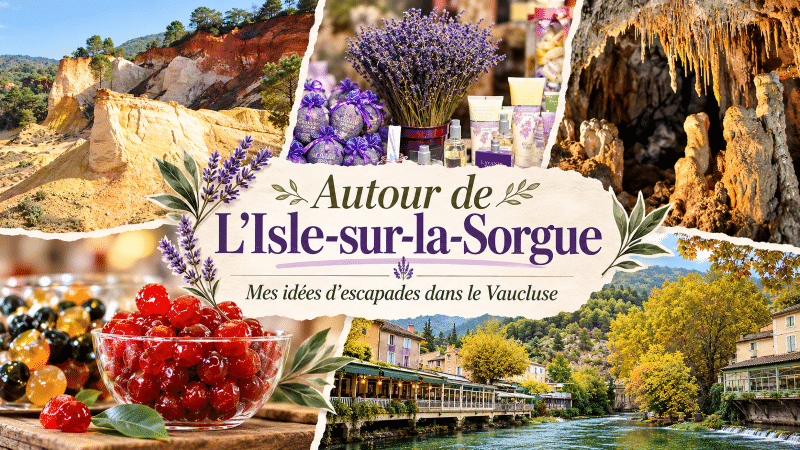
In this article, I’m sharing things to do around L’Isle-sur-la-Sorgue, with our favourite places, a few more unusual visits and my tips for planning your stay in the Vaucluse.
After discovering L’Isle-sur-la-Sorgue, we made the most of our stay to explore several places nearby and see another side of the Vaucluse: more about crafts, food and culture, but still very Provençal.
Planning a trip to L’Isle-sur-la-Sorgue?
Canals, water wheels, antique dealers, good places to eat, the market… I’ve also written a complete guide to the town.
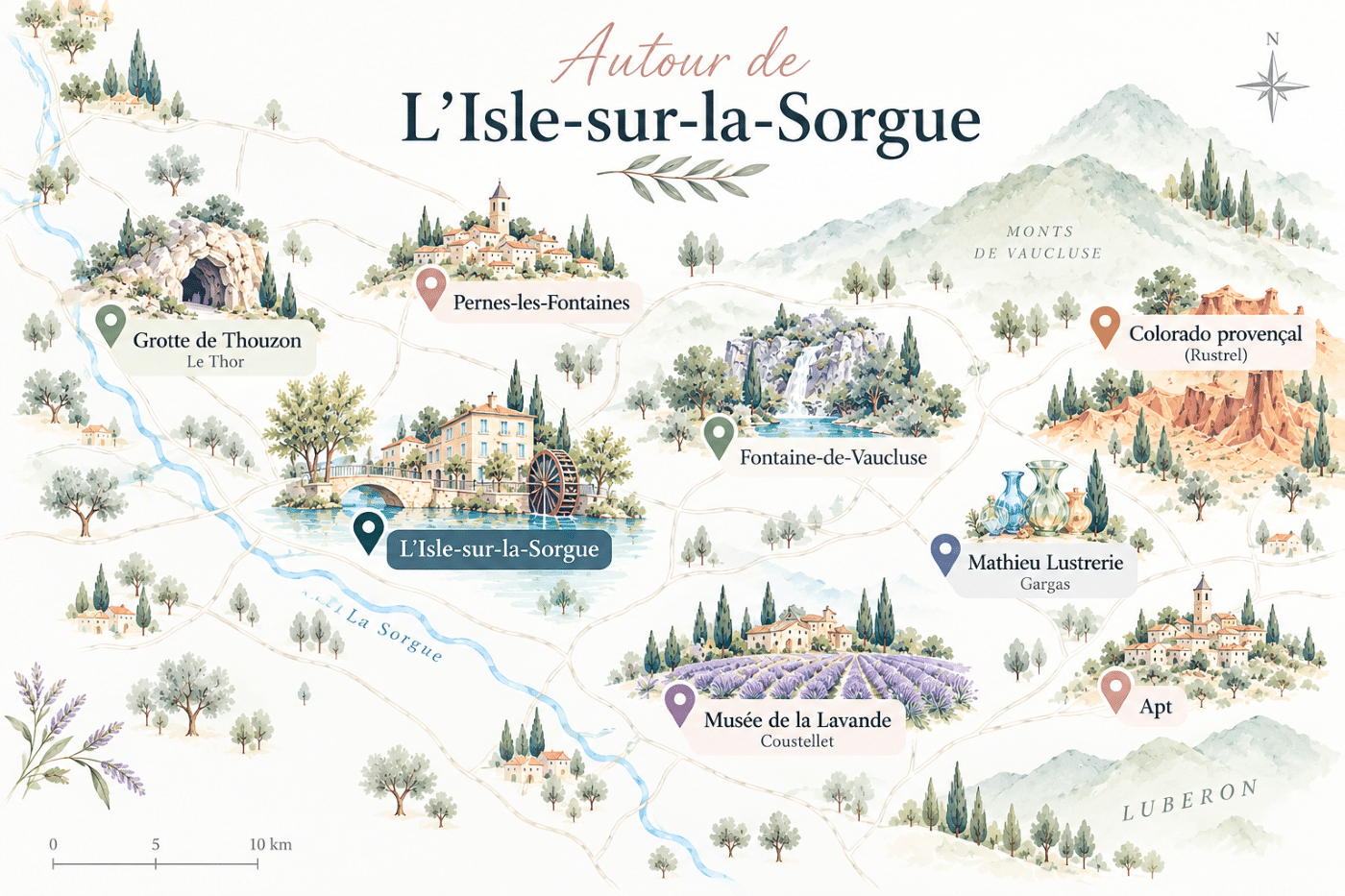
Fontaine-de-Vaucluse, Pernes-les-Fontaines, Apt, Coustellet, Le Thor and Gargas… there are plenty of ideas for visits less than an hour’s drive away.
| Destination | From L’Isle-sur-la-Sorgue | Why go? |
|---|---|---|
| Fontaine-de-Vaucluse | ≈ 15 min | The spring, the Sorgue, Vallis Clausa and a lovely riverside walk |
| Le Thor | ≈ 15 min | The Thouzon caves and their underground world |
| Coustellet | ≈ 15–20 min | The Lavender Museum and Provençal know-how |
| Pernes-les-Fontaines | ≈ 20 min | Fountains, heritage and lots of craftspeople |
| Gargas | ≈ 40 min | The surprising Lustrerie Mathieu and the Luberon landscapes |
| Apt | ≈ 40 min | Candied fruit, the old town and a foodie trip into the Luberon |
| Rustrel | ≈ 50 min | The Colorado Provençal and its ochre landscapes |
Hiring a car to explore the Vaucluse
To visit the area around L’Isle-sur-la-Sorgue, a car is still the most practical option in my view.
The villages, museums and natural sites are quite spread out, but distances are reasonable.
Where to stay to explore the area?
During our stay, we chose to stay in L’Isle-sur-la-Sorgue itself, which turned out to be very convenient for exploring the Vaucluse.
The town is well placed for reaching Fontaine-de-Vaucluse, Le Thor, Pernes-les-Fontaines, Coustellet and the Luberon, while enjoying its lively centre and good restaurants in the evening.
We stayed at the Grand Hôtel Henri, right in the heart of town.
A comfortable, elegant place that we really liked, with the advantage of being able to
explore L’Isle-sur-la-Sorgue on foot once the car was parked.
Visiting Fontaine-de-Vaucluse: what to see and do
A visit between river, spring and heritage.
The village that gave its name to the department is pure Provence, with its colours and its terraces dotted along the river… It’s world-famous for its spring, which gushes out at the foot of a cliff and is the largest resurgence in France and the 5th largest in the world. The walk to this geological curiosity is short (about 800 m from the village centre), flat and accessible to everyone! The water is said to be as incredibly clear as the cave around it is impressive! The exact depth of the chasm is unknown but is at least 308 m!
Needless to say, at the start of autumn, in a downpour, the atmosphere around the chasm and even in the heart of the village was quite different ^^! (#unlucky)
A low sky broken by the mysterious ruins of the Château des Évêques, dark, churning waters and deserted lanes greeted us on arrival, plunging us into a secretive atmosphere straight out of a witch’s tale… far from the fairy-tale images we’d been shown ;)! I loved it! So I recommend visiting this enchanting village in any season… You’ll see very different scenes!


What to see and do in Fontaine-de-Vaucluse
- See the Fontaine-de-Vaucluse spring, of course a must on a first visit.
- Visit the Jean Garcin History Museum: 1939–1945. More on this below.

- Discover Vallis Clausa, the paper mill just opposite the museum.
It shows how rag paper is made using traditional techniques,
and is a lovely introduction to the paper-making know-how that long shaped the region.

- Visit the Santon Museum, to discover another side of Provençal culture.
- Walk up to the Château des Évêques to see it up close and enjoy the walk.
- Canoe down the Sorgue, to see Fontaine-de-Vaucluse from a completely different angle.
Opening times, prices and visiting conditions may change, so check them on the official websites before your trip.
Visit the Jean Garcin History Museum: 1939–1945
As I’ve told you before, the Second World War fascinates me, so I couldn’t miss this museum! It covers the different stages of the war, from the rise of fascism in Europe to the Liberation, via the Occupation, repression and the Resistance in the Vaucluse, and above all offers a different approach to the conflict.
It focuses in particular on people’s daily lives during the war, through little scenes and reconstructed places (such as a ration shop). The collection of objects, posters and books from the period is very rich, and I found the visit very enriching! 


Visiting Apt: the Maison du Fruit Confit
A stop in Apt for a local speciality.
 For centuries, Apt has been the world capital of candied fruit, a little-known Provençal speciality! (Apt’s candied fruit has even been listed as French intangible cultural heritage since early November 2018 – just a few days after our visit!)
This visit was obviously on my list – you know how much of a sweet tooth I have, haha!
Confession of the day: I had never tasted candied fruit. Yes, I know… But at least I started with the very best!
The Maison du Fruit Confit has three areas: the shop, the tea room and a museum area with short films showing the different stages of making candied fruit, plus a scent trail. I admit I didn’t watch all the films – too many for my liking. (I get bored quickly in front of a screen!) But I had great fun recognising the different candied fruit scents… (Such a child! Are my pupils rubbing off on me?) All your senses are involved… In fact, I hardly left the tasting table, where you can try the different candied fruits one by one. Early in the morning, just after breakfast, maybe not the best idea! Hello, sugar rush^^! The shop is really tempting and well laid out, so I couldn’t help giving in and bringing back a few souvenirs for us and our parents… (Especially chocolate-coated fruit jellies – to die for!)
Good to know: foodie events and cookery workshops are regularly organised throughout the year.
Maison du Fruit Confit
538 Quartier Salignan, D900
84400 Apt
https://www.lesfleurons-apt.com/fr/content/9-la-maison-du-fruit-confit
Free entry


Visiting the Lavender Museum in Coustellet
Discovering the heritage of lavender in Coustellet.
This was one of my favourite visits of the weekend! (OK, I fell for a lot of things in the Vaucluse.)
I love the smell of lavender and lavender products. I thought I didn’t have that much to learn about it, but I was very wrong – not least because what I’d always taken for lavender… wasn’t!
True lavender actually has protected designation of origin status and is often confused with lavandin, a hybrid. Real, fine lavender grows in Provence above 800 m. It flowers from mid-June to the end of July, depending on altitude and weather. Its stem is short (about 30 to 40 cm), as is its flower spike, and the plant itself is fairly low and rather untidy…
Far from the photos of endless uniform purple fields you may have seen! Sorry to burst the bubble of all the Instagrammers from around the world who come to pose in Provence’s “lavender” fields, which actually aren’t^^! OK, the result is still lovely, but what they’re photographing is really lavandin!

Why does this difference matter? Lavender and lavandin have neither the same properties nor the same scent, and only fine lavender has medicinal uses (as its botanical name suggests: Lavandula officinalis). So beware of cheap products in shops that mislead consumers!
The Lavender Museum sells products from the “Château du Bois” estate. The Lincelé family has been growing true lavender since 1890 – a real family story! Since our visit, we’ve put some of their advice into practice, such as mixing 1–2 drops of their lavender essential oil with a spoonful of honey for a sore throat, or inhaling 1–2 drops when we have a cold… and found it works for us! I think it’s great! (I admit I’ve always been a bit sceptical about essential oils, but then I was using adulterated supermarket ones…) We’ve also put a little on our pillows to sleep better during a recent stressful period, and I’m sure it has many other uses!
If you love natural, French-made products, you should also find what you’re looking for in the museum shop, which offers a wide range of creams, cosmetics and room diffusers made from plants (and lavender, of course!).

Anyway, in telling you all about the benefits of lavender, I almost forgot to give you a quick overview of the museum. The Lavender Museum in Coustellet explains the difference between lavender and its related species, and details the different stages of extracting its essential oil through a very clear short film, a few information panels and a lovely collection of stills… The visit is informative and very interesting!
Good to know: workshops are also offered for children.
276 Route de Gordes
CS50016 – D2
84220 Coustellet
Tel: +33 (0)4 90 76 91 23
http://www.museedelalavande.com/


Things to do in Pernes-les-Fontaines
The fountains and lanes of Pernes-les-Fontaines.
For fifteen years, the town council of Pernes-les-Fontaines has been buying and renovating old buildings in the historic centre and renting out the ground floors at low prices to around twenty craftspeople, whose list you can find here: http://www.tourisme-pernes.fr/fr/decouvrir-et-se-divertir/la-vitrine-des-talents-d-ici/les-talents-savoir-faire.
The small town has been labelled a “Ville et Métiers d’Art” (town of arts and crafts) since 1998 and holds a dedicated fair every year. No need to wait for it to meet the people who bring the town to life and live from their passion, and learn a little more about crafts you don’t see everywhere! In Pernes, everyone knows each other and the doors are wide open! Over a morning that flew by, we followed a little trail from lane to lane, door to door and shop to shop through this maze-like little town centre.
I loved watching and questioning a bagpipe maker, Murano glass artists, a barrel organ maker, a marquetry artist, a wire sculptor, a sculptor-gilder and a santon maker… I learnt so much about these crafts (sometimes even that they existed) – and I tell you all about it in a dedicated article!
Read about my visit to Pernes-les-Fontaines →


What to see in Gargas: the Lustrerie Mathieu
A workshop dedicated to lighting and fine craftsmanship.
 I find the idea of this chandelier museum, opened in 2010, quite original, and I hope you’ll enjoy discovering this little gem set in a former ochre factory in the heart of the Luberon! Opposite the workshops, the “Mathieu Museum” traces the history of the chandelier and 5 centuries of decorative arts through an exceptional collection of hundreds of pieces.
Régis Mathieu has restored chandeliers for major sites such as the Opéra Garnier and the Hall of Mirrors at Versailles… Needless to say, it’s impressive to see them so close up and in context. You travel through the ages, fashions and eras… The most recent, the arrival of electricity and avant-garde design, is just as interesting. (I do have a soft spot for big sparkling chandeliers^^!)
We had some trouble finding the entrance, as the place is in 2 parts: the museum, and the workshop, which also has plenty of chandeliers and where you can watch the restorers at work. The contrast between the bright red walls and the glittering chandeliers is spellbinding, and the place is very classy – you can wander dreamily and admire these beautiful one-of-a-kind pieces, or rather these unsung masterpieces.
Once again, a lovely way to discover the arts and crafts of the Vaucluse!
https://www.mathieulustrerie.com/portfolio/le-mathieu-museum/
Hameau des Sauvans
84400 Gargas, France
Free entry


What to see in Le Thor: the Thouzon caves
An underground outing near L’Isle-sur-la-Sorgue.
 I couldn’t wait to discover the Thouzon cave (also called the Fairy Cave) after seeing a few photos on the Facebook page of friends who’d been there that summer. Over the past two years, I’ve also developed a real fascination for caves, which leave me speechless: how could nature create such buried wonders? (Yes, I know, it’s all geology and mechanics^^, but it still seems magical to me and leaves me lost for words.)
I must admit I was a little disappointed by the Thouzon cave. The place, although narrow, is splendid and unusual…
You walk along the fossil bed of an ancient underground river… through a forest of tiny stalactites, and discover new kinds of formations created by erosion. But the mysterious, secret atmosphere wasn’t strong enough for me. There were a lot of us in the cave (our group had nearly 30 people and we passed another one), and I wasn’t keen on all the lighting effects. (The one in the largest chamber is breathtaking, though!)
Of course, that’s the risk when you travel during the school holidays and rainy weather drives most tourists to indoor visits. In a smaller group, I might have enjoyed the atmosphere more. Otherwise, the visit is very well suited to children.
Website: grottes-thouzon.com
2083 Route d’Orange,
84250 Le Thor
+33 (0)4 90 33 93 65
Good to know before visiting the Thouzon caves
It stays cool all year round, so bring a light jacket, even in summer.
Opening times and prices may vary with the season, so check them before you go.


More things to do around L’Isle-sur-la-Sorgue
More ideas for visits around L’Isle-sur-la-Sorgue.
If you have more time, other iconic places in the Vaucluse and the Luberon
can easily round off your stay.
- Gordes, one of the best-known villages in the Luberon, perched above the Provençal landscape.
- The Abbaye de Sénanque, famous for its lavender fields in season.
- Mont Ventoux, for the views and the legendary roads.
- The Dentelles de Montmirail, ideal for lovers of hiking and beautiful landscapes.
- Avignon, for the Palais des Papes, the Pont Saint-Bénézet and its historic centre.
- Orange, known for its Roman theatre.
Visiting Rustrel and the Colorado Provençal
The ochre landscapes of the Colorado Provençal.
Less than an hour from L’Isle-sur-la-Sorgue, the Colorado Provençal in Rustrel offers a rather unexpected setting in the heart of the Luberon: old ochre quarries, orange and red cliffs, trails and landscapes that almost make you feel you’ve changed continents.
On our first trip to the Vaucluse, the weather unfortunately didn’t let us enjoy it. We’ve since had the chance to discover more of the Luberon and its landscapes, which I tell you about in an article on a week in the region.
Discover my one-week Luberon itinerary →


FAQ – Things to do around L’Isle-sur-la-Sorgue
What is there to see around L’Isle-sur-la-Sorgue?
Fontaine-de-Vaucluse, Le Thor, Pernes-les-Fontaines, Coustellet, Apt, Gargas
and Rustrel are among the most interesting places to combine with a stay there.
How many days should you spend in the area?
Two to four days are enough to discover L’Isle-sur-la-Sorgue and several nearby sights.
A week is ideal if you want to go further into the Luberon.
Do you need a car?
Yes, as soon as you want to explore around L’Isle-sur-la-Sorgue. The villages, museums and natural sites are quite spread out.
What to do near L’Isle-sur-la-Sorgue with children?
The Thouzon caves, Vallis Clausa, the Lavender Museum and the Colorado Provençal
are ideas the whole family will enjoy.
Where can you see beautiful landscapes around L’Isle-sur-la-Sorgue?
Fontaine-de-Vaucluse, the Colorado Provençal in Rustrel, Gordes, Mont Ventoux
and the Dentelles de Montmirail offer very different landscapes.
Can you visit the Luberon from L’Isle-sur-la-Sorgue?
Yes. L’Isle-sur-la-Sorgue is a good base for reaching several villages and sights in the Luberon,
including Coustellet, Gordes, Gargas, Apt and Rustrel.
This article contains affiliate links.