In my little guide to Marseille, published here a few weeks ago, I told you how much I loved our trip to the Frioul Islands. They had made me dream more than once on Instagram, and I must admit I expected to be a little disappointed once there, put off by pushy crowds of tourists. Ever the optimist, yes! I almost gave up on the idea, but my mum was very keen, and on the very evening we arrived, we stopped at the ticket office on the Vieux-Port (just past the mirrored Ombrière canopy) to buy our tickets.

The Frioul Islands are actually an archipelago of 4 islands off the coast of Marseille: Pomègues, Ratonneau, If and Tiboulen, covering 200 hectares in all. They’re even one of Marseille’s 111 neighbourhoods, part of the 7th arrondissement. Three of the four can be visited – Tiboulen can’t be reached by boat – and the Île d’If is probably the best known, thanks to its Château d’If, a fortress turned prison made famous by Alexandre Dumas’ The Count of Monte Cristo.
The return trip is far from expensive (prices at the time of our visit):
- €10.80 for a return trip to 1 island – either the Île d’If, or Ratonneau and Pomègues, which are linked by the Berry dyke
- €16.20 for a combined return trip to 2 islands, letting you explore Ratonneau and Pomègues with a stop at the Château d’If (skip-the-line ticket here).

We wanted the second option, but there are no boats to the Île d’If when the sea is too rough – and the mistral was up to its tricks when we visited, so we had to give up on Alexandre Dumas’ island and the Count of Monte Cristo’s cell^^.
Perhaps it was a blessing in disguise, as on the morning we arrived, there weren’t many of us on the boat to Ratonneau… I did think I was going to bring up my breakfast on the way, though… The waves were so high and overwhelming that they seemed to swallow our boat, and my complexion was clearly close to the colour of the foam. Every jolt was torture! And there I was, imagining myself sailing off with the wind in my face on the deck…^^

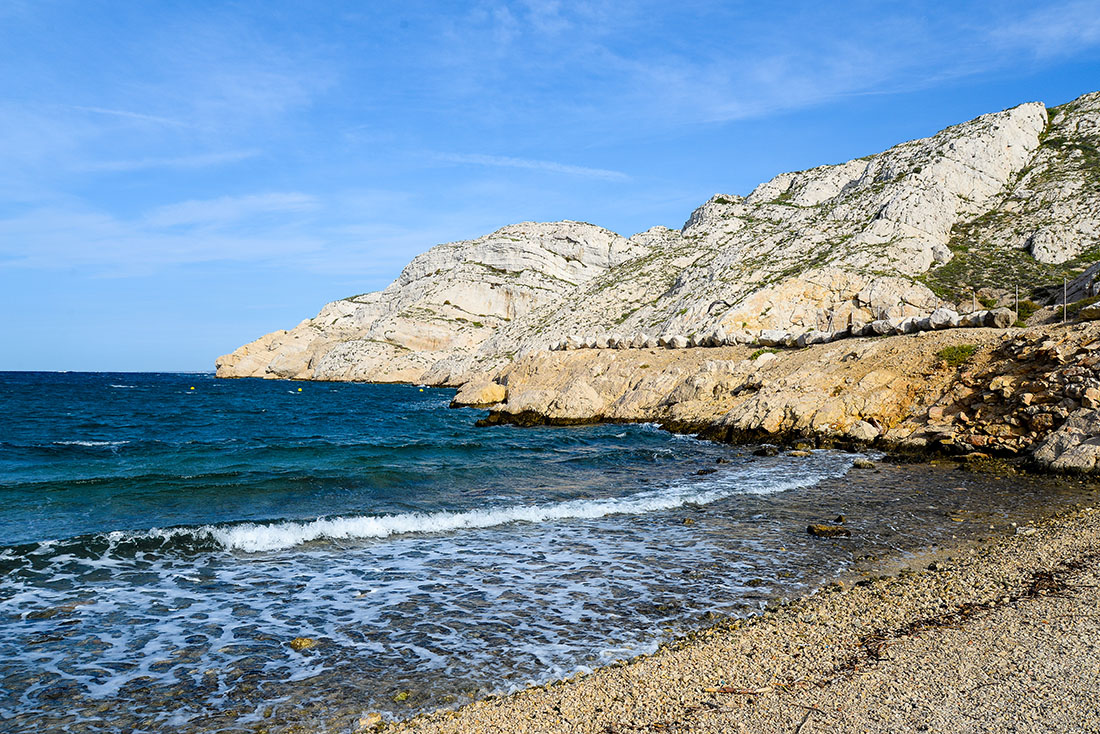
So we arrived on Ratonneau feeling a little queasy, but the sea air and bracing wind soon perked us up, and we set off, more or less at random, along the island’s paths, without straying too far from the main one that goes around it… What a revelation! The wild, bare landscapes are breathtaking. From cove to cove, we admired waters that were sometimes turquoise, sometimes deep blue, turning grey in the roughest corners – sometimes calm, mostly stormy that day…

We walked through arid, sometimes almost lunar terrain, its vegetation decimated by the mistral. I’ve read and heard people complain that “there’s nothing to do on the island” beyond its marina and the few restaurants by the jetty… But that’s exactly its charm…!! You go to the Frioul to hike (and even then, the terrain is very easy – I’d call it a walk rather than a hike), to admire wild, contrasting nature and buildings exposed to history and the elements, now in ruins… If you’re looking for a seaside resort, then yes, move along… As for us, we kept going towards Pomègues, which, at 2.7 km long and 89 m high, is the largest island in the archipelago… but also the wildest and most authentic!


What to see on Ratonneau
Good to know: the island was used as a military base and also as a quarantine station for ships arriving from abroad during the Great Plague that struck Marseille in the 18th century.
What to see:
- Fort de Ratonneau, the island’s highest point, with its ammunition shelters dug into the rock and a 360° view over the surroundings
- the Cap de Croix battery, a 19th-century French gun battery originally armed with 4 240 mm cannons (1876 model) but destroyed in 1943
- the Hôpital Caroline, which housed patients in quarantine and is currently being restored
- the Fort de Brégantin, a relic of Vauban’s fortifications

What to see on Pomègues
- in the distance, the fish farm
- a few traces of the island’s military past: the Cap Caveaux battery to the south-west, the Pomègues battery and fort to the north, the Tour de Poméguet, the Sémaphore battery…

Tips in no particular order:
- Be careful in summer: there’s no shade on the island. With the wind blowing that day, we didn’t really suffer from the heat, but that kind of weather can be even more deceptive! Do bring a hat, sun cream and plenty of water to avoid heatstroke (and maybe a parasol if you plan to spend the afternoon in one of the many coves on the two islands!)
- We couldn’t swim, but the Calanque de Sainte-Estève is the most popular on the island. The Calanque de Morgiret is the closest to the village.
- The crossing between the Vieux-Port and Ratonneau is supposed to take 40 minutes; with the wind and no stop at the Château d’If, our boat took only about fifteen minutes.

Another island to discover in the south: the Embiez
If you love escapes with turquoise sea and little coves, I’ve also written an article about the Île des Embiez, in the Var, reached by boat from Six-Fours-les-Plages. It’s not a day trip from Marseille, but it’s a lovely idea for extending a stay on the coast.
I hope these tips are useful :)!