[This post about Maubeuge and the Salle Sthrau follows a collaboration between the Collectif des Blogueurs HdF and Nord Tourisme. Many thanks to them for organising it – the invitation in no way affects my editorial freedom.]
Not long ago, Aymeric and I headed to Maubeuge, in the Nord département near the Belgian border, for a day out with the BlogueursHdf collective. Let’s be honest: in France the town doesn’t exactly make people dream… except of a moonlit night! (“Le clair de lune à Maubeuge” is a famous comic song, covered by Bourvil – I didn’t know it before our trip, so I went to bed a little wiser that evening!) Like many places, Maubeuge suffers from the clichés surrounding it and is often seen as a sad, austere, run-down town… Needless to say, that doesn’t exactly attract tourists!
As with many other unloved towns, I’d never ventured there, but I decided to give it a chance anyway… Discovering a place also means opening your mind and taking a fresh, objective look at it. That approach has brought us some lovely surprises, as in Lens, Le Havre and Noyon (Le Havre in French)… So did Maubeuge work its charm on us?

Yes and no. Personally – and I do mean personally – I didn’t find the town as a whole very harmonious. Let’s not kid ourselves: the town centre is a bit gloomy and not very inviting… I always try to be objective and honest here, and I am. But wait a minute before leaving the site or having a go at me – I haven’t finished my thought. To my mind, travel isn’t just a quest for the “beautiful”, the “graceful”, the “grandiose” or, worse, the “Instagrammable”. (Though on that front, you can actually find plenty in Maubeuge!)
To truly appreciate the riches of our country, and of the world in general, you also have to immerse yourself and linger over the rest – which is ultimately the most important part… The history of places, their soul, their authenticity, what makes them unique, the people who shape them… Their secrets… The Maubeuge and Avesnois Tourist Office has understood this well, building its communication and hashtag around the theme “Share your secret“…
(PS: it’s a bit like dating: do you only go by looks? That would be very sad, and lots of couples would be doomed!)
(PPS: you could say the same about food and restaurants: the best dishes and restaurants aren’t always the most elegant!)

So my fellow bloggers and I tried to “live” Maubeuge, to dig beneath the surface and travel back through the eras and architectural movements…
Visiting the Salle Sthrau
In fact, this Art Deco hall, recently restored to its former glory, was the main reason for our visit to Maubeuge.
Built in 1624, the building was originally the chapel of the Jesuit college. It was deconsecrated and turned into stables during the French Revolution, before being converted into a ballroom, the “Salle Sthrau“, named after a soldier famed for his bravery…

The ballroom
The building was largely destroyed during the First World War: only the Baroque façade, which you can still admire today, survived the bombing. The hall was reduced to an empty shell, and its restoration was entrusted to the Lafitte brothers between the wars. They designed a monumental festival hall and, above all, a little Art Deco gem, which we were lucky enough to explore on a sensory tour.

The hall isn’t permanently open to the public, which is a real shame as it’s well worth a visit. To see it, you’ll need to wait for the Printemps de l’Art Déco (Art Deco Spring, in April and May in the Hauts-de-France) or book a group tour (from 15 people) on a Thursday – check current arrangements with the tourist office.
From the outside, the building may look a little austere, with its red-brick façade decorated with a few religious symbols recalling its original purpose… But step closer to its majestic wrought-iron door and admire the details of the ironwork depicting a woman playing the lyre – a tribute to the building’s new purpose after its reconstruction – to appreciate its beauty and originality!

It’s a great introduction to the main principles of Art Deco, which is everywhere in the Hauts-de-France… To put it simply, this (actually rather complex) style is clean-lined yet full of curves and colour; it allows itself every extravagance while combining order, geometry and symmetry, draws inspiration from ancient art, uses new materials, and is always in search of light…
If we’d had a checklist to fill in during our visit, we could have ticked every box – so I recommend the Salle Sthrau if you love Art Deco, or architecture in general!
Because beyond its influences, Art Deco above all embodies a new spirit, and the desire to capture the euphoria, excitement, joy and buzz that swept France after the painful nightmare of the First World War, one of the most devastating conflicts it had ever known.
The Roaring Twenties.

For a few dozen minutes, we were transported to the heart of a festive decade of renewal, exploring the different spaces of this incredible building: its majestic entrance hall topped by a monumental symmetrical staircase, its bar with a flower-decorated vault, its shimmering stained glass, its high ceilings and, of course, its exceptional ballroom with its frescoes and honeycomb ceiling. It’s all enhanced by light everywhere, whether natural (pouring in through huge glass roofs, domes and stained-glass windows) or artificial: the wrought-iron light fittings, decorated with masks of tragedy and comedy, are simply sublime! Everything is beautiful, breathtaking, full of detail and finesse. The Salle Sthrau is a little-known gem…
Good to know: for a bit of fun, try to spot the Lafitte brothers’ trademark in each room – a little snail!


Right next to the Salle Sthrau there used to be a small artisan honey and jam business, Le 235, but it has since closed after a fire.
Meeting Sofiane Chalal
Places make Maubeuge, yes… But behind those walls there are also the people who live here, keen to breathe new life into their town and restore its reputation.
Because yes, there’s life in Maubeuge, and Sofiane Chalal – dancer, artist and choreographer, and hip-hop world runner-up in 2008 – would certainly agree. This is where his talent was born and grew, and where he continues to pass on his passion by teaching dance at the Secteur 7 association. An accomplished artist, he was preparing a new show combining dance and theatre at the time, to be staged of course at the Le Manège theatre, which offers local people a great cultural programme at low prices.
In the meantime, he improvised a little hip-hop dance lesson for my fellow #BlogueursHdf right in the middle of the Salle Sthrau ballroom (I didn’t take part, as my neck was playing up that day), and I thought they did rather well! Which just goes to show that a good teacher can work miracles…
And if you’re not convinced, you can always stroll through the streets of Maubeuge on a Saturday afternoon and catch Secteur 7’s rising stars rehearsing under a bandstand…


Discovering the work of Lurçat, the architect who rebuilt Maubeuge
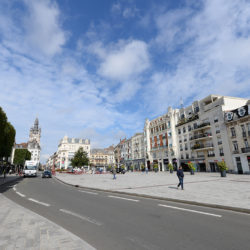
If you love architecture and urban planning, you must wander around the town centre and discover the work of André Lurçat, the chief architect of the town’s reconstruction after the Second World War, whose work is now in the collections of the Centre Pompidou in Paris – and who gave his name to a secondary school in Maubeuge. His task went beyond simply rebuilding destroyed homes: he tried to put into practice his very communist-inspired utopia, a town with no room for inequality… He raised the right bank of the Sambre, had around 200 shops and more than 650 homes built to identical plans and limited to 4 storeys, and created a new street network organised into airy blocks interspersed with green spaces.

The Church of Saint-Pierre-Saint-Paul
We were told that André Lurçat may have inspired Auguste Perret, the famous architect who rebuilt Le Havre and designed a huge concrete tower in Amiens… Not being an expert, I couldn’t say who inspired whom, but the two styles do have similarities, both in the rational organisation of space and in the look of certain buildings. I’m thinking in particular of the Church of Saint-Pierre-Saint-Paul, a joint work by André Lurçat and Henri Lafitte at 1 Rue de Valmy, with its porch on Avenue Franklin Roosevelt. A vast block of reinforced concrete topped by a 43-metre bell tower, it’s surprising at first sight.

I personally really liked it… and its unusual architecture, a reflection of its creator’s thinking: he believed all religions were the same and would eventually disappear. His church was therefore designed to become a performance venue that could hold up to 1,000 people…
He reinvented the traditional idea of a church, offering a neutral, contemporary take on the Stations of the Cross, the Trinity and the stained glass… while letting in plenty of light (the bell tower is lit by glass bricks, alongside a cylindrical tower leading to a 28-bell carillon).
Free entry


Lunch at La Rotonde, like the locals
This café-brasserie, a stone’s throw from the zoo (16 Avenue Albert 1er, 59600 Maubeuge), serves a wide variety of homemade dishes, usually with excellent chips, at rock-bottom prices! I was served a huge fricadelle (a local sausage) for under €5 at the time, with a lovely view of the tourist office on Place Vauban. It’s said to be very popular in Maubeuge, especially on match nights!

A post-lunch stroll around the Vauban fortifications
As Aymeric would say, chips are life… but they do weigh a bit on the stomach! So we ended the afternoon gently with a walk around the fortifications built by Vauban in the late 17th century. They’re remarkably well preserved, with two-thirds still standing; the other third was dismantled after the Second World War to make way for the town redesigned by Lurçat.
Of the four original gates, only the Porte de Mons has kept its defensive complex and the guardhouse of its ravelin intact. Two defensive moats on the south-east side have been kept and turned into fishing ponds. Now green and pleasant to walk around, the site gives you an idea of how a fortified town was defended in the 17th century… and today, since a few swans have made it their home and clearly aren’t always willing to let you get close 😉!


Also in Maubeuge
It has to be mentioned: the town is well known for its zoo (€9 entry at the time), home to around sixty species from five continents. We chose not to visit it, for reasons that are probably obvious: it’s a delicate subject, and we now have mixed feelings about animal parks, which – as in Maubeuge – sometimes contribute to the protection and conservation of species… but still take animals out of their natural habitat… As we don’t have a definitive opinion on the subject, and everyone is free to make their own choices, we prefer not to go in, but we mention it for anyone interested!


If you enjoyed this post, pin it on Pinterest!