
[This post about Namur follows an invitation from Wallonie Tourisme. Many thanks to them for the invitation, which in no way affects my editorial freedom.]
What is there to do in Namur in a day? With its citadel, underground tunnels, historic old-town lanes and the banks of the Meuse and Sambre rivers, the Walloon capital is perfect for a short break.
How could you not fall for Namur? I won’t necessarily present our visit as a full guide like the one for Liège, as we spent less time there and may have fewer tips to share… Or maybe not…
William Turner immortalised it with his brush. Victor Hugo, Chateaubriand and Marguerite Yourcenar mentioned it in their works… Nestled at the foot of the Ardennes, the capital of Wallonia has its own old-fashioned charm, a jumble of history and cultures – so much so that walking its streets felt more than once like travelling back in time.
The town grew up in the shelter of its citadel, a vast rocky spur at whose foot the Meuse and the Sambre meet. Its prime position brought countless invasions that shaped its destiny and wrote the story still revealed today as you wander its streets.

A friend studied in Namur, and, as a little anecdote, her adventures had led me to picture the town as a maze of lanes dotted with bars, little shops and tables groaning under beer tankards! Those clichés, haha! (Thanks, AC!) That said, I wasn’t far off about the narrow cobbled streets, inner courtyards and little squares… It’s funny how we sometimes imagine a place we’ve never set foot in!
And to get to grips with the City of Snails (no, that’s absolutely not its nickname, but the snail is one of the local emblems and I was looking for a way to describe the town!), there’s nothing like a visit to the aforementioned Citadel.

Visiting Namur in a day: the essentials
| Ideal length | 1 day for the must-sees, a weekend to take your time |
| Don’t miss | The citadel, the underground tunnels, the historic centre and the Sambre-Meuse confluence |
| On foot | The centre is easy to explore on foot; the citadel involves a bit of a climb |
| Atmosphere | Heritage, panoramic views, lively lanes and Walloon culture |
What to do in Namur in a day? My itinerary
| When | What to do |
|---|---|
| Morning | Climb up to the citadel, enjoy the views and visit the underground tunnels. |
| Lunchtime | Lunch in the historic centre. |
| Afternoon | Place d’Armes, the old-town lanes, the banks of the Sambre and Meuse. |
| With more time | Add a museum or a water activity, depending on the season. |
Visiting Namur Citadel and the Terra Nova tunnels
We’re so used to wandering everywhere on foot that, that morning, we didn’t even think of driving up to save time. Old habits… We left the Hôtel des Tanneurs, full after a gargantuan breakfast and eager to explore the town we’d passed through the day before at a gentle pace. After putting our bags in the car boot, we crossed the centre to the Meuse (a first taste of Namur’s must-sees) and set off up the little hill on foot. It’s barely fifteen minutes to the top, and we hardly felt it after warming up our legs in the Ardennes the week before – especially with the superb views gradually unfolding before us.

Little by little, we got to know the different areas of this defensive fortress. As I mentioned above, Namur’s strategic position at the confluence of the Sambre and the Meuse very quickly made it one of the most important strongholds in Europe… and the scene of endless sieges! (22 in all!)

As a result, its layout changed more than once over the centuries to keep up with the times and the evolution of weapons (particularly their power and range). Today it is made up of 4 parts… 5, even…
- the medieval layer with its former counts’ castle
- the Médiane, with its impressive gate
- the Esplanade, which hosts various cultural events
- Terra Nova, the Visitor Centre, where we headed first to book a tour of the…
- Underground tunnels!
Did you know Namur was once considered the termite mound of Europe? We didn’t!
Among other things, the fortress hides a fascinating underground network (7 km of galleries) dating back to the Middle Ages, dug in successive stages over the centuries and the various military occupations of the site by the Spanish, the Dutch, the French and, closer to our time, the Germans. Only about 4 km remain – a pretty incredible figure when you know that exploring 500 m already takes a good hour!

The tour is guided, of course, and while waiting for our slot, we took a little tourist train ride along the ramparts. If, like us, you’ve walked up to Terra Nova and the Citadel, you won’t necessarily see new scenery – otherwise, you should enjoy it! Either way, as you can see in the vlog, we had great fun rattling over the cobbles, haha! (And the commentary on the site during the ride was good too.)
(€6 per person at the time, 25 minutes; the ride was included in the €13 Citadelle Pass, which gave access to the tourist train, the guided tour of the tunnels and the Terra Nova Visitor Centre.)


Now for the best part: the one-of-a-kind tour of the underground tunnels!
For one thing, we had a lively guide with a passion for the subject, who took us with her from era to era… For another, I have to admit the staging – a series of “visual tableaux” projected deep inside the galleries – is incredible! We learned all sorts of details about the tunnels, how they were designed and used: as a means of communication, as a firing position, under Vauban as a store for weapons and food, and finally, during the Second World War, as a gas shelter. (On paper, at least – in reality, the work to line the walls with reinforced concrete and seal the rooms with armoured doors was never finished.)
After going down 22 m underground into the bowels of the Citadel, we were quite glad to get back to the surface! (Don’t worry, renovation work has been carried out to make it safe for everyone!)
To learn more about Namur in an interactive way – its location, its different periods of occupation and the mark left by each nation – we highly recommend this tour!
Practical information
- Tour length: 1 hr 15 – 1 hr 30
- Guided tours in French, English and Dutch
- It’s 12–14°C all year round in the tunnels, so bring a jumper in summer.
- Reduced mobility: by reservation only on +32 81 24 73 70; tours possible in a joëlette (an all-terrain wheelchair)
- Prices: check current conditions and prices directly with Namur Citadel.

What to see in Namur town centre and along the Meuse
- You can discover the town in an unusual way:
- by rickshaw (tours of the old quarters, between the Sambre and the Meuse, or towards Wépion, a village famous for its bright red strawberries)
- by “Namourette”, little river shuttles that work like buses and are a fun way to travel along the Sambre and the Meuse, the two rivers running through the town
- by Segway
- on a food tour (count me in!)
And of course on foot or by bike too!
Ask at the tourist office for details.


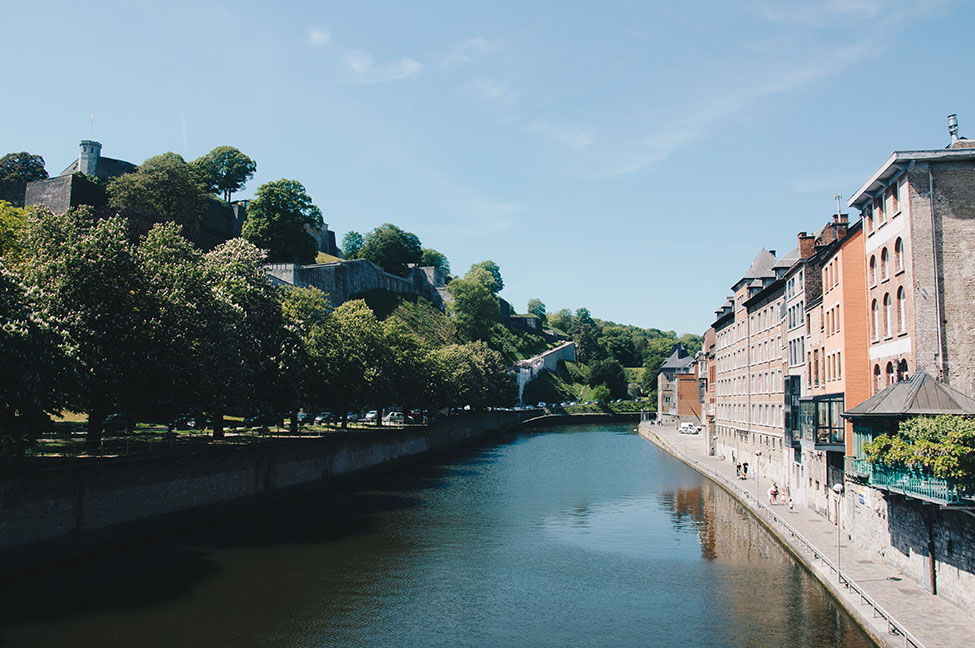

- Explore Namur town centre and its pedestrian streets, reached via the Place d’Armes, Namur’s central square and a former place of execution. Today you’ll meet two folk characters there, Djoseph and Francwés, together with the town’s emblem, a snail. The streets (with their Art Deco façades <3, just like home!) were packed that weekend for the Arts Forains festival (Namur is a very lively town), and I admit I didn’t really take photos of them, but we put a few shots in the vlog.

- Speaking of events, don’t miss the day of Namur traditions and folklore, the Provençal village or the open churches days!
- The town has around ten museums. We’d have loved to visit the one devoted to ancient art, home to a collection ranked among the 7 Wonders of Belgium: the Treasure of Oignies!
- You can also try the water sports on offer in Namur (especially paddleboarding).

Where to stay and eat in Namur: my recommendations
During our stay, we slept and dined at the Hôtel des Tanneurs, an unusual hotel made up of 11 old houses linked together, with 32 rooms, all different… Its architecture alone is worth a visit! We always seem to stay in wonderful hotels in Belgium! Remains of old tanneries, brick vaults, arches and stone walls… Tucked away among little lanes, the place is full of charm!
The rooms are spacious and original, the beds comfortable, and breakfast is varied with good produce (and freshly squeezed orange juice – I love it!). We had a wonderful time. The hotel’s location is ideal, although parking is tricky right in the town centre! (The streets are narrow and there’s no room for an underground car park.) We parked at the Casernes car park, 300–400 m away.
The hotel has two restaurants, and we dined at the Grill, with equally elegant, carefully designed decor! Hats off to the smiling staff and above all to the quality of the cooking and the dishes made with good produce. I’m not as much of a meat-lover as Aymeric (vegetables are my life!), yet I loved my steak, tender and full of flavour!


FAQ – Visiting Namur
What can you do in Namur in a day?
I’d suggest starting with the citadel and its tunnels, then heading back down to the historic centre and the banks of the Meuse and Sambre.
How long do you need to visit Namur?
A day is enough for the main highlights. A weekend lets you add a museum, a water activity or more time in the centre.
Is Namur Citadel worth visiting?
Yes, for both the views and the tunnels. It’s clearly one of the most memorable sights in town.
Is Namur easy to explore on foot?
Yes. The centre is compact and pleasant to walk around. The climb up to the citadel just takes a little more effort.
What is there to do around Namur?
You can extend your trip to Dinant, the Belgian Ardennes or other Walloon towns such as Liège.
More ideas in Belgium (in French)
Namur on video