
[This post about the Route 62 follows a collaboration with the Route 62 association. Many thanks to them for organising it – the invitation in no way affects my editorial freedom.]
The United States has Route 66; France has its Route 62, in the Nord-Pas-de-Calais (62 being the number of the Pas-de-Calais département, in case that needs saying). It links 14 must-see sites, brought together in an original association. The Route 62 association even offers a free discount card (in the form of a little booklet) giving you reductions at each partner site, including historic sites, unusual outings, inns and hotels, restaurants… We were invited, on the first weekend of the summer holidays (ages ago now!), to try out some of the activities offered by Route 62 members, and to discover the area around Saint-Omer in more or less unusual ways. Over 3 days, we travelled through space and time, between past and present, old-fashioned roads and nature, darkness and beauty ❤️
The weekend promised plenty of surprises!
So here are a few ideas of things to do around Saint-Omer and along the Route 62.
You’ll also find my 15 weekend ideas in the Hauts-de-France here.
A vintage drive with Les Belles Échappées, Clairmarais
Ferme de l’Abbaye, 1 voie communale des Murs, 62500 Clairmarais
We started the weekend in top gear! The Belles Échappées adventure began a few years ago. As a young man, the owner travelled across Europe in a 2CV and other equally old cars, and fell in love with this kind of slow travel, which lets you discover the soul of a country through its quiet, sometimes forgotten back roads… while chatting with local people drawn to these unusual vehicles. He then decided to put his passion to work for his region. Les Belles Échappées now rents out a range of unusual vehicles (2CVs, Solex mopeds, vans…) with several routes to explore the Saint-Omer area. Bikes let you explore the marshes freely, while the 2CVs and Solexes let you venture further afield.

Mathilde and Charlie joined us for the weekend. Mathilde and I often see each other at the French travel bloggers’ fair, and we’d met Charlie in Angers a few years ago, and all four of us got on well. So it was with them that we learned to tame the beast… or at least that Aymeric had to forget all his driving habits (and modern technology) to take the wheel of a gorgeous 2CV, far more comfortable than I’d imagined. (OK, to be fair, he normally drives my Panda, which isn’t exactly high-tech either…)

Quite an adventure! The first few minutes were rather chaotic, especially when we had to restart the car on our own (luckily, the owner had helped us the first time). It doesn’t get more retro than this! Otherwise, nothing insurmountable – apart from braking, which you need to anticipate! I have fond memories of this quirky drive, which had us in fits of laughter!

We drove as far as the Watten windmill, with a lovely view over the surrounding countryside… and had lunch at L’Auberge Flamande, which we recommend. The food is local, indulgent (well, it is the Hauts-de-France!) and homemade.

Price of our trip at the time: €159. By Solex: €20, tandem: €24…
Visiting the Blockhaus d’Éperlecques, the first V2 and V1 base
Rue des Sarts, 62910 Éperlecques
As you know, I live in Picardy, an area marked above all by the First World War. That’s why, until now, my visits in the region had mostly focused on that conflict. I’d almost forgotten about the occupation of the Nord and Pas-de-Calais during the Second World War (placed in the “forbidden zone”), which several Route 62 sites highlight, including the Blockhaus d’Éperlecques… which is a shame, because that period of history fascinates me just as much…
So I loved rediscovering this side of the history of part of the Hauts-de-France through two sites that are, quite objectively, exceptional.

Open to the public since 1973 and listed as a historic monument in 1985, the Blockhaus d’Éperlecques is a huge, authentic bunker in the heart of the forest of the same name. It was built by Nazi Germany in 1943–44 as a launch base for V2 rockets aimed at London and the south of England…
The visit, entirely outdoors, takes about 1 hr 30 and is divided into three areas that tell you about the world at war and the occupation of the Nord-Pas-de-Calais, the horrors of deportation, and the V1 and V2 missiles, the Nazi regime’s revolutionary weapons… rarely covered in Second World War museums.


It all begins inside an old railway wagon, placed on the site in tribute to the forced labourers taken from labour camps to build the bunker… Thousands of men were mobilised and worked to exhaustion, in extremely harsh living and working conditions… to complete this huge project for Nazi Germany.
Kraftwerk Nord West was its code name. For the Germans, the location was ideal: isolated and out of range of naval guns and warships, but close to sand and gravel quarries and a railway line… The Blockhaus d’Éperlecques was far from a random choice…
The second part of the visit takes you into the forest, along a path leading up to the bunker that seems to tell its story as you go…
Old tanks and missiles placed along the path punctuate the walk, and sound effects engage all your senses to bring the past to life: the darkness of the time, the scale of the operation… You learn in particular that the bunker was never finished, because of repeated British and American bombing raids – even though the Allies didn’t know its original purpose. Part of the building was nevertheless turned into a liquid oxygen factory…

Finally, you reach “the beast”: an immense concrete fortress, barely scratched by the tonnes of bombs dropped on it… 22 m high, covering 1 hectare. It’s impressive, to say the least – frightening, even… chilling. If the project had succeeded, the war could have taken a very different turn. It makes you realise once again how lucky we are to have escaped that dark era…
I’m deliberately not telling you more, so you can discover it all for yourself… You can’t fail to appreciate this informative, interactive place steeped in history!

Adults: €10 – children (8–14): €6.50 at the time of our visit
A boat trip in the Audomarois marshes with O’MARAIS by Isnor
3 rue du Marais, 62500 Clairmarais
The Audomarois marshes cover more than 3,700 hectares across 15 municipalities. An exceptional wetland, it was designated a UNESCO Biosphere Reserve in 2013… So it’s a must if you’re in the area!

The best way to enjoy it is by bike or by boat! Isnor offers several guided tours from Clairmarais, in rowing boats, canoes or, like us, electric bacôves (traditional flat-bottomed marsh boats). The trip is pleasant and tells the story of the marshes, shaped by people (originally monks) over hundreds of kilometres of waterways to meet their needs, their traditions and their market gardening. Around fifty vegetables are grown in the Audomarois, such as cauliflower and chicory! The little cruise also lets you enjoy the wildlife (moorhens, herons, great crested grebes…) and plants through a few encounters and anecdotes.

We weren’t lucky with the weather on the day, but fortunately the company lent us raincoats!


The trip through this watery labyrinth is calm, pleasant and relaxing, especially on a Sunday morning! I always love these green escapes and pastoral landscapes, even in the rain! It reminded us a little of the Hortillonnages in Amiens and the marshes of Bourges – all calm and serenity!
This is where we had lunch, at La Baguernette. It serves lots of local specialities, and we ordered welsh (a cheesy, beery local take on Welsh rarebit) to keep in shape, haha!

Adults: €12 – children: €10 at the time of our visit
An afternoon at La Coupole
La Coupole, rue André Clabaux (Mont-à-Car), D210, 62570 Helfaut
5 km from Saint-Omer.
La Coupole was perhaps one of my favourite visits in the Hauts-de-France that year. We spent a whole afternoon there, but you could easily spend the day. This History Centre and 3D Planetarium is incredibly comprehensive and, although it’s officially devoted to the Second World War, it covers so many related subjects – from Nazi madness to the space race, via the Resistance and the dark years of the Occupation – that it appeals to young and old, history buffs or not.

From the outside, the building, built in a former chalk quarry, is immediately imposing, both for its unusual shape (it made me think of a spaceship, but I think my mind was already heading that way!) and its size. The dome is 71 metres across and 42 m high. 55,000 tonnes of concrete were needed to build this indestructible structure, intended as a V2 launch base… A huge 26-tonne engine, still visible on site, made it self-sufficient. It was designed to launch up to 200 V2 rockets a day towards London and the whole of Allied Europe. As with the Blockhaus d’Éperlecques, the outcome of the Second World War could have been decided here, and the war could have taken a very different turn if the Nazis’ project had succeeded.

Few people realise that the Second World War and the space race are linked. The V2 designs and techniques developed by the German engineer Wernher von Braun were later taken up and developed by the Americans to fly to the Moon with the Apollo programme.
La Coupole puts the emphasis on this… A whole floor is devoted to the V1 and V2 missiles, which you can see up close.

This fascinating section really interested me… but of course I was far more moved by the part devoted to the Second World War itself, between Occupation, Resistance and the horror of the camps. You visit with an audio guide, and the commentary is as thorough as the exhibition design it accompanies. Here, history is something you experience. Models, photos, historical and archive films bring the visit to life. Even though I know the subject and have visited many related sites – including the Mauthausen camp in Austria a few weeks earlier – I always leave this kind of museum moved and changed…
Here, it’s all so complete that it couldn’t be otherwise. The site is so huge that it’s divided into several areas: the underground galleries leading to the museum (it’s 10–12°C inside, so bring something warm), the exhibition itself, and the 3D planetarium.


The planetarium is a real bonus. Several short documentary films are shown every day at set times on the concrete dome of the former bunker. We watched an excellent film about the stages of space exploration, which not only took us from planet to planet across the Milky Way, but also told the story of the steps that led to the Moon landing… On the 50th anniversary of Apollo 11, it was very topical! The 3D effect is breathtaking!
In short, this site I’d never heard of a few weeks earlier blew me away, and I really regret not going sooner. I can’t wait to go back!


Prices at the time of our visit:
- HISTORY CENTRE adults: €10
- HISTORY CENTRE adults, reduced: €8.50 (students and jobseekers, with proof)
- HISTORY CENTRE children (6–16): €7
- HISTORY CENTRE family: €22 (2 adults + 1 child) + €2 per additional child
- PLANETARIUM adults, 3D: €7.50
- PLANETARIUM adults, reduced: €6 (students and jobseekers, with proof, 2D film)
- PLANETARIUM children (3–16): €6
- PLANETARIUM family: €17 (2 adults + 1 child) + €2 per additional child
Visiting the Brasserie du Pays Flamand, Blaringhem
The Brasserie du Pays Flamand is a craft brewery founded in 2006 by two childhood friends, partly based in Blaringhem in a former distillery. Now a big name in the region, it also has a second production site in Merville.

It makes a wide range of beers from regionally sourced ingredients and specialises in top-fermented beers, some aged in oak barrels… Several have won awards: its Anosteke Saison was named the world’s best beer in its category at the World Beer Awards. True beer lovers should enjoy it! I don’t drink alcohol myself, but I was almost tempted to try! It was my first brewery visit (apart from the Guinness Storehouse in Dublin, on a very different scale), and I found it interesting to learn about all the thought that goes into each beer to bring out the best flavour.


The tour is very thorough, too. After introducing the history of the site and the brewery, our guide took us into the brewery itself, showing us the raw ingredients and the machines used to make beer. A tap room next to the brewery lets you enjoy a tasting at the end of the visit.
Tour and tasting BY APPOINTMENT only – remember to book – €6 at the time
425 Rue André Plockyn, 59173 Blaringhem


Where to stay around Saint-Omer: a night at the Hôtel Najeti in Lumbres
-> Book a night at the Hôtel Najeti
We spent the second night of our weekend at the Hôtel Najeti (Hôtel du Golf) in Lumbres.
I really liked this very stylish hotel, with spacious, bright rooms, quality beds and a green setting, as the picture windows look out over the golf course. The hotel also has a spa area with a sauna and Jacuzzi, perfect for unwinding at the end of the day! If I tell you we had dinner delivered to our room, that probably shows how low our energy levels were by the end of day two… (Nothing to do with the very light food of the Hauts-de-France, of course… 😉)
From €90 a night at the time


Another place to stay: La Ferme d’Hodicq in Brexent-Énocq: on the first night, we stayed a little further out towards the Opal Coast, as there was nothing available in Saint-Omer (a film festival was on and everything was full!). We tried this lovely place listed with Gîtes de France and loved the large rooms, the incredibly warm welcome, the cleanliness and the very generous homemade breakfast (cookies, muffins, pastries…). If you plan to combine Saint-Omer with a weekend on the Opal Coast, it’s perfect!

A golf taster session in Saint-Omer
Chemin du Bois, 62380 Acquin-Westbécourt
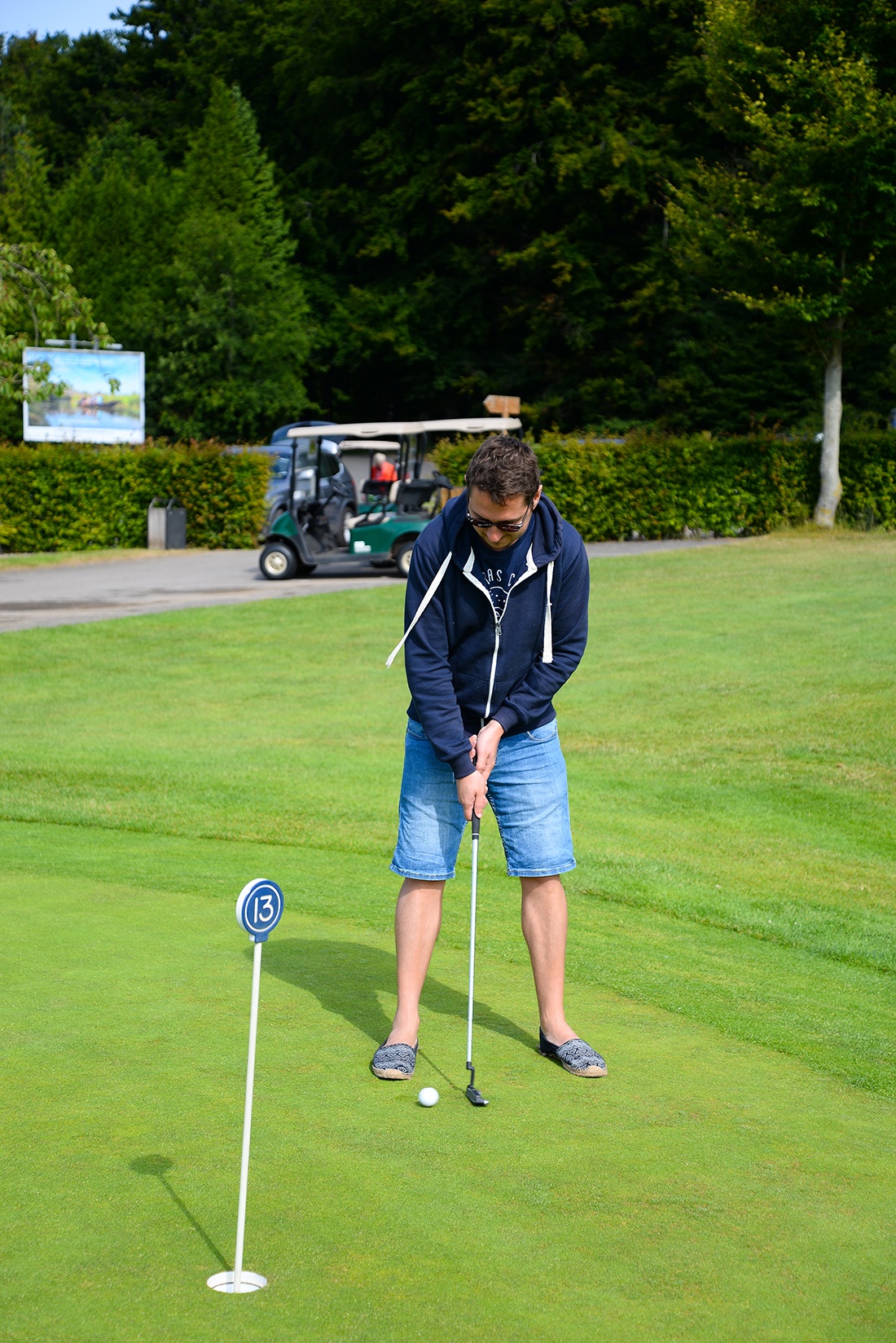
My experience of golf was pretty limited until now. Before this taster session, Aymeric had wisely advised me not to boast too much about my crazy golf skills (I don’t have great memories of it, having split my chin open with a club once)… To be fair, the two activities have little in common apart from the name. I admit I wasn’t very keen on the idea at first. Golf isn’t really a sport that inspires me: it’s generally known for being expensive and needing very specific equipment… Saint-Omer golf club does, however, offer good deals for experienced golfers wanting to try the course, reasonably priced monthly memberships and, in our case, four-hour beginners’ sessions with an instructor and equipment hire for €59 per person (at the time).

Our session, offered as part of our stay, was adapted and lasted 1 hr 30 – enough time to get to grips with the world and rules of this game, which is far more complex than you’d think, and to try out the main clubs used by beginners. We started with putting (rolling the ball into the hole, as in crazy golf), picking up tips from our instructor to aim better. I have to say I wasn’t that bad! (Who’d have thought?) On the other hand, I never managed a single decent swing – probably a lost cause with my neck problems. Aymeric and Mathilde, however, did brilliantly!
I really enjoyed the session, and no one was more surprised than me. I’d do it again without hesitation!


A rail-bike ride in the Pays de Lumbres
Nielles-lès-Bléquin, 62380
We ended the weekend on a slightly sportier note, with a rail-bike ride! We’d discovered this activity – pedalling a little vehicle along a disused railway line – in the Aveyron the year before, and loved this unusual way of discovering hidden corners.

This ride in the Pays de Lumbres was a little less dizzying than our first experience, but just as enjoyable. After a quick safety briefing, we set off on our route of about 9 km there and back through the woods, which starts with a long climb. We took turns pedalling along the way. The slope is fairly gentle, but you might as well share the work, right?! The way back, all downhill, is much more relaxing! Don’t worry, you don’t need to be particularly sporty – it’s accessible to everyone! (Proof: I managed just fine 😉!)


It’s a really fun activity for families or friends. If you have children with you, they’ll love it! There’s a snack bar and picnic tables on site, if you’d like to spend a relaxing afternoon in nature…
(Personally, I loved the quirky, funny little road signs dotted along the way!)

Prices at the time: Pass 5 (5 people, one 2-person and one 3-person rail-bike, 4 pedallers needed): €45 – Pass 4 (4 people, 1 rail-bike): €28 – Pass 3 (3 people, 1 rail-bike): €25 – Pass 2 (2 people, 1 rail-bike): €22
If you enjoyed this post, pin it on Pinterest!