When I come back from holiday, I usually get a bit fixated on one place that really struck me 🙂 In Budapest, it’s the Chain Bridge, which I found truly magnificent. Budapest’s other bridges are just as interesting, but this one was the closest to our hotel, so we crossed it often…
I even used one of my photos of it as my computer wallpaper, which rather intrigued my pupils ^^
“What’s that, Miss? A castle?
– No, a bridge!
– Wow, there are loads of lights!”
And indeed, at night, the Széchenyi Bridge, as locals call it, is beautifully lit up. Impressive!
We saw this on our very first evening, after walking along the Danube and before crossing to the other bank in search of a little restaurant…

On the morning of the second day, we signed up for a guided tour of the city (half price through a French flash-sale travel site). We paid €26 for 2 at the time, and for 3 hours a minibus took us round the city’s main sights. We’re not usually fans of these whirlwind tours – it was a first for us. In the end, I was very happy with our city tour 😀 During those three days, my numb feet, a little sore from chilblains, struggled with the cold and snow. Hard to patrol Hungarian streets in those conditions! Seeing some of Budapest’s key sights this way limited my frustration. And our French-speaking guide shared his passion for his city and his knowledge in great detail, which turned out to be far more informative than the few paragraphs in my guidebook ^^
It was on this tour that we learned more about the Chain Bridge. In fact, it was destroyed (along with all Budapest’s other bridges) just before the end of the Second World War. So it isn’t the original structure we crossed so many times, but a faithful reconstruction (reopened in 1949, on its 100th anniversary).
The Chain Bridge was one of the first large suspension bridges in Europe, and the first permanent bridge across the Danube in Budapest, which partly explains why it’s the darling of tourists and locals alike…
Since 1849, it has linked what are now the city’s two main halves. Buda and Pest were once two separate – and rival – towns.
It was only a couple of decades after the bridge was built, in 1873, that they were united (together with Óbuda). For a while the name “Pest-Buda” was used, before the city became known as… Budapest, the name we know the Hungarian capital by today 🙂

The bridge is named after Count István Széchenyi, the driving force behind this ambitious and costly project. The idea was born in dramatic circumstances: the count had been unable to reach his dying father’s bedside in Vienna because of the winter conditions and the lack of a permanent bridge across the Danube.
It’s commonly called the Chain Bridge after the huge chains that hold it up between its towers and the banks.

Four stone lions guard the bridge’s entrances and seem to protect your crossing from their pedestals.
A legend says that shortly after their unveiling, their sculptor, János Marschalkó, threw himself into the Danube. An apprentice shoemaker is said to have pointed out that the lions had no tongues, and Marschalkó became the target of mockery. Unable to bear the shame, he supposedly took his own life… As with all legends, it’s hard to separate fact from fiction ^^ (in reality, he lived for many more years).
(The lions do actually have tongues – they’re just hard to see from below!)

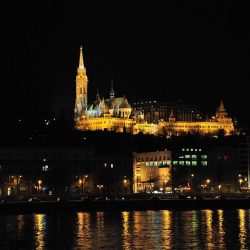
As you cross, enjoy the unique view of the Parliament, or of Buda’s hill and its funicular (not always snowbound!)… See also my snowy visit to Castle Hill.


I hope you enjoyed this crossing – or at least that it didn’t bore you too much!
Have a lovely day, everyone! 🙂