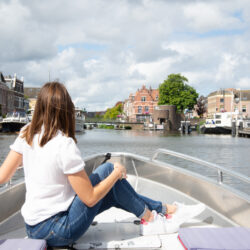

What to do in Delft on a weekend break? Set between Rotterdam and The Hague, Delft is one of the prettiest towns in the Netherlands. Known for its famous blue-and-white pottery and as Vermeer’s birthplace, it also charms with its canals, gabled houses, little alleys and human-sized historic centre.
We spent a weekend in Delft and completely fell for this town, which is easy to explore on foot. In this guide, I share Delft’s must-sees, the visits we tried, where to stay and eat, and my tips for organising your trip.
I love the Netherlands: the country never stops surprising me each time I visit, and I find it a very kid-friendly destination, which may explain why we’ve been three times in 2 years with Elena^^! This summer was no exception, and we set off on a little trip between three superb Dutch cities in South Holland, between Amsterdam and Rotterdam and very close to one another: Delft, The Hague and Leiden. In terms of organisation, with a small child, we could hardly have made it simpler!
Delft was our first stop. Birthplace of the painter Johannes Vermeer, who painted among other works “The Milkmaid” and “Girl with a Pearl Earring”, and cradle of the production of the famous blue-and-white pottery that bears its name, Delft is steeped in history. Both an open-air museum and an ideal spot for a relaxing weekend out of time, Delft reveals itself along its canals, its intimate alleys lined with picturesque houses and buildings, and its tasty and surprising addresses.
For more information, I refer you to the Delft Tourist Office website.
💙 Visiting Delft: at a glance
- 📅 Ideal length of stay: 1 to 2 days
- 🚆 Getting there: about 1 hr from Amsterdam, 15 min from Rotterdam and 10 min from The Hague by train
- 🚶 Getting around: the historic centre is very easy to explore on foot
- 🎨 Delft is known for: Johannes Vermeer and the famous blue-and-white pottery
- 🏛️ Don’t miss: the Markt, the Nieuwe Kerk, the Oude Kerk, the Oostpoort, Royal Delft and the canals
- ❤️ My favourite: the Oostpoort and the alleys along the Oude Delft
- 👨👩👧 With kids: a pleasant destination, easy to get around with young children
- 🌷 Best time to go: from spring to early autumn
What to do in Delft? The highlights at a glance
Delft is easy to explore on foot. Here are the main places to discover, how long to allow and what makes them interesting.
| Place | Recommended time | Why go? | My verdict |
|---|---|---|---|
| The Markt | 30 min to 1 hr | To admire the Town Hall, the Nieuwe Kerk and the bustle of the market | Delft’s unmissable heart |
| Nieuwe Kerk | 45 min to 1 hr | For the royal tombs and the panoramic view from the tower | Worth visiting if the weather is clear |
| Oude Kerk | 30 to 45 min | For its leaning tower and Vermeer’s tomb | An emblematic silhouette of the city |
| Oostpoort | 30 min | To see the last surviving medieval gate in Delft | One of my favourite spots |
| Royal Delft | 1 hr 30 to 2 hrs | To understand the history and making of the famous Delft Blue | A fascinating, essential visit |
| Vermeer Centrum | 1 hr | To discover Vermeer’s world, techniques and light | Best if you love painting |
| Prinsenhof Museum | 1 hr | To understand the history of Delft and William of Orange | Very comprehensive |
| Canal cruise | About 1 hr | To see the façades and monuments from the water | A pleasant way to see the city differently |
🚗🇳🇱
This stop is part of my Netherlands road trip
Planning a trip to the Netherlands? Delft is one of the stops on my 7 to 8-day itinerary, designed to discover the country’s most beautiful cities without racking up the miles. Find the map, journey times and all my tips for organising your stay.
Getting to Delft
Delft is easily reached by train from the main Dutch cities. The town has two stations: Delft Central, the busiest, and Delft-Zuid. Regular services link Amsterdam, Rotterdam and The Hague to Delft every day. The journey takes about 1 hour from Amsterdam, around 15 minutes from Rotterdam and around 10 minutes from The Hague.
Since we were fairly loaded up with Elena, for convenience we travelled to the Netherlands by car. Be aware, however, that as in many Dutch towns, driving in Delft’s centre can be tricky, as the streets are rather narrow and parking is expensive and often limited. We personally opted for an underground car park a few hundred metres from our hotel.
It’s cheaper to use the P+R car parks, generally located outside the city but linked to it by public transport.

Oostpoort
Getting around Delft
Delft’s town centre, a stone’s throw from the central station (and our hotel, which I present below), is human-sized and easy to explore on foot or by bike.
For slightly longer journeys, you can take, as we did one morning to reach Royal Delft, the electric tuk-tuks run by Delft City Shuttle (5 euros per person), which serve several sites in the city and also let you discover its main points of interest on a fixed route of around forty minutes.

What to do in Delft? My visits and must-sees
🚶 My itinerary for visiting Delft in 1 or 2 days
Visiting Delft in one day
- ☕ Start the day on the Markt and admire the Town Hall
- ⛪ Visit the Nieuwe Kerk and climb the tower if the weather allows
- 🏘️ Stroll along the Oude Delft and discover the little hidden courtyards
- 🎨 Visit the Vermeer Centrum or the Prinsenhof museum
- 🚤 Take a canal cruise
- 📸 End the day at the Oostpoort
Visiting Delft over a weekend
Day 1:
- The Markt, the Nieuwe Kerk and the Oude Kerk
- Stroll through the historic centre and along the canals
- Vermeer Centrum or the Prinsenhof museum
- Canal cruise
- Dinner in the town centre
Day 2:
- Visit to Royal Delft
- Lunch at Brasserie 1653
- Walk to the Oostpoort
- Art and antiques market if you’re in Delft on a Saturday
- A last free stroll through the alleys and hofjes
Wandering through Delft’s centre to discover its must-see sights
On either side of the town’s canals, you find the relaxed atmosphere and Dutch architecture we love so much: little squares, cobbled alleys, brick and gabled façades, small bridges… Delft has… 431 of them! Unimaginable, isn’t it?

A real maze, in which you happily make your way at the whim of chance and the wind, the best way of discovering the city, in the end, perhaps stumbling upon a little hidden courtyard, a hofje, such as the Begijnhof, the Klaeuwshofje or the Hofje van Pauw.

We began our stroll on the market square, a beautiful square framed by the Town Hall (Stadhuis), with its Renaissance silhouette, and the Nieuwe Kerk, the New Church, three unmissable places on a weekend in Delft. During our visit, one of the town’s two weekly markets was on. Stalls of fresh fruit and vegetables, cheese, bread, treats, flowers, clothes and souvenirs bring the Markt to life.


Built in the Gothic style at the end of the 14th century, the Nieuwe Kerk basilica is known for housing the vaults of the Princes of Orange, including the surprising mausoleum, all sculptures and ornaments, of William of Orange-Nassau, an important leader of the Protestant Reformation in the Netherlands who played a major role in the country’s independence from Spain.


Delft’s New Church is open to the public, but was already closed when we arrived. A shame, as I’d have loved to enjoy the panoramic view over the city from its tower too!
Don’t confuse it with the Oude Kerk, the “Old Church”, Delft’s Leaning Tower of Pisa, which won’t escape your gaze! Built in the 13th century on the foundations of an earlier building, and on ground too soft, which explains its tilt, this handsome red-brick building houses in particular Vermeer’s tomb and those of other figures from the town.

Among its “charm assets”, Delft has many picturesque canals, the Oude Delft being the oldest, decked in green in summer: thousands of duckweed plants grow on the surface. This may come as a surprise, but they are not algae, rather aquatic plants that purify the water.

I also really liked the Oostpoort, or East Gate, the only one of the town’s five gates to have been preserved. Now converted into a home, it can still be walked through and opens onto a large pond patrolled by swans and ducks! An enchanting scene, and one of the places I found the cutest in the city.


A little further on, the viewpoint of the painting “View of Delft” requires a small effort of transposition and visualisation, but may be worth a stop for a little comparison? A before and after that shows how much the city has changed!

Don’t miss the little world museum, Voor de Kunst, with its somewhat unusual structure… as it’s set up in a telephone box, on the Oude Delft, the city’s oldest canal! Every month, an artist is invited to exhibit a work at Voor de Kunst. Original, isn’t it?

Visiting Royal Delft
Delft is mainly known for its porcelain, nicknamed Delft Blue, made into tulip vases, cups, tiles…


The museum itself is magnificent!
Although I knew Delftware by name (or by sight), to be honest I knew more or less nothing about it! So we discovered its history, its particularities and some of its secrets inside the pottery factory itself, Royal Delft, now largely converted into a museum.

As a little anecdote, it is now the only one still in operation, after a great boom in Delft in the 17th century, when there were as many as 34 such factories! Taken over by Joost Thooft, the pottery gradually stood out and renewed itself to face English competition (which was wiping out its rivals one by one), as well as improving in quality and lasting through time. Even today, Royal Delft’s pieces are made and hand-painted following the centuries-old tradition.

The factory visit lets you grasp the beginnings of its establishment, the importance of pottery in the history of the city and the Netherlands, and the stages in making each product / work. You can watch a few artists at work in the Workshop section, as well as a lovely photography exhibition. It also helps you truly understand how the pottery has come through the ages by renewing and diversifying itself: producing for the Royal Family, making monumental ceramics or launching special, limited collections, such as the one around Miffy, the little rabbit star of the Netherlands.


I found this visit fascinating, and essential to understanding Delft as a whole and its singularities! We were accompanied by a French-speaking guide who was truly passionate about his subject, which made it all the more gripping.
Royal Delft offers audio tours. Audio and guided tours in French are among the possibilities.
Ticket prices: Adults €15.00 – Young people aged 13-18 and students €9.00 – Children up to and including 12 free

The current exhibition, superb and poetic!

The other side of Delft pottery, little known: monumental ceramics
Visiting the city’s museums
Delft is a very cultural city with many museums, the best known being the Vermeer Centre Delft and the Prinsenhof Museum.
The Vermeer Centre Delft (Vermeer Centrum Delft)
Say Delft and you say Vermeer, and his birthplace had to pay him tribute by opening a centre dedicated to the painter and his work. Unfortunately, no original work is on show there; for that you’ll need to go to the Mauritshuis in The Hague or the Rijksmuseum in Amsterdam. However, an educational trail lets you decode his body of work and better understand his paintings, as well as his choices of colour, perspective and lighting effects. The museum closes at 5pm; we sadly arrived too late to visit, and I’m a little disappointed, but that will be for another visit.
Voldersgracht 21, Delft
Prinsenhof Museum
A former convent and later the royal residence of William of Orange, who was assassinated there, the Prinsenhof Museum, housed in a large building, now presents a collection of paintings, objects, artefacts and furniture tracing the history of Prince William of Orange, of the city of Delft and its pottery more generally, and also of the creation of the Dutch Republic. The museum also puts on temporary exhibitions on a variety of subjects. In short, it’s extremely comprehensive! Outside, its hofje (courtyard) is freely accessible and offers a little respite after a long, instructive visit!
Prinsenhof Delft, Sint Agathaplein 1, 2611 HR Delft. Tel.: +31 15 260 2358.


Among the city’s other museums, we can mention the museum of the painter Paul Tetar van Elven, the museum of crafts, the tobacco museum, the psychiatry museum…
A canal cruise in Delft
To see Delft with fresh eyes, change your viewpoint and, rather than gaining height, settle down below in one of the sightseeing boats that sail its canals. The cruise lasts a little under 1 hour and teaches you quite a lot about Delft’s history and its emblematic buildings. A little laminated, illustrated guide was provided during the cruise, and we noticed many details that hadn’t necessarily struck us at first glance; I appreciated the practicality. For the little ones, though, bring a sticker book^^’!
Rederij Brands, Koornmarkt 113


Also worth visiting in Delft:
- The botanical garden
- In summer, an art and antiques market takes place every Saturday in the Hippolytusbuurt district, Voldersgracht and Wijnhaven, from 9am to 5pm.


💕 If you’re short of time in Delft…
If you only have a few hours, concentrate on these five highlights:
- 🏛️ The Markt, with the Town Hall and the Nieuwe Kerk
- 🌊 The Oude Delft canals, lined with typically Dutch façades
- 🚪 The Oostpoort, the town’s last historic gate
- 💙 Royal Delft, to discover the history of the famous Delft Blue
- 🚤 A canal cruise, ideal for a quick overview of the city
Where to stay in Delft?
During our stay, we slept at the Hotel Ibis Styles, a very stylish, comfortable Ibis with an excellent location, close to the central station and the centre. We could do everything on foot and with a pushchair, which was much appreciated with a 2-year-old girl! We also had a more-than-decent view ^^! The room was spacious, and the three of us were able to settle in comfortably for a few nights.
Unfortunately the hotel has no car park, but reception suggested several public car parks nearby for around twenty euros per 24 hours.
Breakfast is fairly varied, with something for everyone, although Elena and I had a soft spot for the waffles!
Van Leeuwenhoekpark 2, 2611 DW Delft

Where to eat in Delft?
Bistro Mes Amis
Ideally located in Delft’s old centre, Bistro Mes Amis offers an authentic, welcoming break, with several classic French dishes on the menu, skilfully revisited by a Dutch chef who loves France! I was torn between several of them and finally opted for a bouillabaisse, which I recommend! A treat! The cooking is masterful, flavourful and refined. Special mention for the charming welcome. The meal is accompanied on Thursday evenings by a little live concert of French songs, which softens the evening and makes the moment all the more pleasant!
Hippolytusbuurt 10, Delft


Spijshuis de Dis
This place in the heart of Delft was also a real favourite! The menu is varied, made up of tempting traditional Dutch dishes: smoked fish, meats in sauce, stews… They all made me want to order, especially when eyeing the fine, well-presented dishes of our neighbouring diners! The food is delicious when served and the plates are more than generous! The service is professional and smiling.
Beestenmarkt 36, Delft


Brasserie 1653
We had lunch at Brasserie 1653 after our visit to Royal Delft. The setting is pleasant, with a lovely outdoor area that we sadly couldn’t enjoy because of the unsettled weather. The menu is simple but effective, mainly made up of soups, filled sandwiches and salads. The dishes we chose, appetising, are served on Delft pottery plates, naturally! The desserts are also very tempting; I’d happily go back for afternoon tea!
Rotterdamseweg 196, Delft


FAQ: planning a weekend in Delft
Is Delft worth the detour?
Yes. Delft is a human-sized town, very pleasant to explore on foot, with beautiful canals, a preserved historic centre, several museums and a strong identity built around Vermeer and blue-and-white pottery.
How long do you need to visit Delft?
One day lets you see the main monuments and stroll around the historic centre. Two days are preferable to visit Royal Delft, several museums and calmly enjoy the canals and good addresses.
Can you visit Delft in a day from Amsterdam?
Yes. Delft is about an hour by train from Amsterdam. The station is close to the historic centre, which makes it easy to see the main sights on a day trip.
How do you get around Delft?
The town centre is compact and very easy to explore on foot. Cycling is also a good option. To reach Royal Delft or see the main sights quickly, you can also use an electric shuttle.
What should you absolutely see in Delft?
The main must-sees are the Markt, the Nieuwe Kerk, the Oude Kerk, the Oude Delft canals, the Oostpoort and Royal Delft. A cruise also lets you see the city from another angle.
Where to stay in Delft?
I recommend choosing a hotel between the central station and the historic centre. This location lets you do everything on foot and makes day trips to Rotterdam, The Hague or Amsterdam easy.
Is Delft suitable for a family stay?
Yes. The centre is calm, compact and easy to get around with a pushchair. The cruise, the canals, the markets and Royal Delft also let you vary the activities with children.
Delft, Leiden or The Hague: which city should you choose?
Delft is ideal for a romantic, historic weekend in a small canal town. Leiden offers a university atmosphere and many museums, while The Hague suits those who want to combine culture, architecture and the seaside.
[This article about Delft follows a collaboration with Visit Holland. I thank them for the invitation, which in no way affects my editorial freedom. Unpaid commercial collaboration.]
If you liked this article, pin it so you can find it again on Pinterest: