

Planning a trip to Malta and wondering what to do on the archipelago? In this complete guide, I share the 15 must-sees to discover in Malta, my favourite spots, a suggested itinerary, the most beautiful landscapes, where to stay and all my tips after two trips to the island.
There are destinations you visit… and others that stay with you long after you get home. For me, Malta is clearly in the second category. Between the golden streets of Valletta, the spectacular Dingli Cliffs, the turquoise waters of the Blue Lagoon, the megalithic temples and characterful towns like Mdina, Malta offers an incredible variety of landscapes despite its small size.
I’ve been twice, at two very different times of my life: the first, fifteen years ago, with the wide eyes of a young traveller discovering the world; the second, for an English refresher course at MaltaLingua, with a gentle nostalgia and the wish to revisit the places I’d loved, but also to see those I’d missed.
There’s a real mismatch between the size of the island and its riches: tiny on the map, Malta is packed with things to see, do and feel. Honey-coloured towns glowing in the sun, crystal-clear water worthy of a postcard, temples as old as the pyramids, spectacular cliffs, and that Mediterranean atmosphere, both peaceful and vibrant.🤍
Whether you come to learn English, explore, dive, party or simply put your life on pause for a few days, Malta offers a surprising range of places and experiences.
So here are my 15 favourite things in Malta – tried, tested and, for some, experienced more than once. You’ll find all the visits I recommend to plan your trip easily.
Things to do in Malta with kids: my free explorer’s notebook
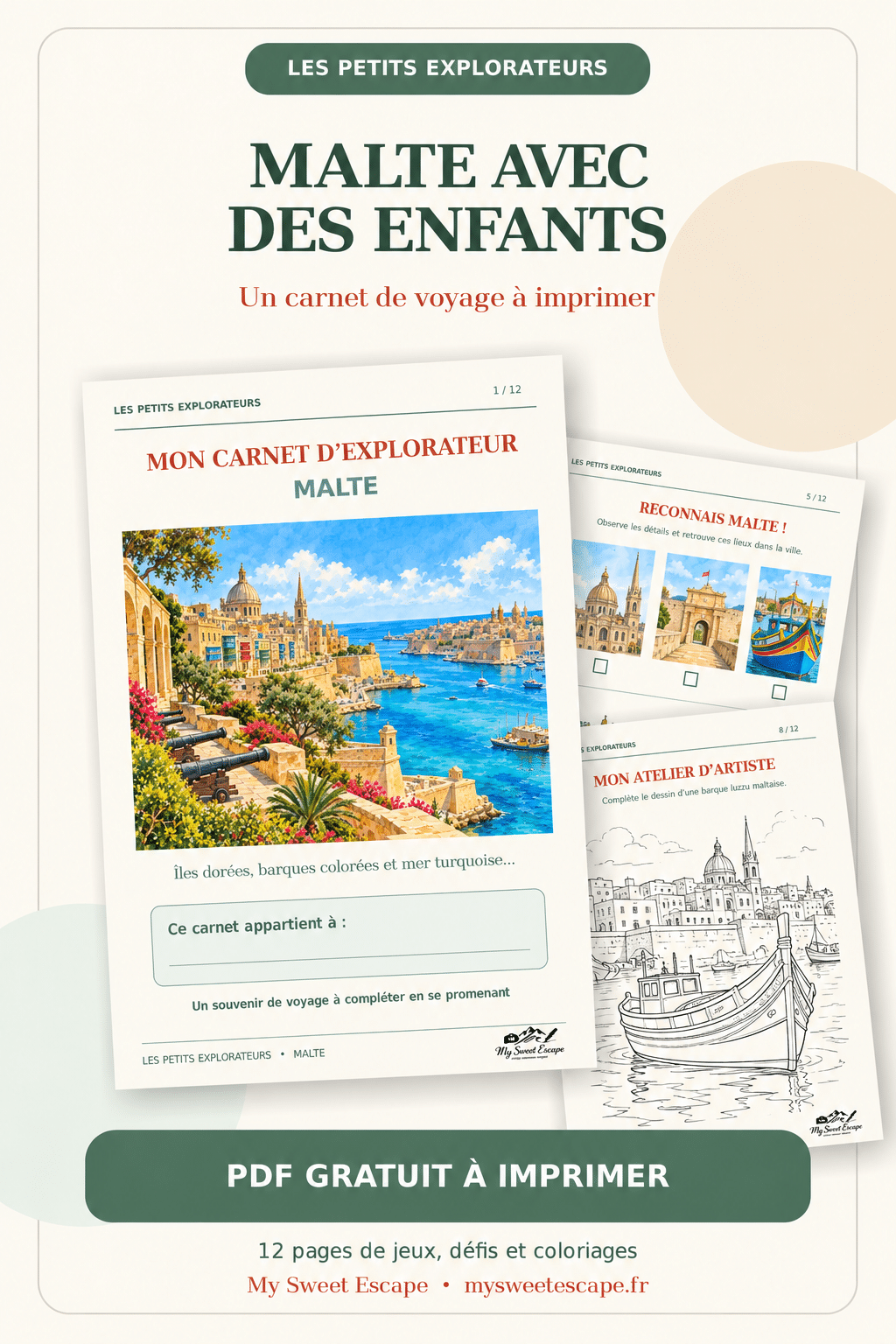
To discover Malta as a family, I created a 12-page A5 printable notebook: watercolours to recognise, quizzes, word searches, a luzzu boat to colour in and little challenges to complete during the trip.
📖 Download the free Malta notebook (PDF, in French)
12 pages · A5 format · Games and colouring
Travelling to Malta: the essentials
- Ideal length: 5 to 7 days
- Capital: Valletta
- Getting there: Direct flights from many European cities.
- Getting around: Bus, hire car or boat trips.
- Don’t miss: Valletta, Mdina, Gozo, Comino, the Blue Lagoon and the Dingli Cliffs.
- Best time to go: April to June and September to November.
- Ideal for: a first trip to the Mediterranean, a cultural break or a road trip.
- My tip: spend at least a day on Gozo – it’s one of my biggest favourites.
Things to do in Malta at a glance
| Place | Time | Budget | Don’t miss |
|---|---|---|---|
| Valletta | 1 day | Free | The Upper Barrakka Gardens, the streets and the waterfront. |
| Mdina | ½ day | Free | The medieval city and its ramparts. |
| Gozo | 1 day | Ferry | Victoria, the cliffs and the wild scenery. |
| Blue Lagoon | ½ day | Boat trip | The extraordinary turquoise water. |
| Dingli Cliffs | 2 hrs | Free | The sunset. |
| Marsaxlokk | 2 hrs | Free | The harbour and the colourful luzzu boats. |
🗺️ Suggested 7-day Malta itinerary
In my view, a week is the ideal length to see Malta’s main highlights without rushing. This itinerary combines historic towns, natural scenery, beaches and a day on each of Gozo and Comino.
Day 1 – Discover Valletta
Start your stay in the Maltese capital. Wander its honey-coloured streets, admire the traditional balconies, visit St John’s Co-Cathedral and enjoy the view from the Upper Barrakka Gardens. End the day on the waterfront or around the Grand Harbour.
Day 2 – Explore the Three Cities
Cross the harbour by boat to discover Vittoriosa, Senglea and Cospicua. These former fortified cities have a calmer atmosphere than Valletta, pretty streets and superb views over the harbour.
Day 3 – Visit Mdina, Rabat and the Dingli Cliffs
Spend the morning in Mdina, the former capital nicknamed the “Silent City”, then continue to Rabat. At the end of the day, head to the Dingli Cliffs to admire the coastal scenery and, weather permitting, the sunset.
Day 4 – Spend a day on Gozo
Take the ferry to Gozo and discover Victoria and its citadel, the island’s villages, its coves and its wilder scenery. A day gives you a good overview, but a night there offers a more peaceful and authentic experience.
Day 5 – Discover Comino and the Blue Lagoon
Set off early to enjoy the turquoise waters of the Blue Lagoon before the main tour boats arrive. You can also walk Comino’s trails and discover quieter coves around the island.
Day 6 – Marsaxlokk and the south of Malta
Stroll around the harbour at Marsaxlokk, famous for its colourful boats, then continue to St Peter’s Pool or the coastal sites in the south of the island. If you like, you can also visit the Ħaġar Qim and Mnajdra temples.
Day 7 – Enjoy the northern beaches
End your stay with a more relaxed day at Għajn Tuffieħa, Golden Bay or Paradise Bay. These beaches let you enjoy the Mediterranean one last time before you leave.
💡 To adapt: with five days, I’d drop the Three Cities day and combine Marsaxlokk with a beach or a site in the south. With ten days, I’d spend at least one night on Gozo.
Where to stay in Malta
Your choice of accommodation mainly depends on how you like to travel. For a first visit, I generally recommend staying in Valletta, Sliema or St Julian’s. These towns are well served by buses and make it easy to explore the whole island.
If you’re looking for somewhere quieter, Mellieħa is an excellent option, especially for the northern beaches. And for a more authentic atmosphere, I recommend spending at least one night on Gozo, a wilder island that truly stole my heart.
How many days do you need in Malta?
Three days let you see the main highlights, such as Valletta, Mdina and Marsaxlokk.
With 5 days, you can add Gozo or Comino without rushing.
To make the most of the archipelago, I recommend a week. You’ll have time to visit the historic sites, do several coastal walks, discover the most beautiful coves and spend a whole day on Gozo.
When to go to Malta
Malta enjoys a particularly pleasant Mediterranean climate.
The months of April to June and September and October are, in my view, the most pleasant: mild temperatures, long days and fewer crowds than in high summer.
I’ve also been to Malta in winter. Temperatures stay mild, the light is superb and the sites are much less busy, even if swimming is only for the brave.
🏖️ Where to swim in Malta: my favourite beaches and coves
Even though Malta is best known for its historic heritage, the archipelago also has magnificent coves and a few lovely beaches. Here are the ones I recommend if you want to mix cultural visits with swimming.
- 💙 Blue Lagoon (Comino): Malta’s most famous spot, with incredible turquoise water. Go early in the morning or late in the afternoon to avoid the crowds.
- 🌊 Għajn Tuffieħa: a superb beach lined with cliffs, ideal for watching the sunset.
- 🏖️ Golden Bay: one of the island’s most beautiful sandy beaches, perfect for a relaxing day.
- 🐠 St Peter’s Pool: a natural pool loved for its crystal-clear water and by cliff-jumpers.
- 🌅 Paradise Bay: a small cove with clear water in the north of Malta, with a lovely view of Gozo.
If you’re visiting Malta in summer, get to the most popular spots early, especially the Blue Lagoon, to enjoy them before the tour boats arrive.
Good to know: access to the Blue Lagoon is now managed with a time-slot booking system to limit visitor numbers. Check the current arrangements before your trip to Comino.
Things to do in Malta: my 15 favourites🤍
1) Visit the Blue Grotto
The Blue Grotto, or Grotta Blu, is a set of sea caves carved by the waves, at Żurrieq, on Malta’s south coast.
On the edge of the cliffs, where the waves crash and leave a fine spray of foam behind them, an enchanting picture unfolds. The water turns an almost supernatural turquoise when the sun shines into the caves, and the reflections change with the time of day and the light.
Every visit combines sea, light and tranquillity… Perfect for feeling the island’s Mediterranean soul!
It’s one of Malta’s most iconic natural sites, ideal for lovers of spectacular seascapes or for diving. Various boat trips from Wied iz-Żurrieq let you explore the caves from another angle.
The colours of the place have stayed with me since my first visit 15 years ago!

2) Wander the streets of Mdina at golden hour
Mdina, the Silent City, sits high in the centre of the island and keeps a timeless atmosphere. I’d discovered it 15 years ago and loved wandering this peaceful maze, where every cobblestone, every old door and every courtyard breathes history, from the Knights of St John to today’s residents.
This year, I went back by chance at sunset and was captivated by the town’s face, as if lit from within. At golden hour, its narrow streets and baroque façades are bathed in golden light, bringing out every detail and making for a walk with an almost magical aura.
Mdina remains one of the unmissable historic sites to visit in Malta, where time seems to slow down at every corner.

3) Be blown away by the Dingli Cliffs
A few minutes by bus from Mdina and Rabat, and 250 metres above the sea, the Dingli Cliffs, Malta’s highest cliffs, offer a dizzying view over the Mediterranean.
The surprisingly strong wind and the vast horizon, punctuated by the picturesque Chapel of St Mary Magdalene, make for a striking sight. It’s one of the best viewpoints for admiring the Maltese coast and really feeling the power of the island’s natural landscapes. The colours are said to be incredible at sunset, with a breathtaking panorama.
That day, as time was getting on, I chose to end my day in Mdina, which I wouldn’t otherwise have had time to visit before flying home. So I’m counting on you to see Malta’s heights at sunset and let me know how it was!

4) Discover the emerald waters of Comino and the Blue Lagoon
Comino, a small island between Malta and Gozo, is famous for the Blue Lagoon and its incredibly clear emerald water. The first time I visited Malta, I chose Gozo instead, a bit sceptical and afraid I’d be disappointed by the site’s overhyped summer reputation.

This year, my visit was completely different. For the curious or those looking for a bit of peace, the island has hidden paths that take you away from the crowds of the Blue Lagoon.
Exploring Comino on foot is a real surprise: every cove and every viewpoint invites you to stop and take it all in. A swim would have been tempting – the October sun was still warming the water… But I’d forgotten my swimsuit…
As a consolation prize, I gave in to the classic pineapple juice served… in a pineapple! Definitely a bit touristy, but so refreshing and photogenic that I didn’t regret it.

5) Explore the picturesque fishing village of Marsaxlokk
Marsaxlokk was my first stop on the island, and as soon as you reach the harbour, you feel immersed in the heart of Malta. This fishing village with its timeless charm is famous for its colourful boats, the luzzi, and its Sunday fish market.
The stalls overflow with fresh fish, shellfish and seafood, while fishermen and souvenir sellers haggle with a smile.
Every corner of the harbour is photogenic, between the bright colours of the boats and the reflections on the water, and local life blends with the beauty of the coastal scenery.
It’s also the ideal starting point for a walk to St Peter’s Pool , which I tell you about below.
A perfect place to stroll and soak up the Maltese atmosphere – but watch out for pickpockets, as the crowds sometimes attract opportunists.

6) Walk from Marsaxlokk to St Peter’s Pool and Delimara
At the tip of Delimara lies the beautiful natural pool of St Peter’s, a very popular swimming spot with locals and tourists alike… when the sea is calm, at least. The waves can quickly make swimming dangerous.
Despite its slightly remote location, don’t imagine an isolated, wild spot: in October there were still plenty of swimmers, and I dread to think how busy it gets in high summer!
Even so, the site is sublime and gives access to the Delimara rock formations, which visitors completely ignore but which are absolutely fascinating. A well-marked path lets you walk there from Marsaxlokk in about thirty minutes, perfect for combining a hike with nature.
On the way back, I tried to make it a loop and, carried along by my feet, stumbled upon an incredible viewpoint (spotted on Google Maps) over Il-Ħofra ż-Żgħira bay, a semicircular bay nestled beneath lunar-looking cliffs. What an incredible surprise for my first afternoon: I couldn’t have dreamt of a more idyllic start to my stay.

7) Take an English course at MaltaLingua English School
This experience was one of the most rewarding of my year 2025, and I talk about it in much more detail here: My language stay in Malta with MaltaLingua
Learning English in Malta, where it’s one of the two official languages, has a special charm: the setting is lovely, the MaltaLingua school is high-quality and run by a team of motivated teachers, and the island itself offers the perfect mix of relaxation and discovery. Between lessons, you can stroll along the beaches, explore picturesque villages or simply follow the 14 other things to do in Malta in this article. 😉
An adventure that combines learning and fun, and left me with memories as rich as my new language skills!

8) Watch the sunset from Valletta’s ramparts
Valletta, Malta’s capital, is a baroque gem perched between the sea and its fortifications. Strolling its narrow streets lined with colourful wooden balconies, getting lost in its hanging gardens and little squares means diving into the history of the Knights of St John.
A little detail I love: here and there, red telephone boxes recall the island’s British past. I’d loved Valletta on my first visit, and I wanted to add a touch of magic to the second.
So, like me, head to the Upper Barrakka Gardens at the end of the day.
The sky turns pink, orange and gold, spreading a golden cloak over the Three Cities and a sprinkling of glitter over the calm sea, while the silhouettes of the buildings stand out against the fiery horizon, giving even more depth to this living watercolour. These sweet moments will stay with me for a long time…
After dark, I left my perch for a moment to buy a few snacks. Arancini in hand, I settled back down to gaze at the twinkling Three Cities and the boats in the harbour and listen to the calm of the city at dusk. That’s the charm of travelling solo: every moment becomes precious.
Between photos, views, exceptional sunsets and historic walks, I love Valletta so much!

9) Hike from beach to beach from Golden Bay to Għajn Tuffieħa, Malta’s most beautiful coastline
I discovered this walk by chance. Getting off the bus at Golden Bay, I headed towards Għajn Tuffieħa, a name meaning “the eye, or spring, of the apple” in Maltese. Indeed, Għajn Tuffieħa seems to gaze over the bay, like an eye open to the sea, a source of serenity, beauty and light.
The path follows wind-sculpted cliffs. Golden beaches and almost secret coves reveal themselves as you walk. I wasn’t ready, and I was blown away, especially as I headed towards Qarraba Bay: the clay slopes gently down to the sea and the light clings to it as if in a dream. Everything seems suspended, silent, frozen – a moment out of time. Despite struggling to get out of bed that morning, this little solo hike was an incredible breath of fresh air, a total immersion in Malta’s wild, unspoilt nature.

10) Enjoy the nightlife and party in Sliema
Sliema and St Julian’s are the heart of Malta’s nightlife. Lively bars, Irish pubs, modern clubs and seafront terraces create a unique atmosphere where the city’s energy mingles with the lights reflected on the water.
I loved strolling there on several evenings, blending into the cosmopolitan, festive atmosphere without ever feeling unsafe.
And to round off my stay, my last evening was memorable: we partied with my classmates, adding our own spark to the vibrant nightlife.
Between music, laughter and a friendly atmosphere, Sliema and St Julian’s show a livelier side of Malta than you might imagine.

11) Taste Maltese food: traditional dishes and local specialities
Maltese food is a real journey for the senses, at the crossroads of Mediterranean, Italian and British influences! Restaurants and cafés reflect this richness: you can enjoy traditional dishes while being surprised by international touches, the result of a cosmopolitan past.
For a quick bite, there’s no shortage of options: sandwiches, snacks and local street food let you eat quickly between visits. That’s what I usually went for on my day trips.
But Malta also has authentic specialities not to be missed, such as stuffat tal-fenek, a rabbit stew slow-cooked with local herbs and a true symbol of the island. Fish dishes are also plentiful!
12) Spend a day on Gozo, Malta’s sister island
For me, Gozo is an island apart in the Maltese archipelago: more authentic and rural than the main island. On my first visit, I spent a whirlwind day there, arriving at 11am, and I still have vivid memories of it: the ferry crossing from Malta, the sea air on my face and the feeling of entering a slower, almost frozen world… or the sense of space, rolling countryside, golden stone villages and sandy beaches bathed in light.
We took the bus to Victoria, the island’s quiet capital, dominated by its medieval citadel, perched on a hill with a panoramic view over the surrounding countryside. That day, I felt that Gozo had preserved a part of its tradition and authenticity that I dreamt of finding again on my second trip.
However, between my English lessons, Valletta, the beaches and all my other planned visits, I sadly didn’t have time to go back. But I still dream of returning to explore Gozo by scooter this time, to ride its winding roads, stop wherever I like and enjoy the island at my own pace, free from the constraints of buses and their fixed routes.

13) Explore the Ħaġar Qim and Mnajdra temples
The islands of Malta and Gozo are home to seven megalithic temples, including those of Ħaġar Qim and Mnajdra, among the oldest temples in the world and listed as UNESCO World Heritage Sites. Discovered in the 19th century, these sites impress with the massive size of their stones and the ingenuity of their architecture.
From ancient plans carved into the rock, it has been deduced that these temples were more than three times their current height – fascinating evidence of the architectural skills of Malta’s inhabitants several thousand years ago.
Walking among these massive stones, imagining the ancient ceremonies and rituals, feeling the weight of history is a real journey back in time.
These temples are a must for anyone wanting to delve into Malta’s prehistoric past and admire a heritage that’s unique in the world.
-> I wrote about them here (in French), but the article is very, very old!

14) Get lost in the Three Cities (Vittoriosa, Senglea, Cospicua)
My biggest regret in Malta! Two trips, and I’ve never had time to get lost in the Three Cities lining the Grand Harbour. So far I’ve had to make do with admiring them from the heights of Valletta, where the rooftops, fortifications and quays give a taste of their timeless charm.
Vittoriosa, Senglea and Cospicua are said to form a real maze of cobbled streets, little squares and fortifications where you can sense the island’s historic soul: that of knights, sailors and merchants.
I dream of one day getting lost in these streets, admiring the time-worn façades and discovering the beauty of their architecture.
The Three Cities remain a promise to keep. ^^
15) Stroll around Ta’ Qali Crafts Village
Ta’ Qali is the heart of traditional Maltese craftsmanship, a village where artisans still work glass, wood, lace and leather using techniques passed down from generation to generation… A living heritage, where every gesture tells a story and a skill!
I visited a glassworks and watched the different stages of making these delicate objects, fascinated to see how, from a simple glowing ball, the glassblowers managed to create precise shapes and give them bright, flattering colours…

FAQ: planning your trip to Malta
How many days do you need to visit Malta?
I recommend at least five days to see the main highlights. A week is ideal to add Gozo, Comino and a few beaches without rushing.
What is the best time to go to Malta?
April to June and September and October offer, in my view, the best balance between pleasant weather, warm enough sea and reasonable crowds.
Should I hire a car in Malta?
A car makes it easy to explore the whole island, but you can also visit Malta using the bus network and organised trips. Be aware, though: they drive on the left.
Where should I stay in Malta?
For a first trip, I recommend staying in Valletta, Sliema or St Julian’s. If you’re looking for somewhere quieter, Mellieħa or Gozo are excellent alternatives.
What budget should I plan for a trip to Malta?
Malta is still more affordable than many other Mediterranean islands. Your budget will mainly depend on the season, the type of accommodation and the number of trips you plan.
Can you visit Malta without a car?
Yes. The main towns and most tourist sites are served by buses. Ferries also make it easy to get to Gozo and Comino.
What is the most beautiful place in Malta?
If I had to choose just one, I’d say Gozo. This wilder island has magnificent scenery, authentic villages and a much more peaceful atmosphere than the main island.
I hope these tips will be useful for your visit 🙂


