
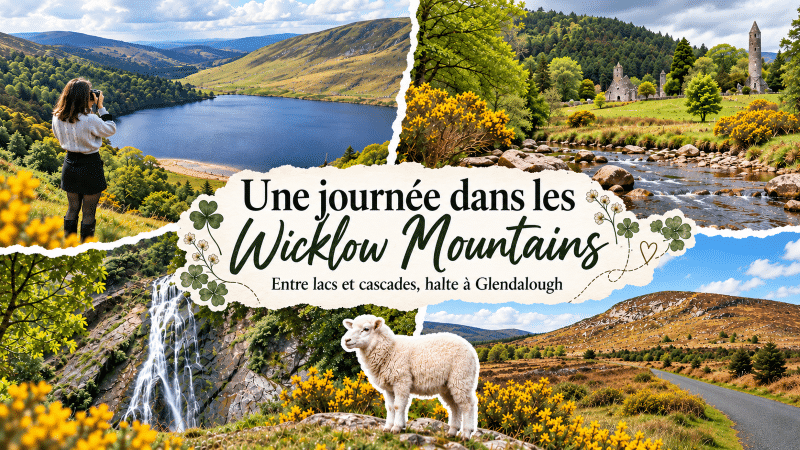
More than ten years after my first visit to the Wicklow Mountains, I really wanted to see these Irish landscapes again, as they’d made such an impression on me at the time. On that first trip, I travelled all over the country, from Connemara to the Ring of Kerry via the Cliffs of Moher, but actually saw very little of this region right on Dublin’s doorstep.
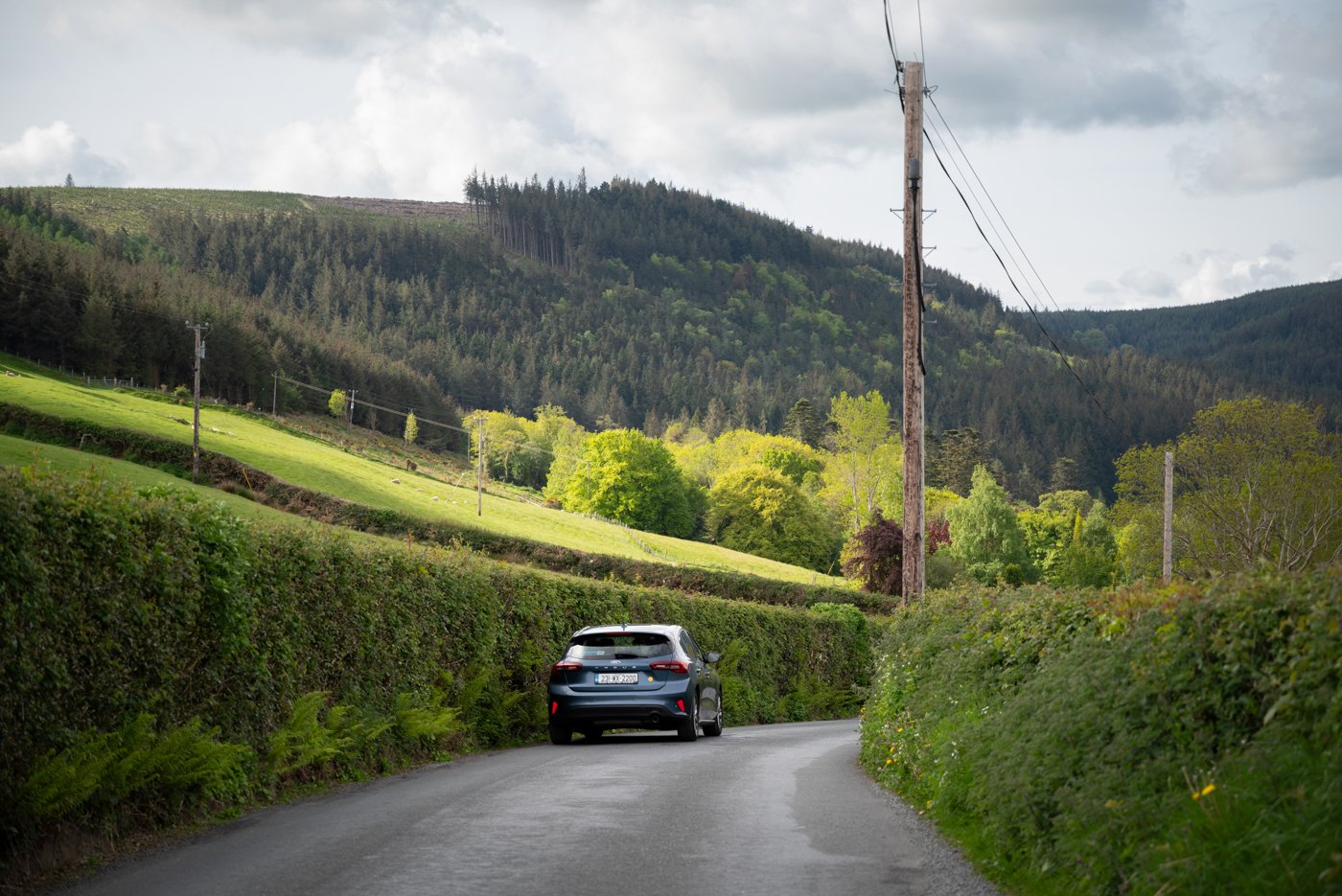
This time, being so close to the capital worked out nicely. Our plane landed at around 9 am, so we picked up our hire car at the airport and set off without even going into Dublin. A few dozen minutes later, we were already back in the Ireland I love so much: narrow roads, rolling hills, and sheep reduced to tiny white dots in a landscape broken up into an incredible palette of greens, greys and blues, shifting into a thousand shades with the light.
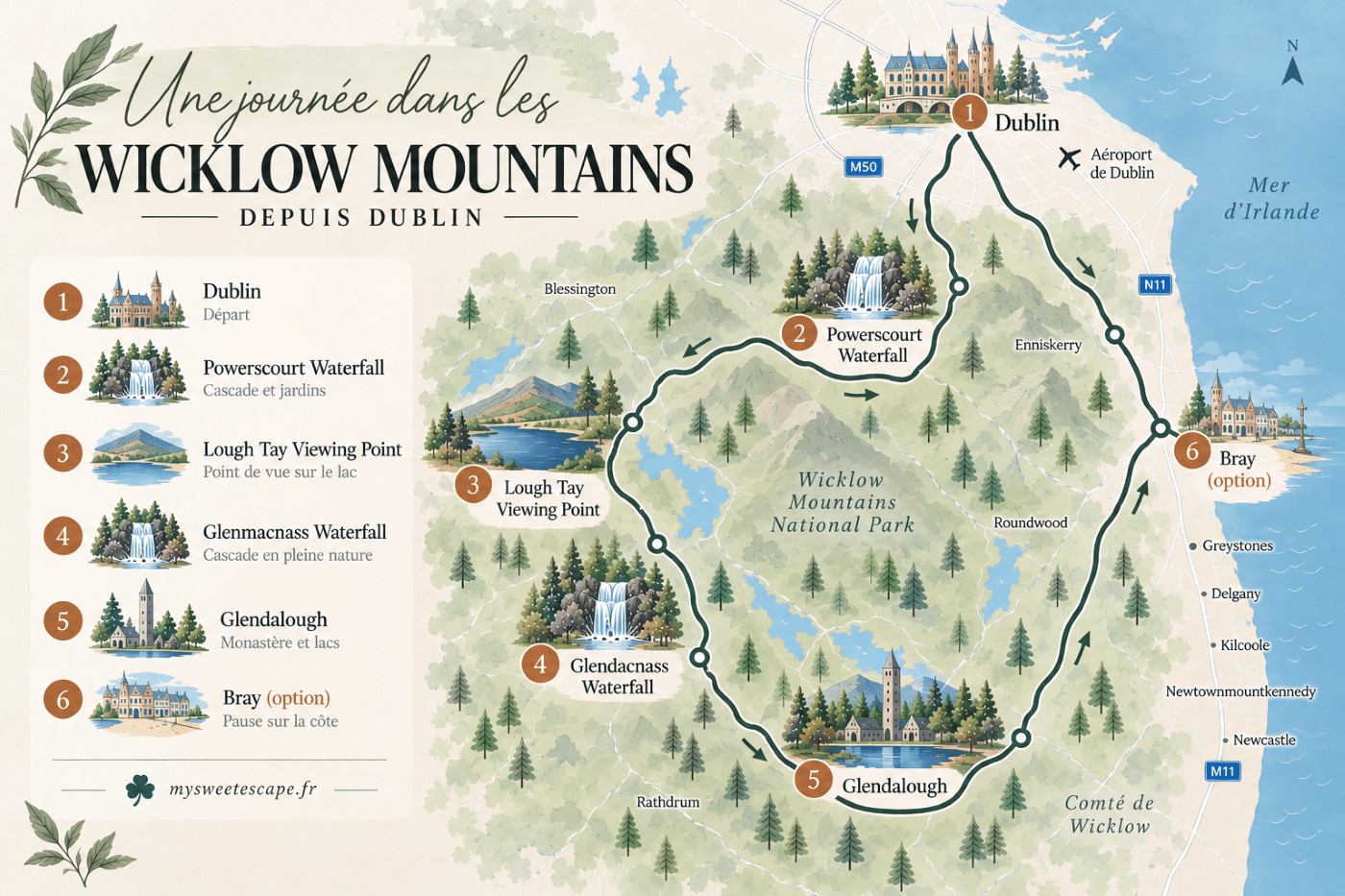
We had a whole day ahead of us to explore the Wicklow Mountains from Dublin, with Glendalough as the main stop and several stops along the way, planned or not: Powerscourt Waterfall, Lough Tay, the Military Road, Glenmacnass… before a final detour to Bray.
So today I’m sharing our one-day itinerary in the Wicklow Mountains and all my tips for planning your own day trip from Dublin.
What to do in the Wicklow Mountains in one day? Here are the stops we chose: admire Powerscourt Waterfall, gaze at Lough Tay (Guinness Lake), drive the Military Road and the Sally Gap, stop at Glenmacnass Waterfall, then discover the monastic site and lakes of Glendalough. Our day ended in Bray, on the coast. I detail each of these visits below, along with our route linking them.
3 days in Dublin?
Find my Dublin weekend itinerary, with what to see, my favourite addresses and a day-by-day plan to make the most of the city.
Planning a day in the Wicklow Mountains: practical information
| The Wicklow Mountains at a glance | |
|---|---|
| ⏱ Time needed | 1 day from Dublin |
| Transport | A car is ideal for this itinerary |
| Route | Powerscourt Waterfall → Lough Tay → Military Road → Glendalough → Dublin (with a stop in Bray, why not). See the map below. |
| Walking | Easy if you stick to the walk between the monastic site and the two lakes |
| Highlight | Glendalough and its two lakes |
| 🌦 Weather | Very changeable: be ready for sun and rain on the same day ^^ |
| What to bring | Good shoes, especially if you want to hike above the lakes |
| When to go? | All year round; I think the colours must be especially beautiful in autumn |
Hire a car to discover the Wicklow Mountains
For this day, we chose to hire a car directly at Dublin Airport. As our plane landed at around 9 am, we were able to pick it up and head straight for the Wicklow Mountains, without even going into Dublin.
In my opinion, it’s the most practical way to follow this kind of itinerary: we could stop whenever we wanted and even change our plans at the last minute. As often on my trips, I booked our car through BSP Auto, a car hire comparison site.
Don’t want to drive in Ireland?
If you’d rather discover the Wicklow Mountains without hiring a car, several day trips depart from Dublin, especially to see Glendalough and the Wicklow landscapes.
One-day itinerary in the Wicklow Mountains
The stops on our loop from Dublin.
| Stop | Why stop there? | What to do there |
|---|---|---|
| Powerscourt Waterfall | A beautiful waterfall nestled in greenery, impressive when you reach its foot | Admire the waterfall • short walk around the site • enjoy the park |
| Lough Tay | One of the most iconic landscapes in Wicklow, with its very dark lake surrounded by hills | Stop at the viewpoint • photos • hikes nearby |
| Glenmacnass Waterfall | A waterfall in the wild, surrounded by much more rugged landscapes | Scenic stop • waterfall • walk in the area |
| Military Road / Sally Gap | For me, one of the most beautiful parts of the drive: wide open spaces, moorland and almost desert-like scenery | Scenic drive • lots of photo stops • hikes in the Wicklow Mountains |
| Glendalough | The highlight of the day: an ancient monastic settlement in a magnificent valley | Monastic site • round tower • graveyard • Lower Lake and Upper Lake |
| Glendalough – hikes | To discover more of the valley and get a view over the lakes from above | Easy walk between the lakes • several hiking trails • viewpoints from above |
| Bray – optional | A seaside stop that’s easy to add on the way back to Dublin | Seafront • promenade • Bray Head if you still have some energy and time |
Powerscourt Waterfall, an unplanned first stop
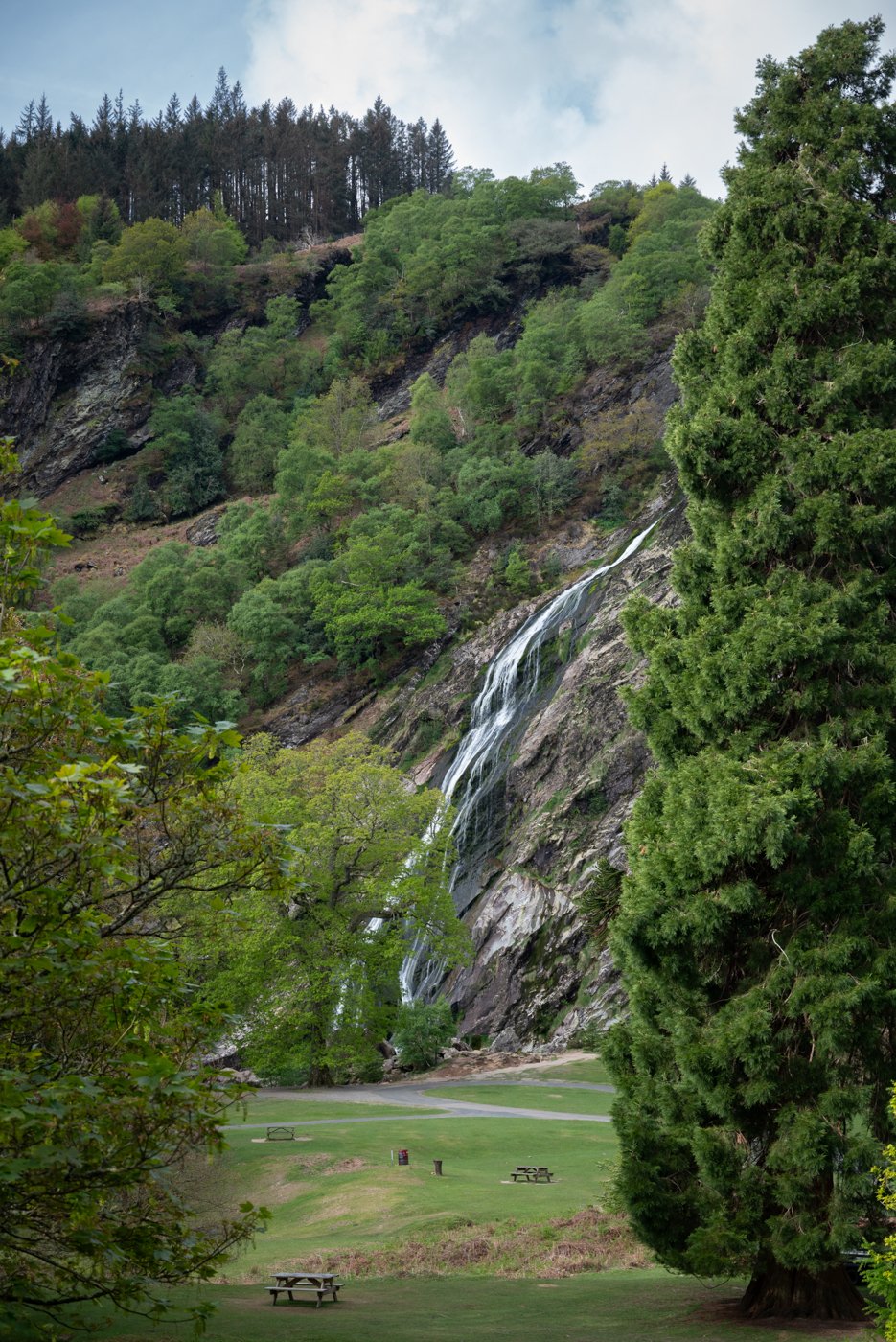
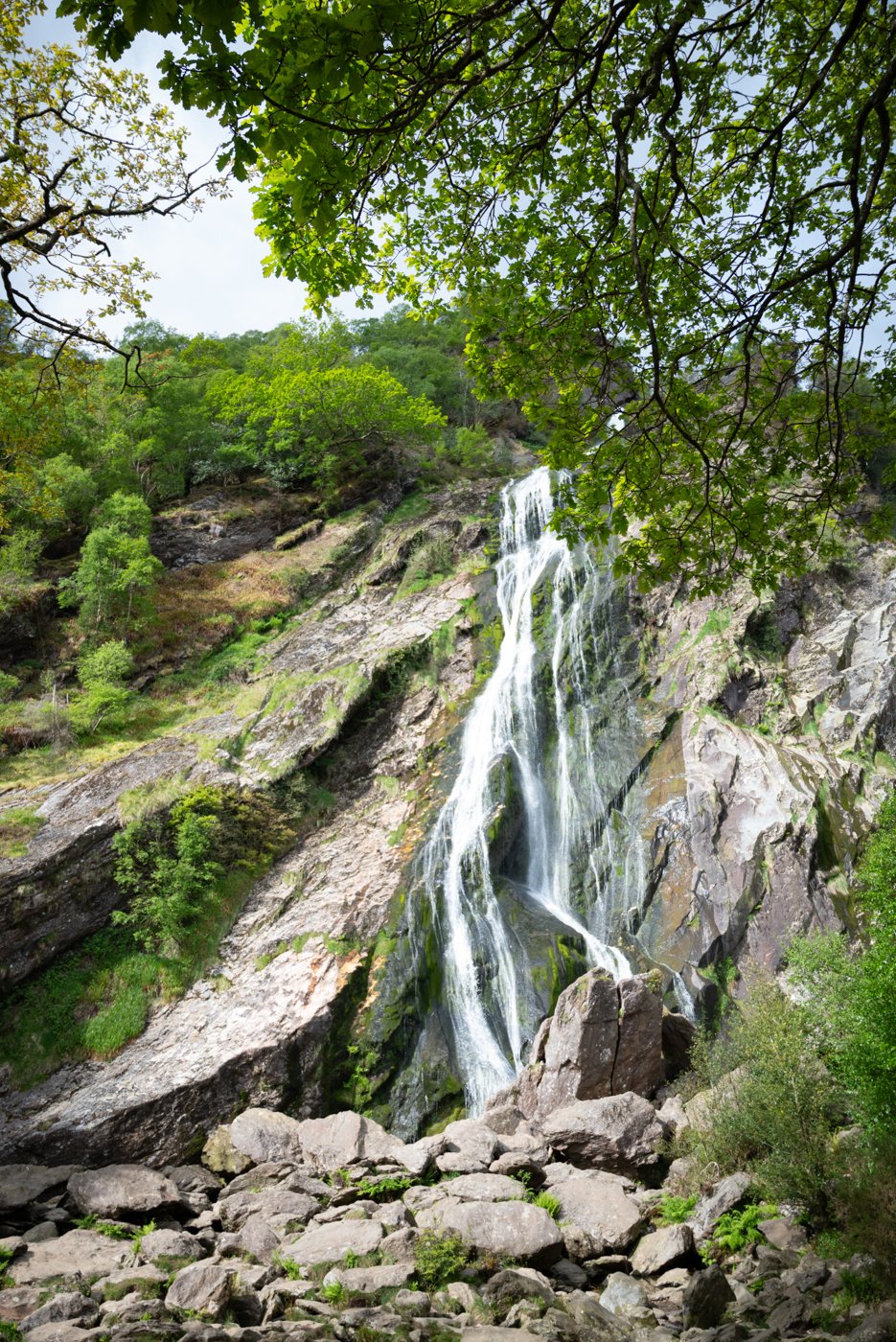
A first stop at the foot of one of the best-known waterfalls in Wicklow.
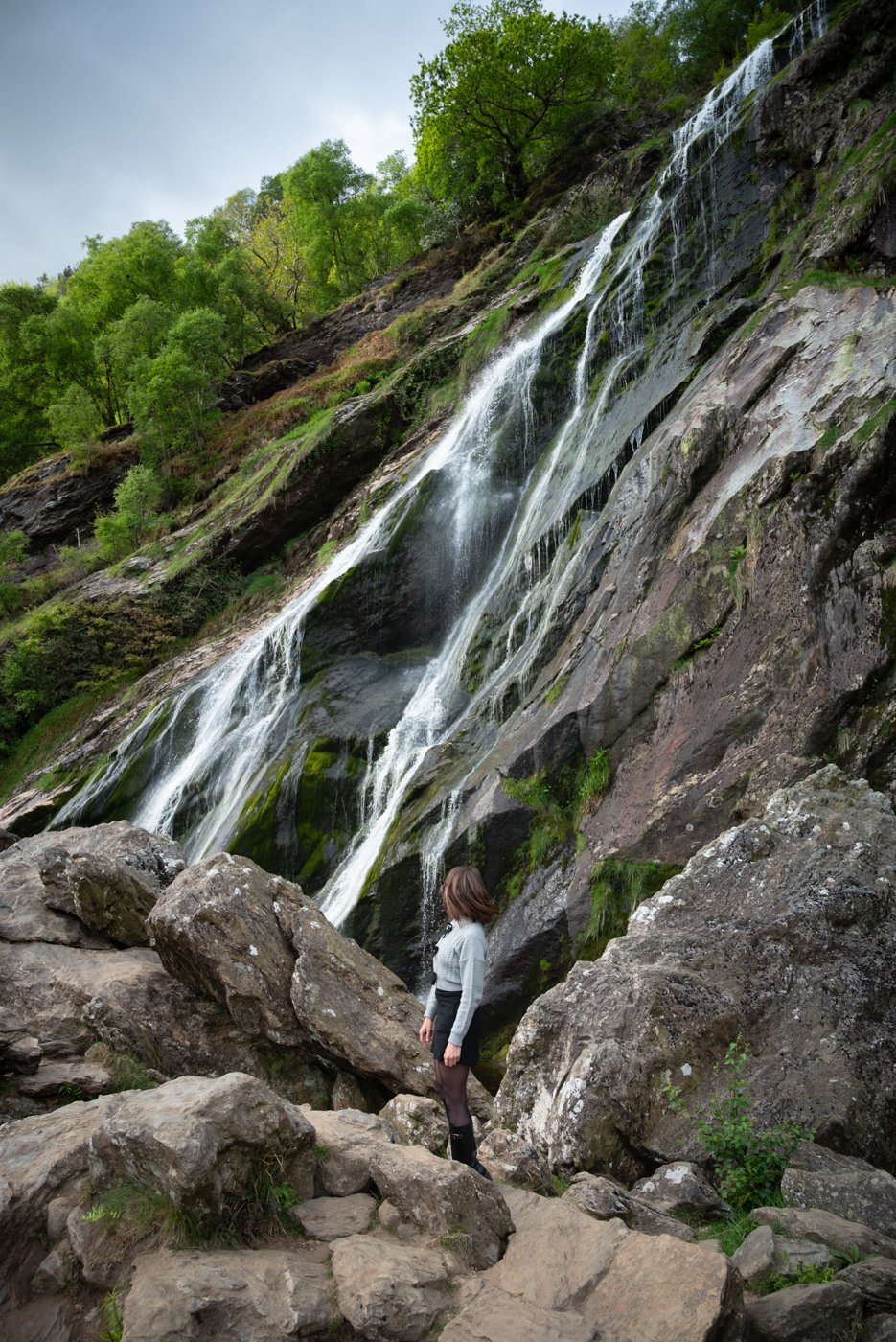
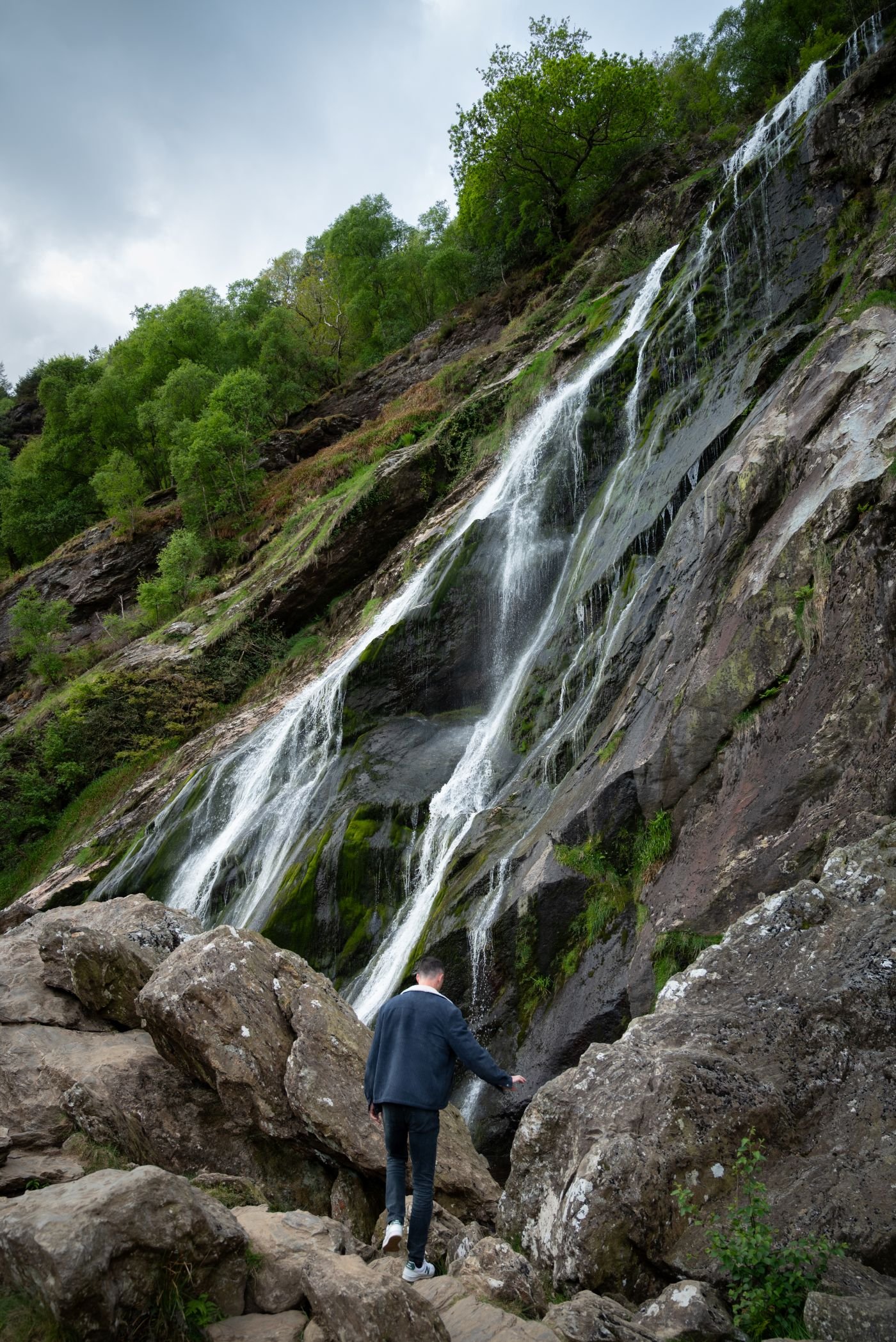 Powerscourt Waterfall wasn’t originally on our plan! As we headed towards the Wicklow Mountains, I spotted several signs for the waterfall by the roadside…. After a bit of quick research, we decided to make a short detour to see it.
And sometimes chance works out well, as Powerscourt Waterfall is simply the highest waterfall in Ireland! Here, the water tumbles down the mountain for 121 metres, in the middle of a large wooded park.
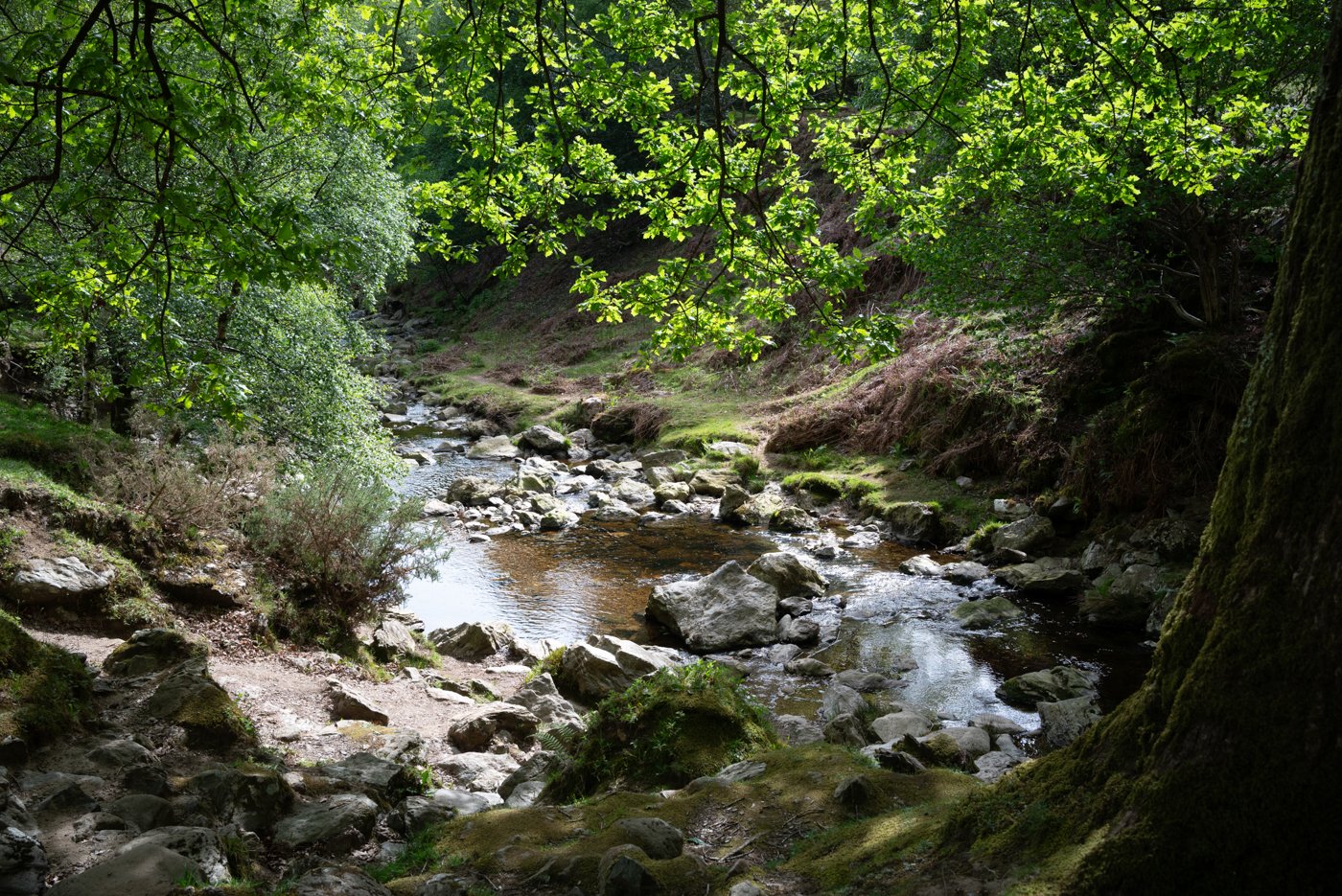
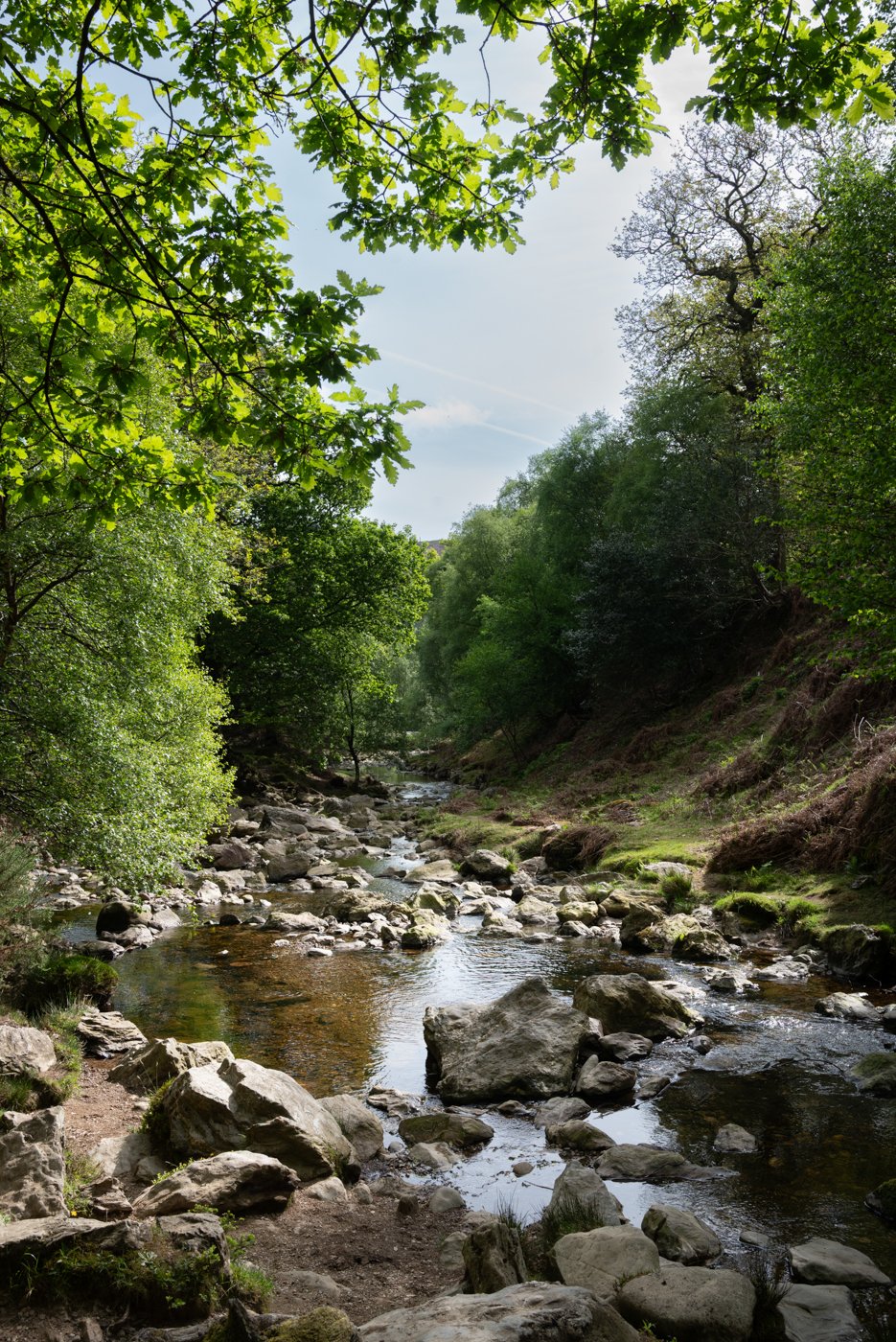
It must have been around 10 am when we arrived and, to my great surprise, there was literally nobody there. Absolutely nobody! We had the foot of the waterfall to ourselves and took our time admiring it from every angle.
There is, however, an entry fee: currently around €8 per adult. Parking is included and is close to the waterfall. There are several picnic tables on site, as well as toilets, a kiosk selling food and drinks and even a children’s playground.
Powerscourt Waterfall and the famous Powerscourt Gardens are two separate sites, about 6 km apart. We just visited the waterfall before setting off again towards Lough Tay.
Lough Tay (Guinness Lake), one of the most beautiful landscapes in the Wicklow Mountains
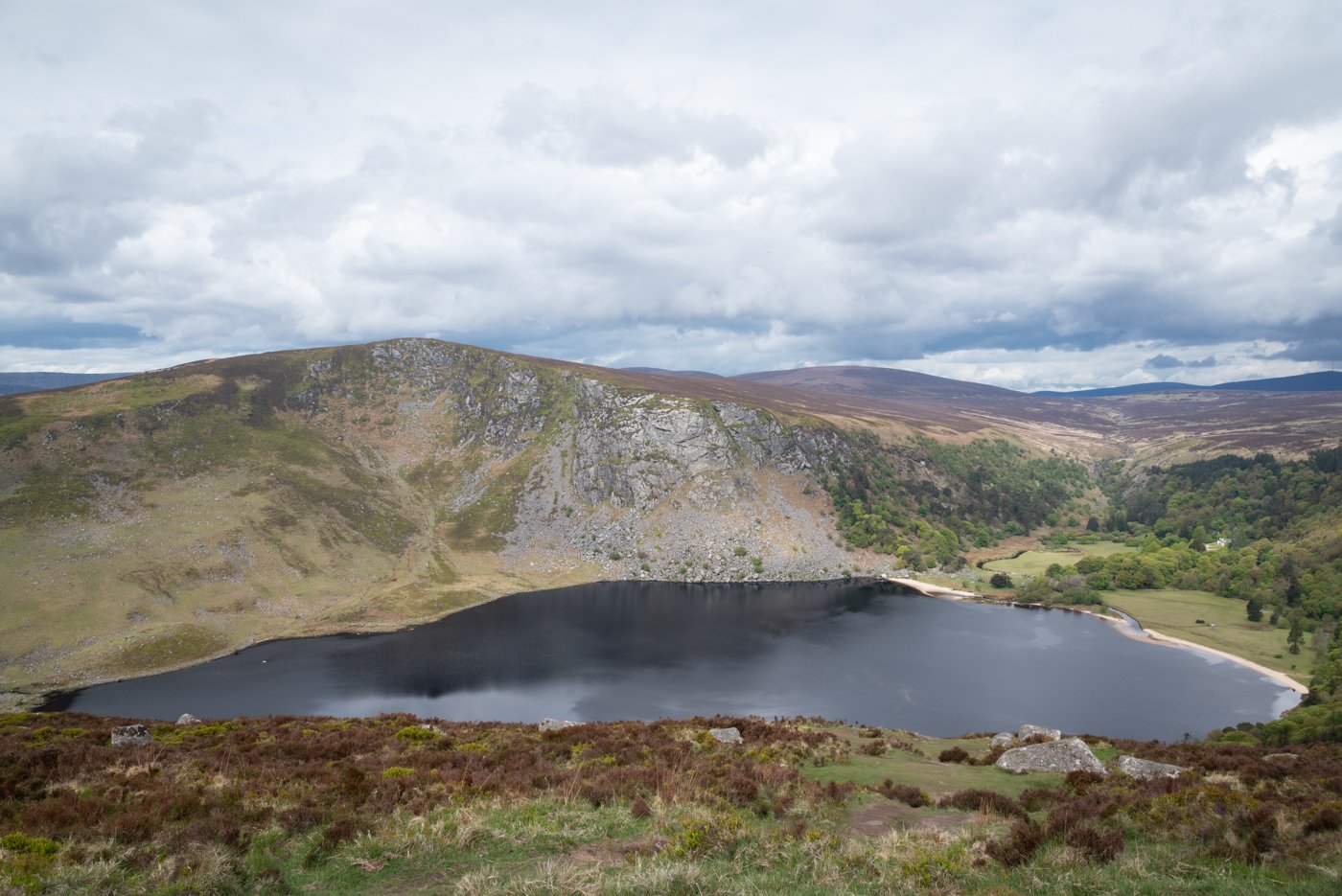
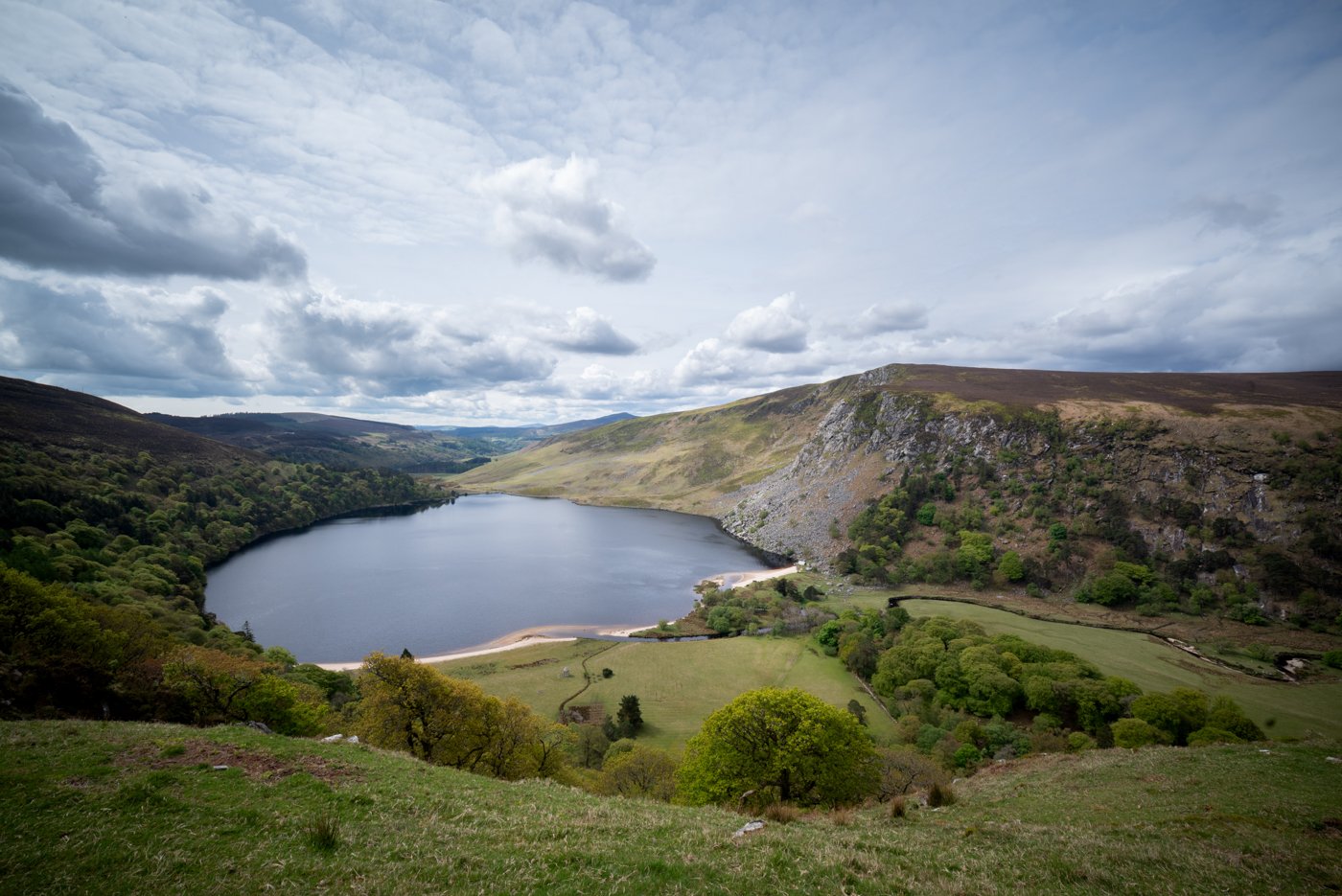
A dark lake surrounded by hills, among the most iconic landscapes in the Wicklow Mountains.
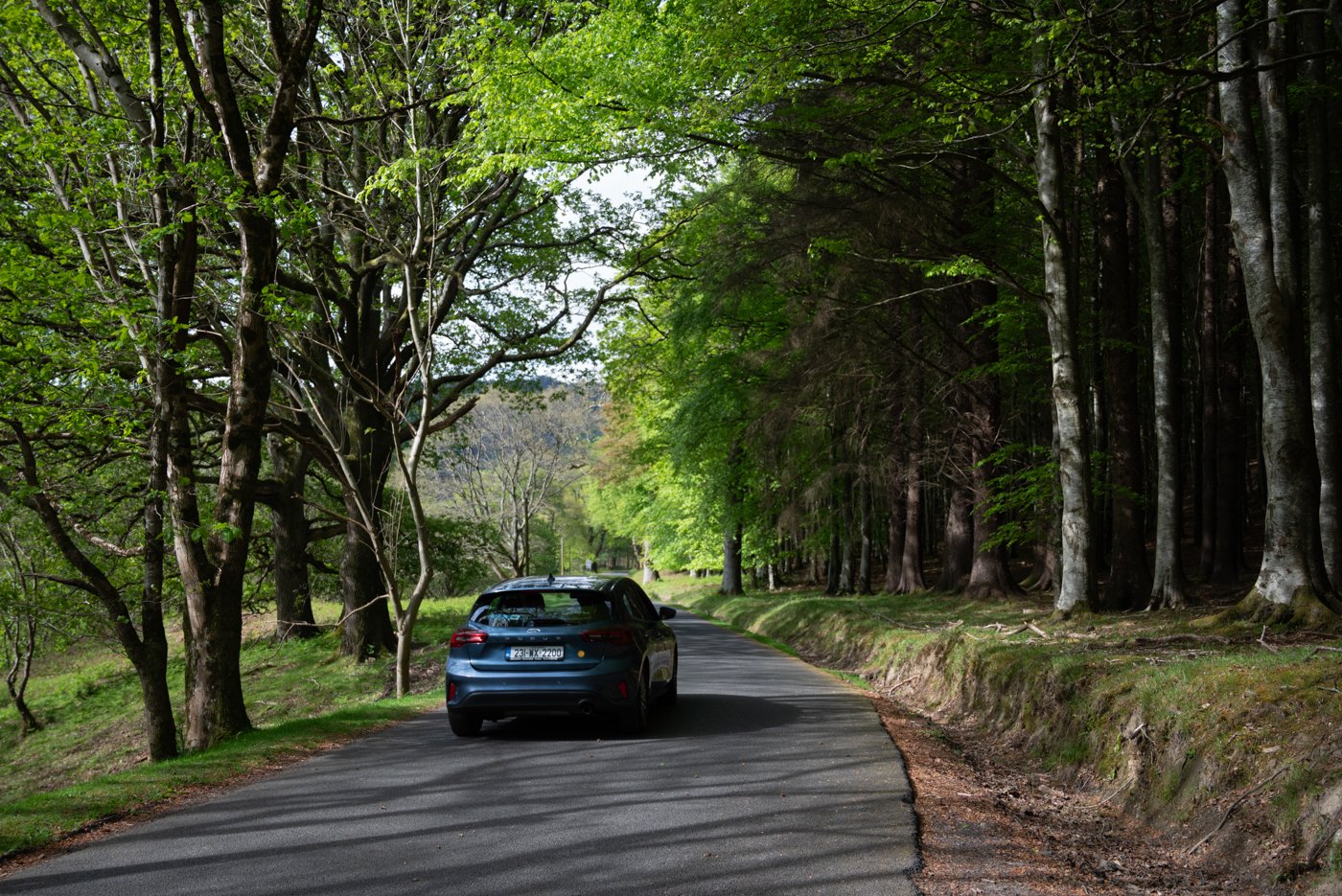
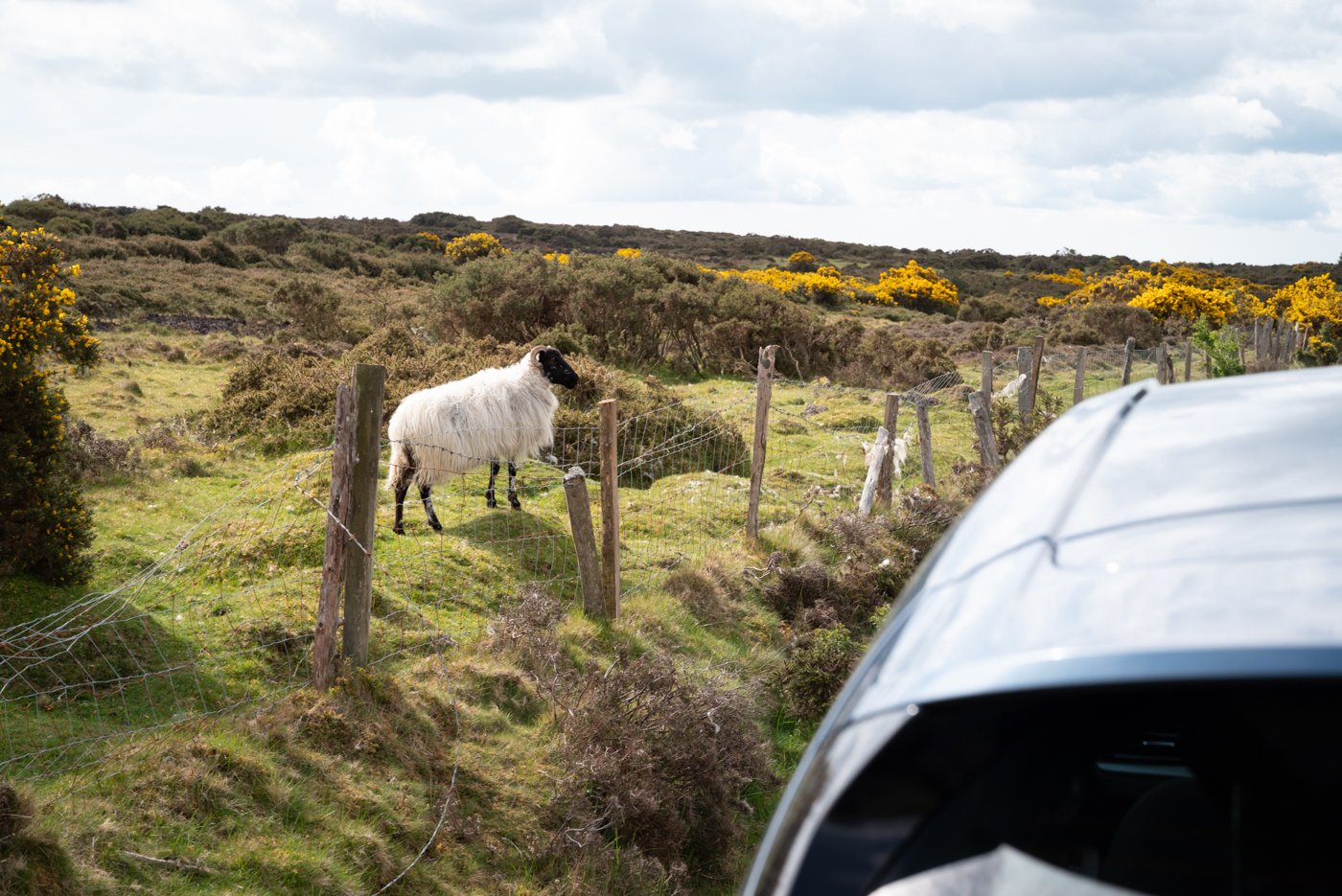
We then got back behind the wheel and headed for Lough Tay. The roads became narrower and the scenery wilder, with rolling hills and fields dotted with sheep in every shade of green. A real life-size impressionist painting, its colours and shadows seeming to dance with the sky.
Lough Tay was one of the places I absolutely wanted to see again. I’d discovered the lake on my previous trip to Ireland, twelve years earlier, and it had really stayed with me. So I was quite curious to see whether the magic would still work this time.
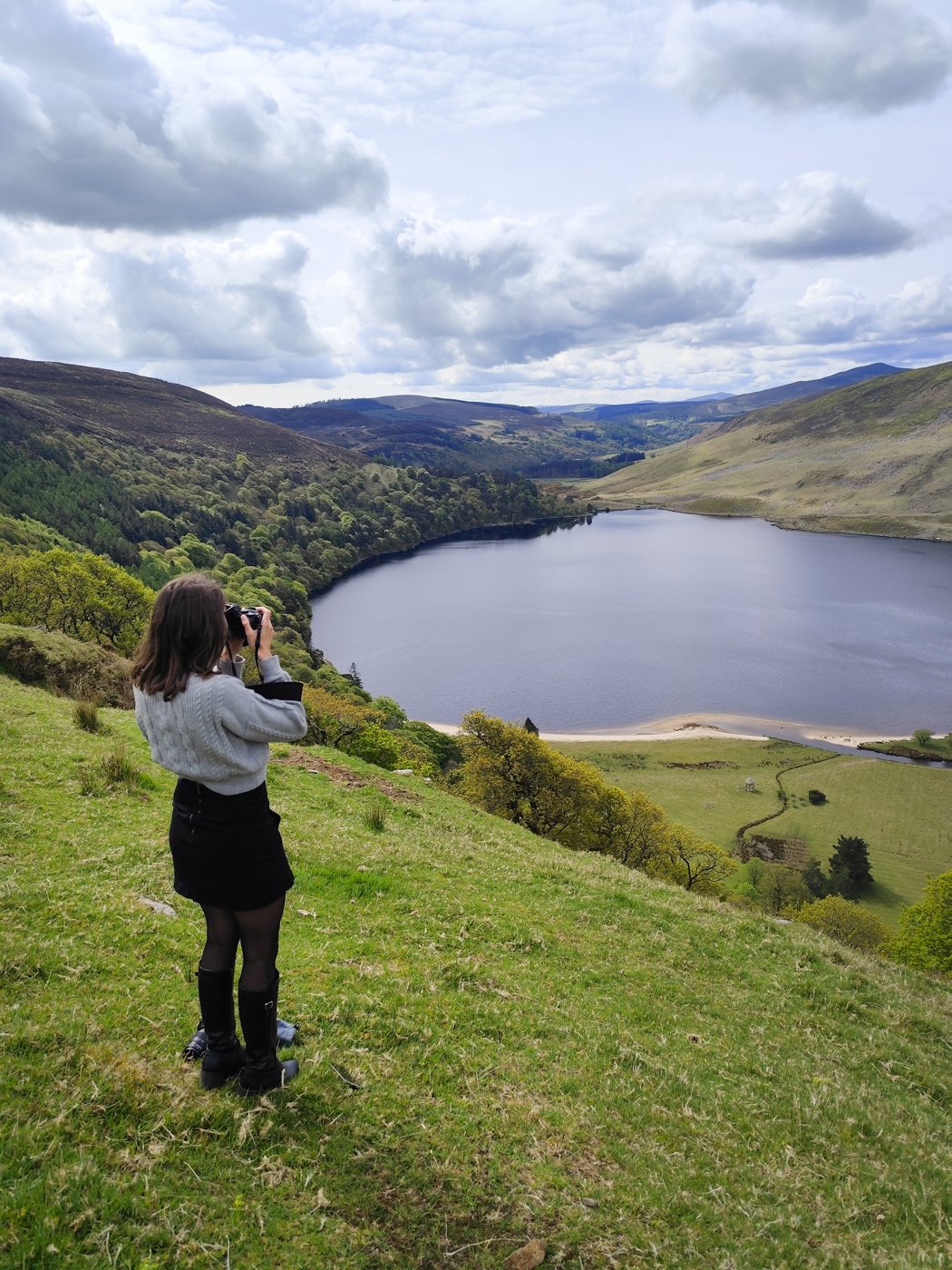
It did! With its very dark water surrounded by the hills of the Wicklow Mountains, Lough Tay is as beautiful as ever. We stopped at the viewpoint overlooking the lake to enjoy the view before continuing on our way.
Lough Tay: practical information
The lake, also nicknamed Guinness Lake because of its dark water and small white sandy beach, is mainly seen from the viewpoints high up along the road. The lake and its shores are on private land and aren’t open to the public.
To explore further on foot, several hikes cross the area, especially along the Wicklow Way and up Djouce Mountain. If you’re simply following our one-day itinerary, a stop at the viewpoint already gives you a lovely view over Lough Tay.
Driving the Military Road and Sally Gap in the Wicklow Mountains
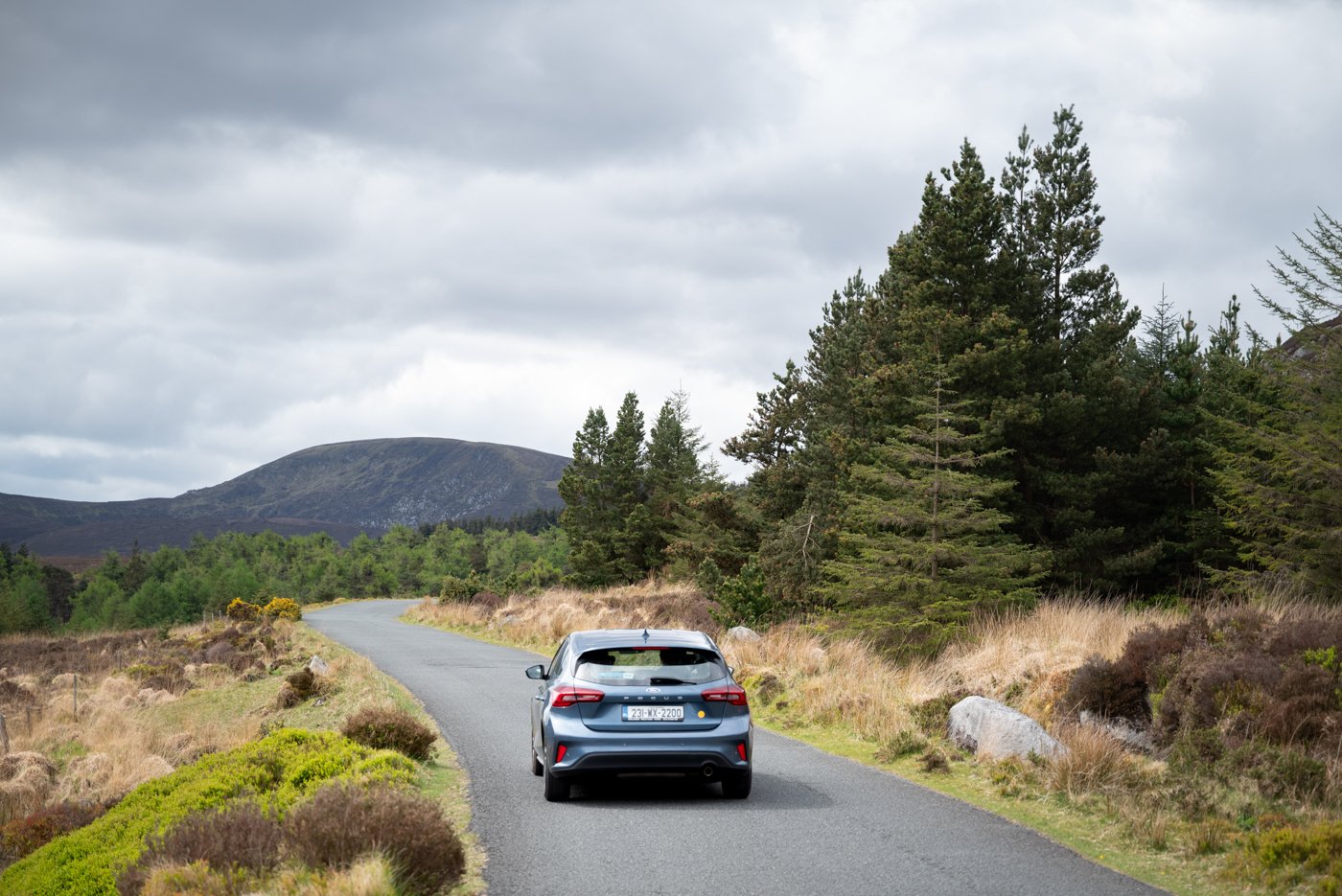
A road through the moorland and hills of the Wicklow Mountains.

A complete change of scene! We continued along the Military Road, which crosses some of the wildest landscapes in the Wicklow Mountains. Here, the vegetation thins out and the bright green fields gradually give way to vast stretches of moorland in browner, russet and ochre tones.
This may be one of my favourite stretches of road in the Wicklow Mountains. A wild, almost deserted, windswept land. That feeling, at times, of reaching the end of the world. Some very barren stretches even gave me a few Breaking Bad vibes, haha! A far cry from the image we instinctively have of Ireland…
The road passes through the Sally Gap, one of the main crossroads in the Wicklow Mountains, before continuing towards Glendalough. Here, you don’t necessarily need a specific sight to visit: the pleasure comes from the drive itself, the landscapes rolling by and the spontaneous stops at viewpoints.
Why is it called the Military Road?
Its name comes straight from its history. After the Irish Rebellion of 1798, several rebels took refuge in the Wicklow Mountains and continued to resist British forces. The terrain and isolation of the region made pursuing them particularly difficult.
To give the British army easier access to these mountains, a road was built from 1800, crossing Wicklow from north to south.
Glenmacnass Waterfall: one of Ireland’s most beautiful waterfalls
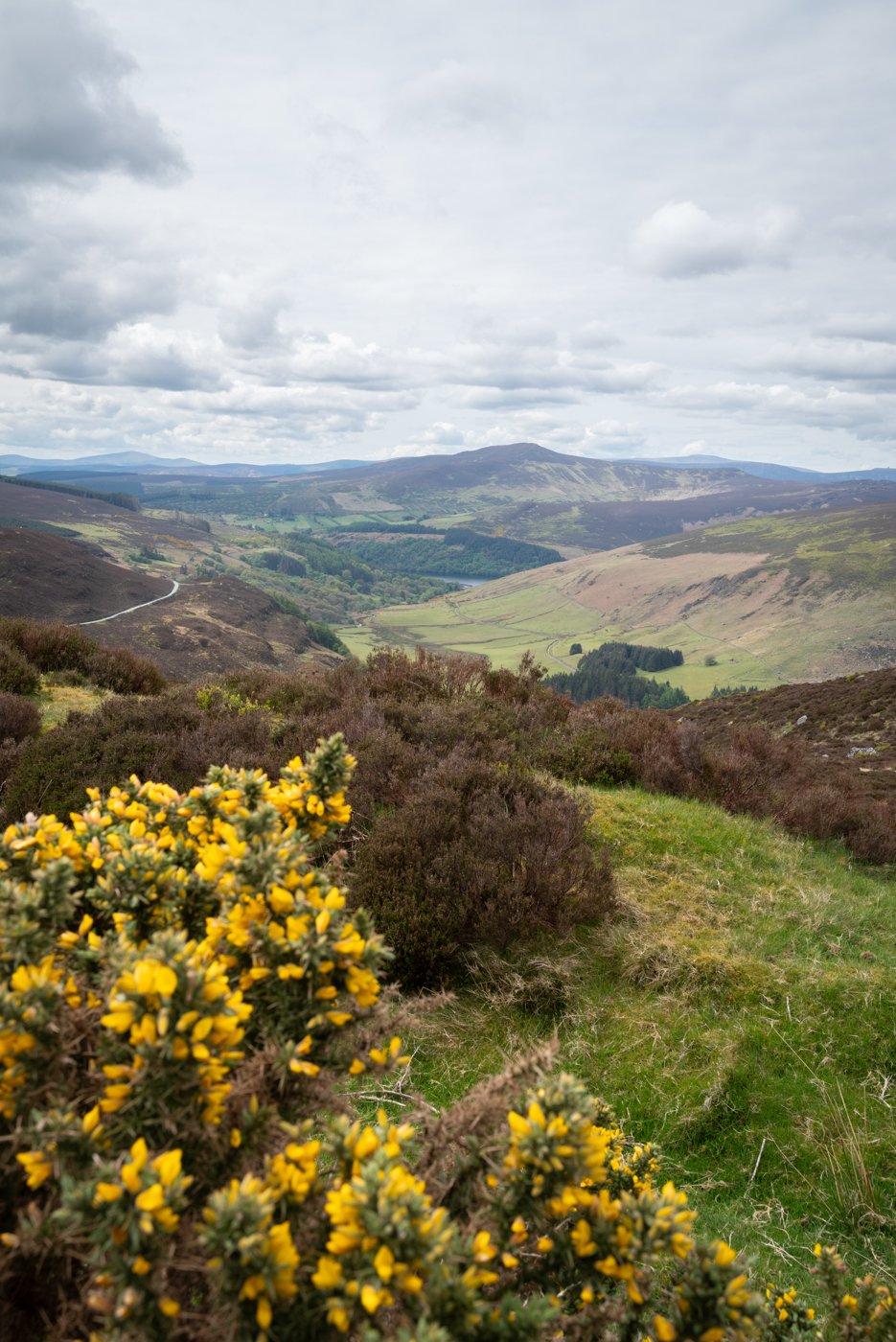
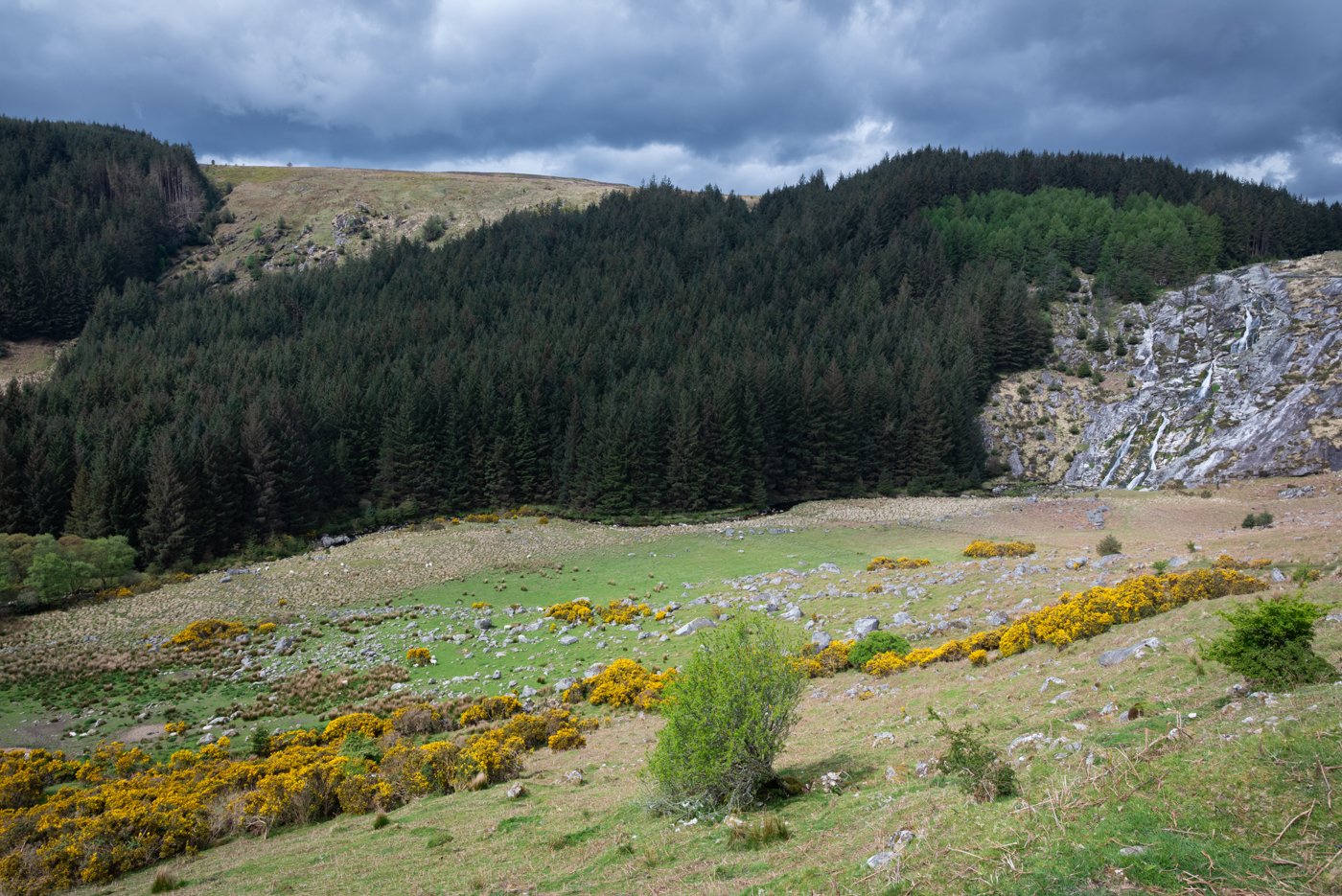
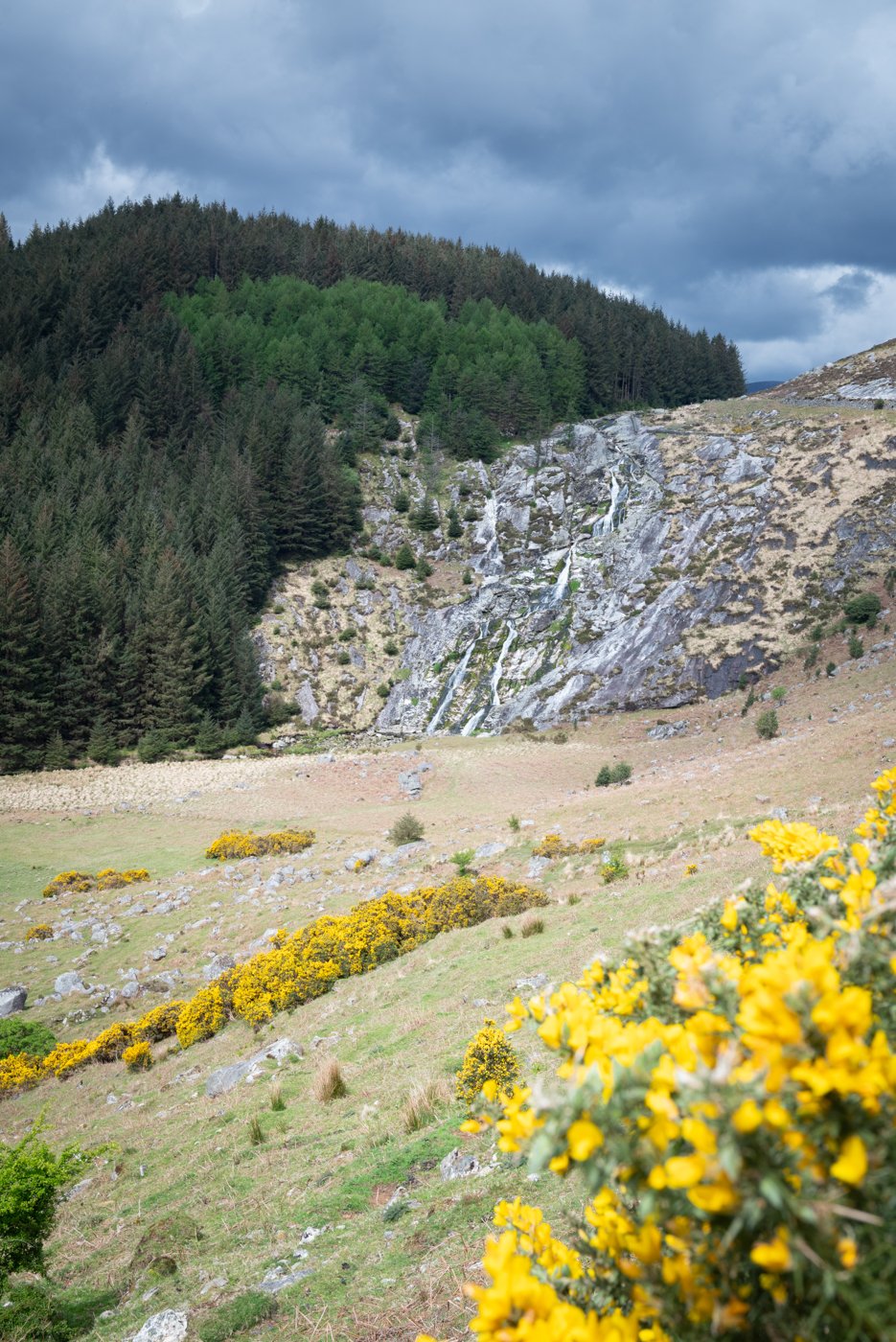
A waterfall by the roadside, in a valley landscape.
Glenmacnass Waterfall actually tasted a little like revenge ^^! While planning this new trip, I’d completely forgotten that I’d already tried to see it on my first trip to Ireland, twelve years earlier… without ever finding it!
This time, Google Maps made it easy and we spotted it without any difficulty on the road to Glendalough. We didn’t try to reach its foot and ended up admiring it from a distance, from the road. The view was already magnificent: the waterfall appears in the middle of this vast wild landscape, tumbling down the mountainside before reaching the valley under the cover of the pine trees.
Quite a grand setting…
Seeing Glenmacnass Waterfall
The waterfall is free to visit. There’s a car park above Glenmacnass Waterfall, a few minutes’ walk from the top. You can also admire it from a distance from the road, with a great overall view of the waterfall and the valley.
Be careful, though, if you stop along the Military Road: the road is narrow and winding. Don’t try to climb down the rocks to the foot of the waterfall.
Visiting Glendalough, in the heart of the Wicklow Mountains
Between a monastic site, lakes and hiking trails.
Where to eat in Glendalough? A friendly break at St Kevin’s Kitchen
After Glenmacnass, we carried on to Glendalough, our goal and the biggest stop of the day.
We started our visit… with lunch! Our stomachs, awake since very early that day, were starting to rumble, and my mood was starting to show it. As the restaurants near the site aren’t exactly cheap, we went for a burger at St Kevin’s Kitchen, a little snack bar nearby. We had a very good burger at an outdoor table with a Belgian family who were just finishing a road trip around Ireland. It was a chance to think back to my previous trips to the country and swap notes on the places we’d each visited.
Over the years, I’d perhaps forgotten a little how much this country had impressed me on my first visits. This day in Wicklow certainly refreshed my memory.
The Glendalough monastic site
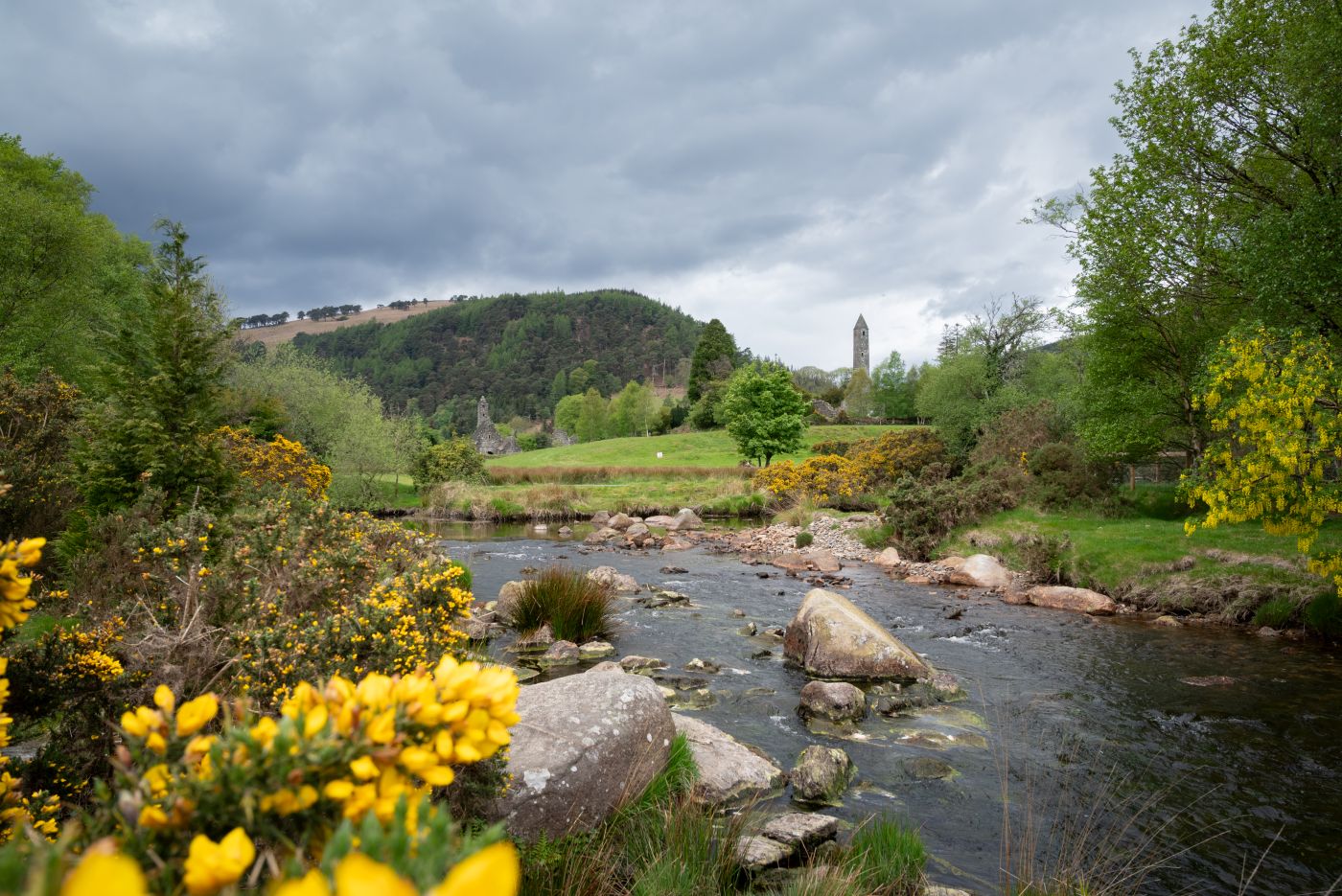
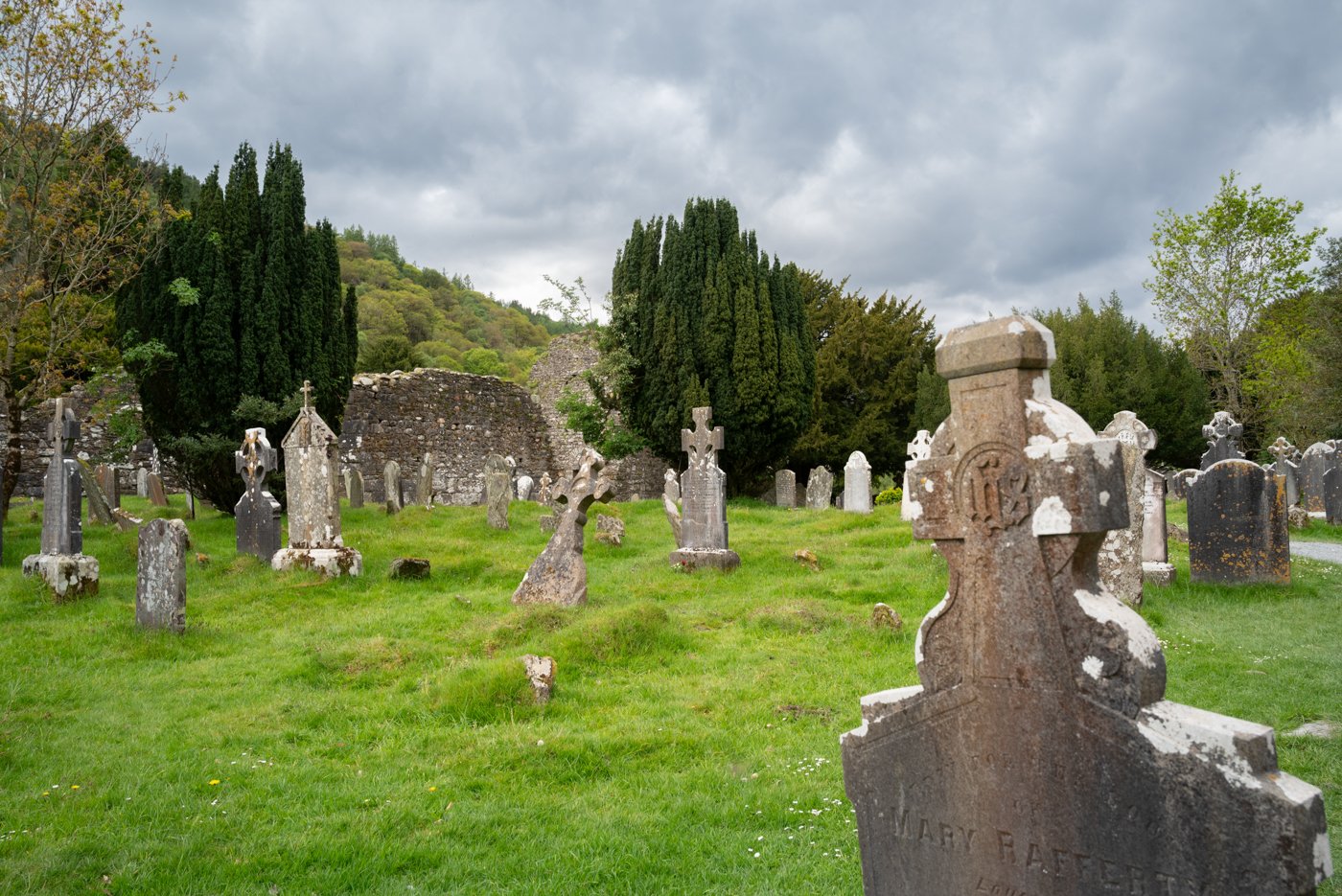
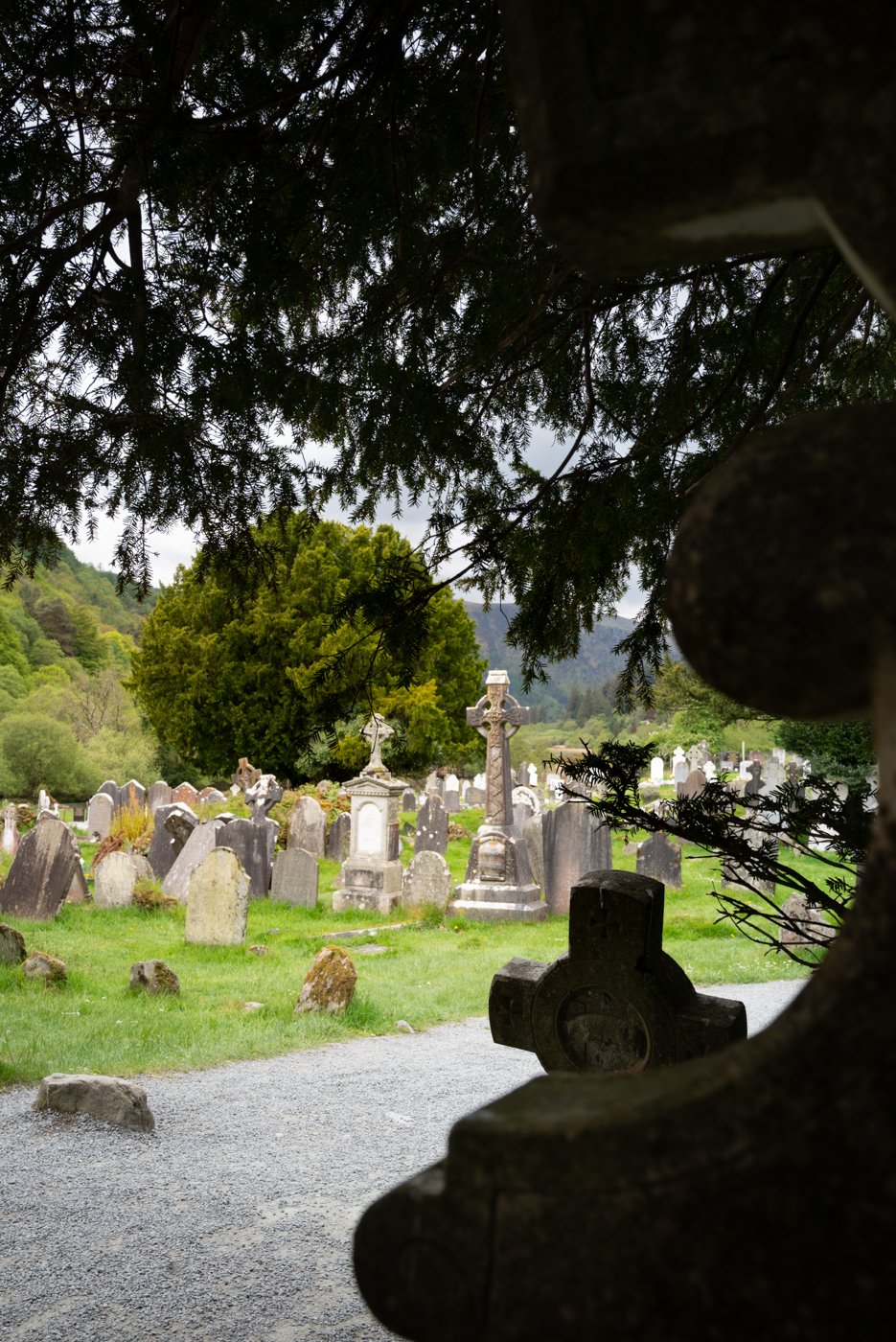
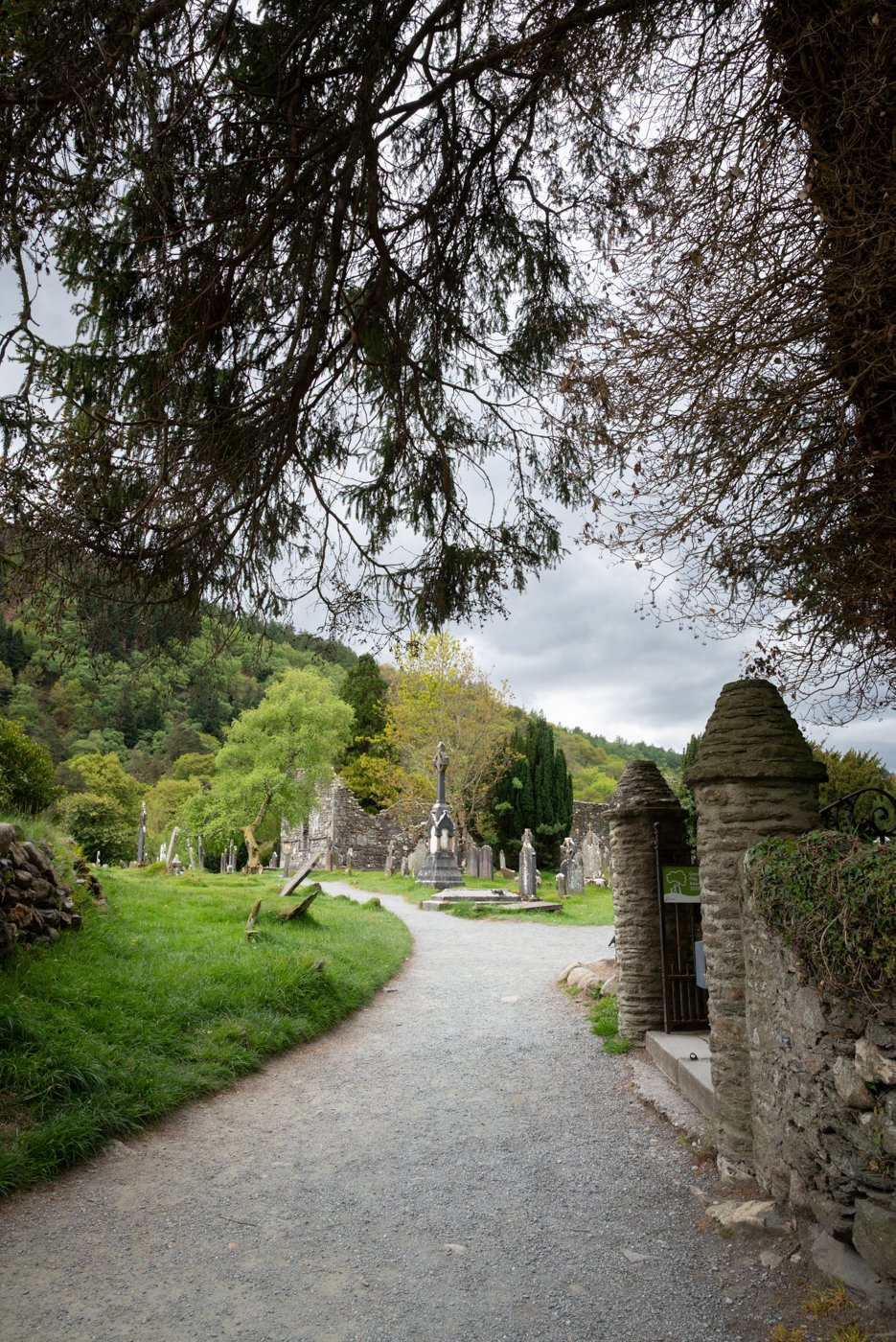
With full stomachs, we then made our way to the old Glendalough monastic site, founded in the 6th century by St Kevin. For several centuries, it was one of Ireland’s great religious centres, and today it still has several medieval remains, including its famous round tower, the ruins of its cathedral and several small churches.
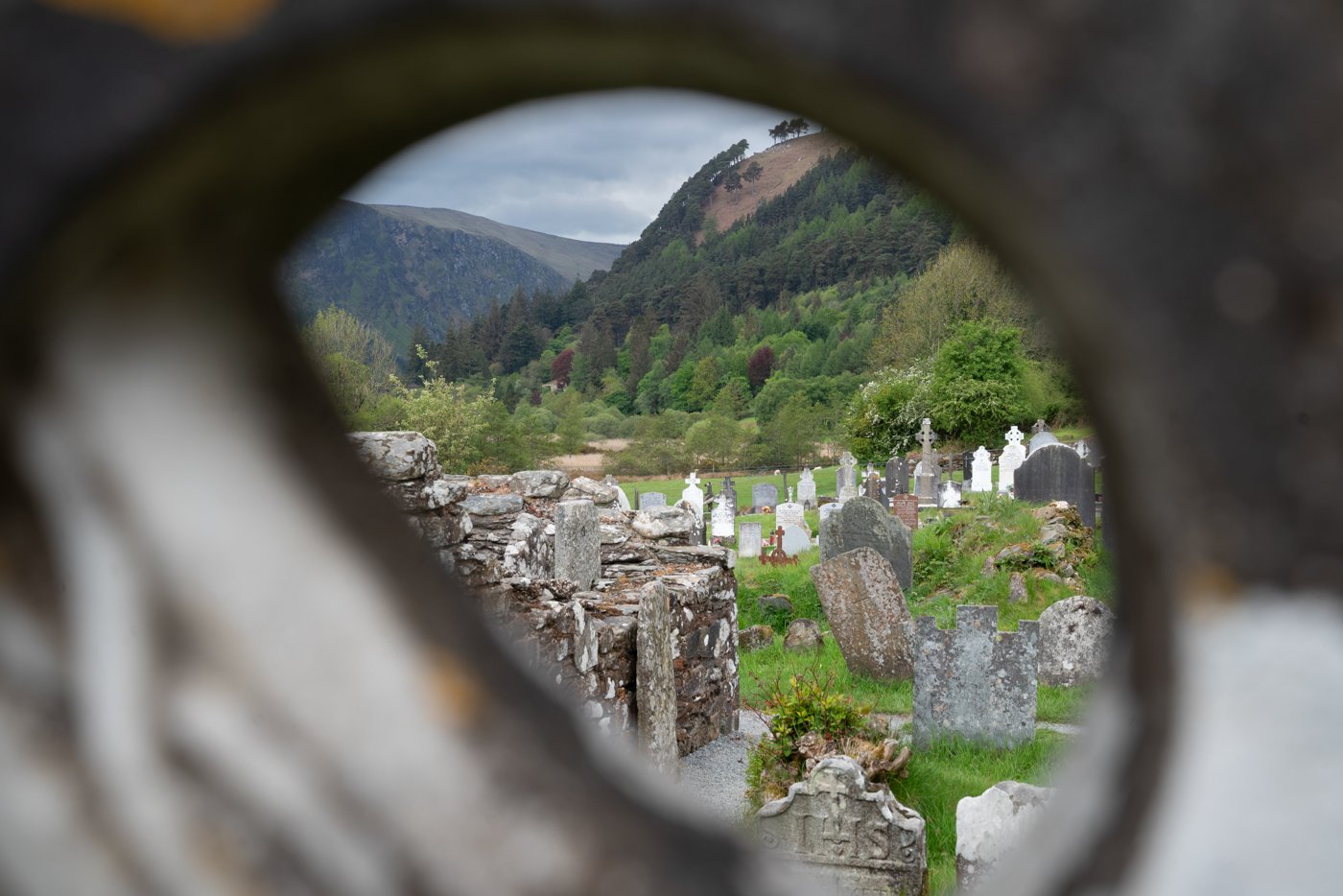
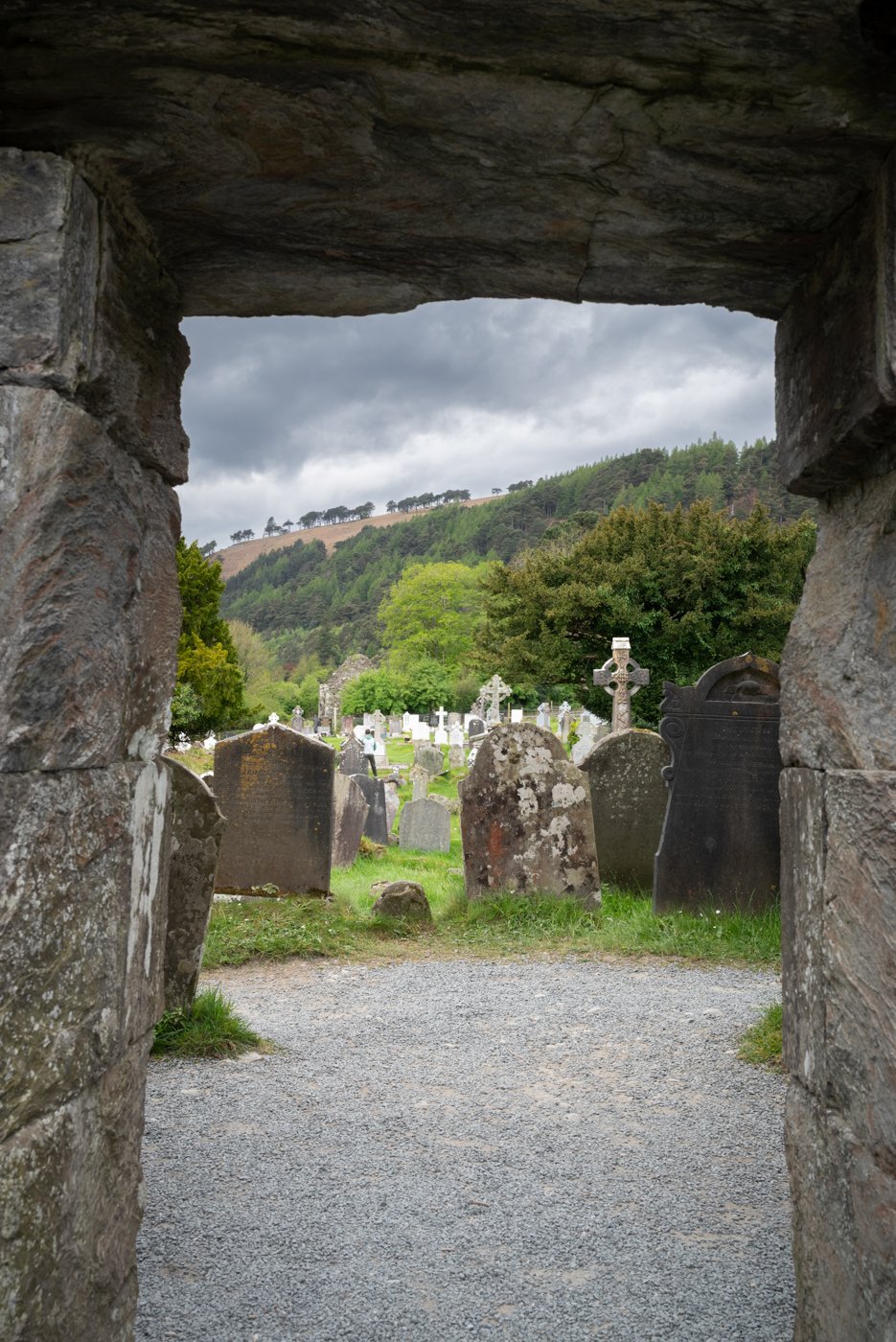
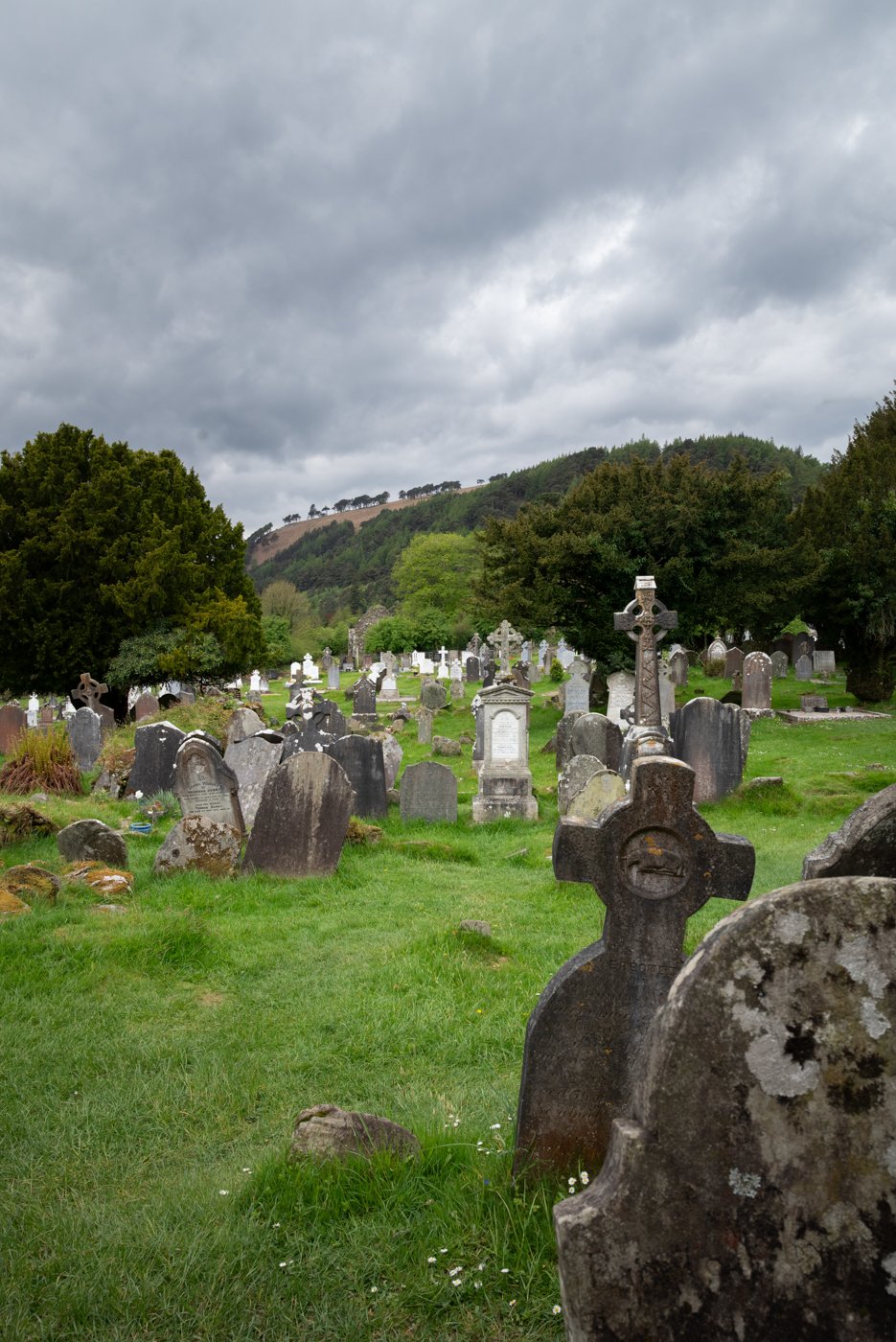
We started by wandering around the graveyard, among the old stones and crosses, some covered in moss. The grey skies that had followed us since we arrived gave the place an even more mystical atmosphere. I can easily imagine Glendalough under a thick autumn mist: you wouldn’t be far from a Halloween film set… or Harry Potter ^^!
Lower Lake and Upper Lake: the must-do walk in Glendalough
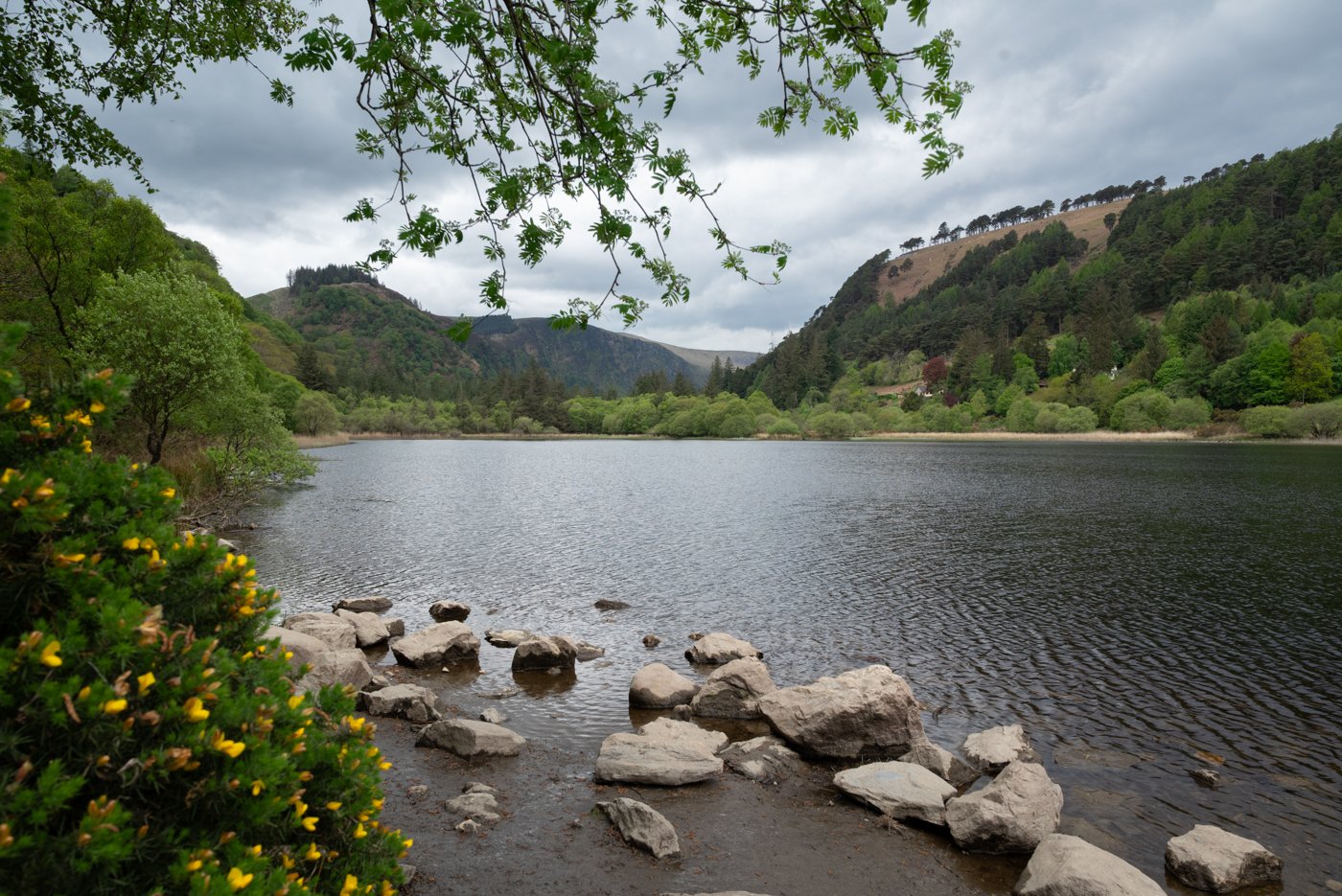
After discovering the monastic site, I really wanted to carry on walking to the Lower and Upper Lakes of Glendalough. I’d already walked this path with Mélanie twelve years earlier and had very fond memories of it.
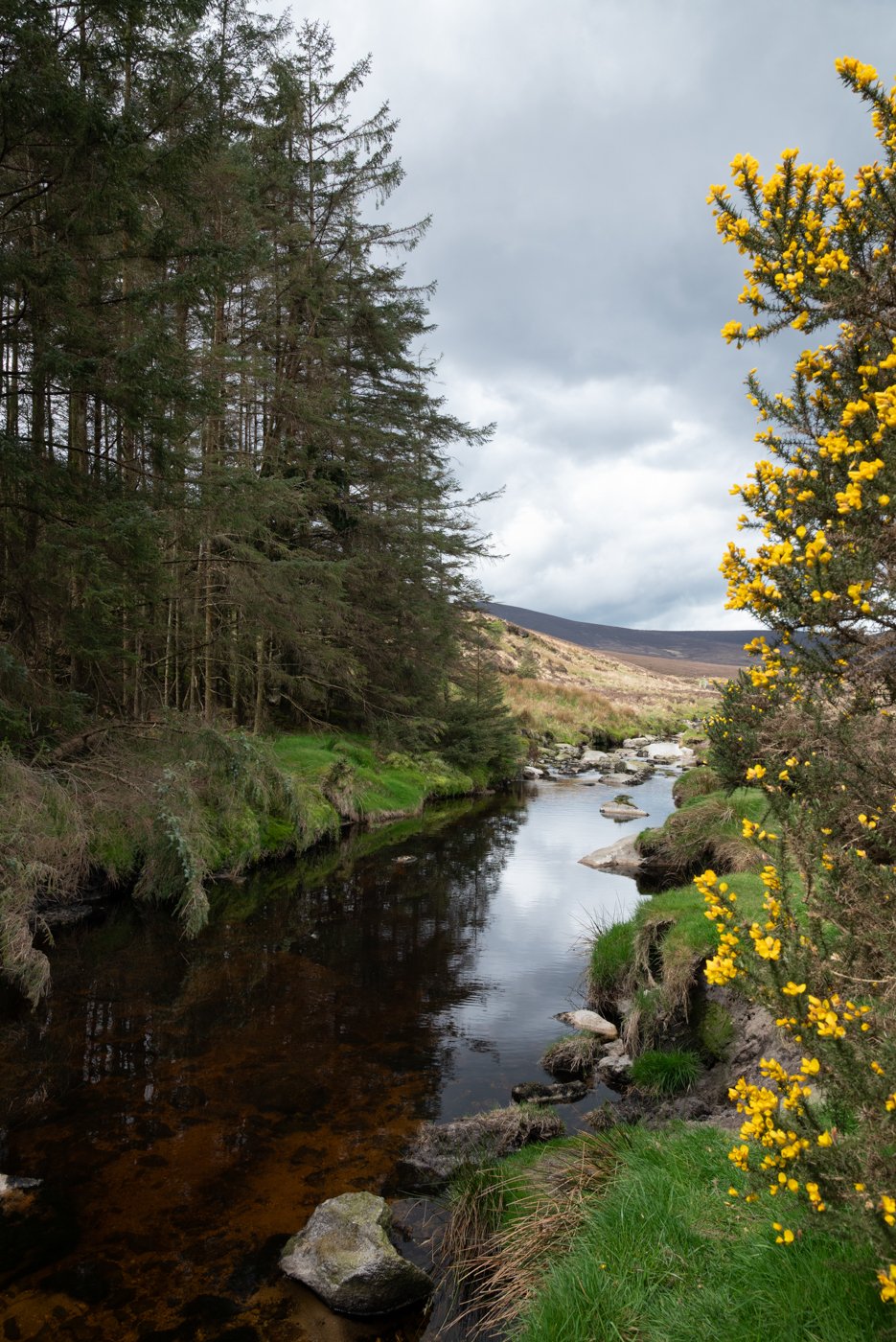
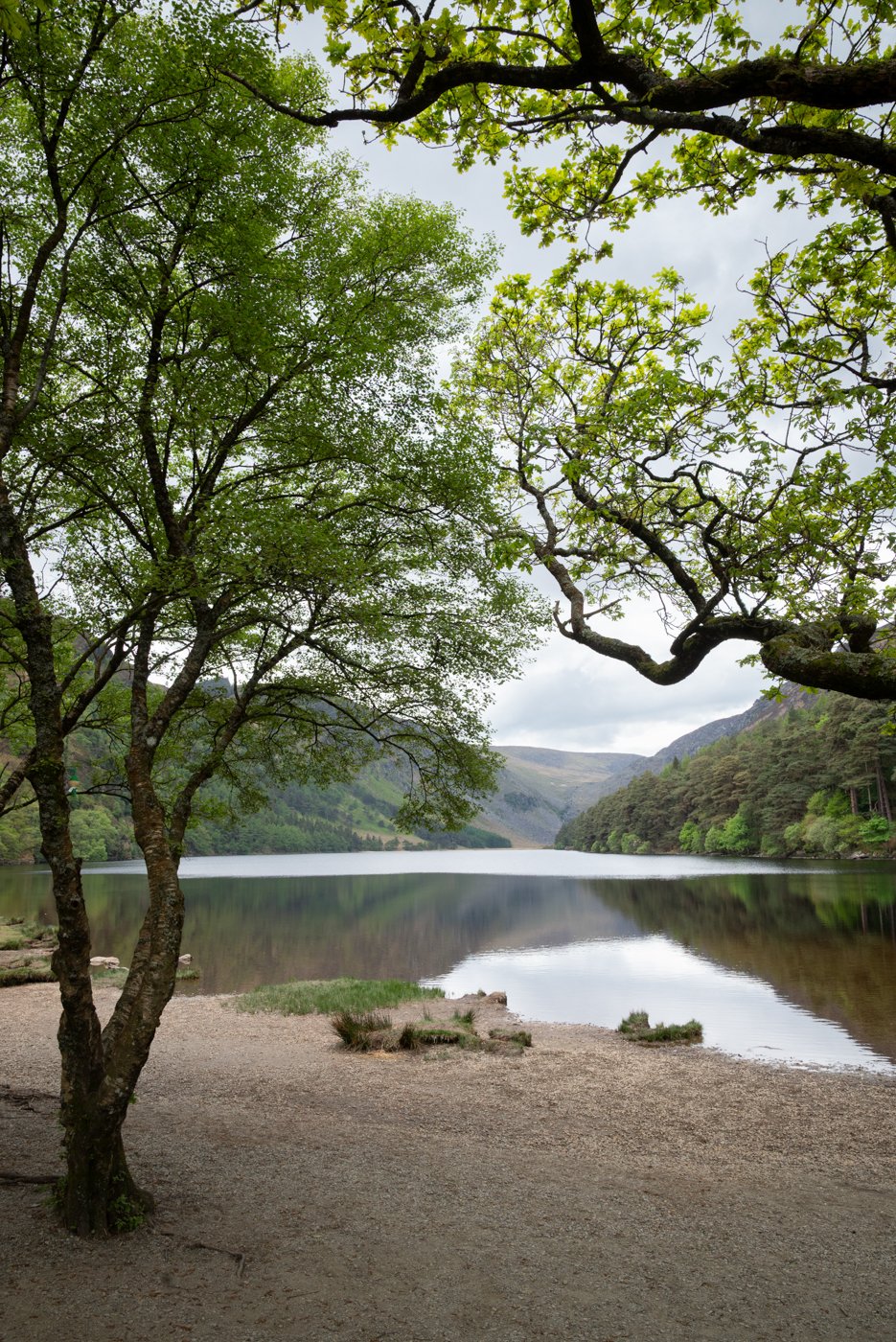
The walk is really pleasant and easy, on a well-maintained path that winds between tall trees before running along the lakes. A little after-lunch stroll worthy of a Brothers Grimm forest! I found the same feeling of calm and peace as on my first visit, even though the scenery was quite different this time.
On my previous visit, it was the very beginning of spring. The vegetation was still quite sparse and the landscapes leaned more towards grey and ochre. This time, everything was much greener, almost lush in places. I’d be very curious to see the valley in autumn, when the trees start changing colour!
We carried on to the Upper Lake, the larger of the two, surrounded by mountains and forests. I’d have loved to climb a little higher to see the valley and lakes from above, but my boots were clearly not the most suitable footwear, and we wanted to keep some time for the rest of our day before heading back to Dublin.
Which hike to do in Glendalough?
Glendalough has several waymarked trails, from a gentle stroll to a proper mountain hike. Here are three options depending on how much time you have:
For an easy walk: Green Road Walk
A 3 km loop (about 45 min), with 101 m of ascent, through the woods and along the Lower Lake. A good option for enjoying the valley without planning a real hike.
To walk a bit further: Derrybawn Woodland Trail
An 8 km loop (about 2 hrs) through the forest, with lovely views over the valley and the Upper and Lower Lakes. The route has more climbing. (311 m of ascent)
To see Glendalough from above: Spinc Short Route
A more demanding 5.5 km hike (about 2 hrs) that climbs above the Upper Lake and offers superb views over the valley. The trail crosses mountainous terrain, so wear good shoes and be ready for changes in the weather. (568 m of ascent)
Good to know: entry to the national park is free, but parking may be charged.
A last stop in Bray before heading back to Dublin
A seaside stop before heading back to Dublin.
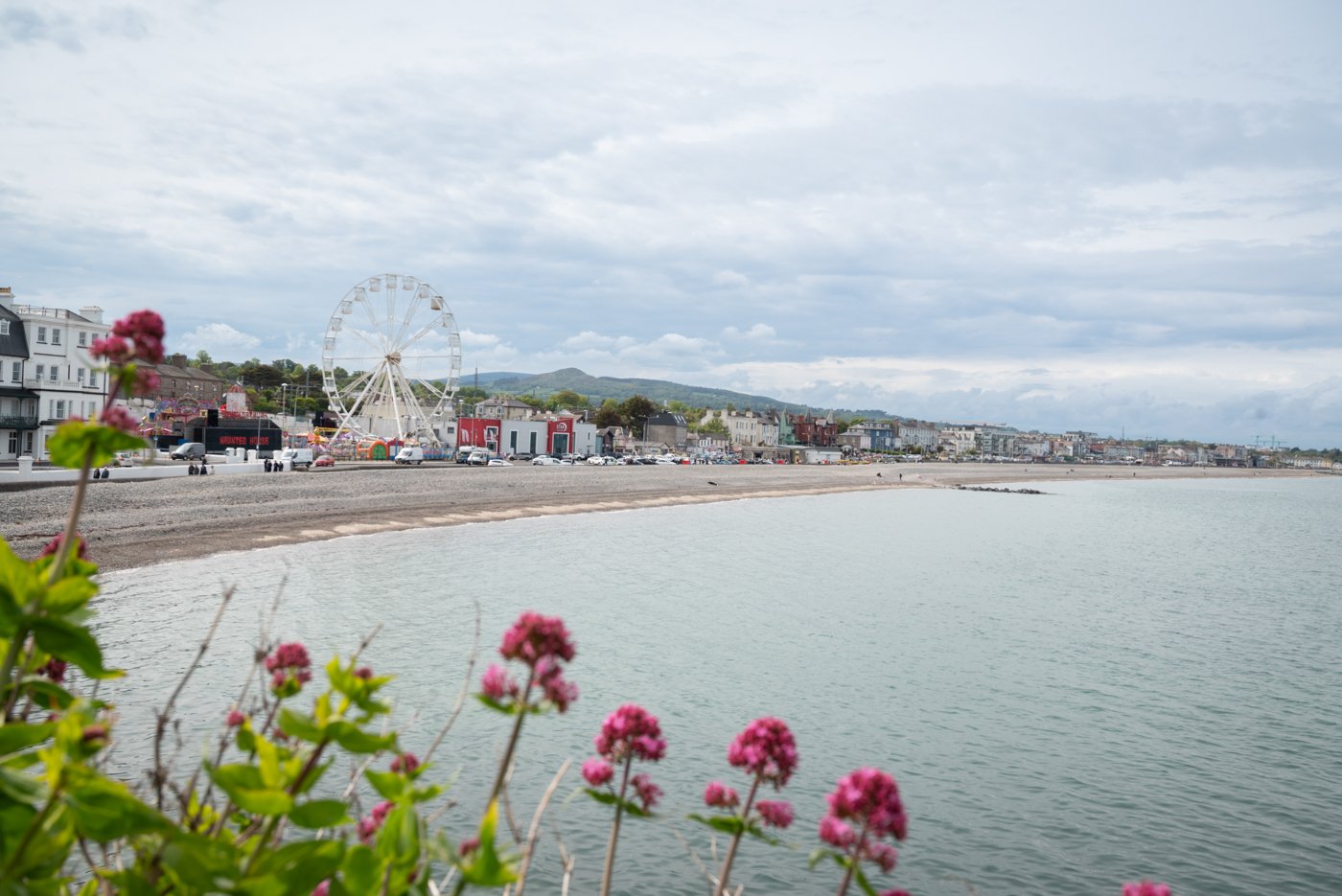
Before heading back to Dublin, we made the most of the end of the day with a last stop in Bray, on the coast. I already knew the town and its surroundings from my previous trip to Ireland, but it was a chance to stroll along its seafront again before returning the car. 🙂
Want to extend your trip around Dublin?
Wicklow is of course not the only day trip from the capital. In this article, you’ll find my ideas for days out and visits around Dublin.
Visiting the Wicklow Mountains from Dublin without a car
Can you visit the Wicklow Mountains without a car?
Yes, but you’ll need to adapt your plans. Without a car, Glendalough is the easiest stop to reach. Powerscourt Waterfall, Lough Tay, Sally Gap and Glenmacnass are much harder to combine by public transport. If these landscapes appeal to you, as I explained above, an organised day trip will be easier.
By bus with St Kevin’s (route 181)
This is the classic way to reach Glendalough from Dublin. The family-run St Kevin’s Bus Service has operated this route since 1927, via Bray, Roundwood and Laragh.
- Departure: south Dublin city centre (St Stephen’s Green / Leeson Street area). Check the exact stop before you go.
- Journey time: about 1 hr 35.
- Time on site: the company advertises more than 3.5 hours at Glendalough, which is enough for the monastic site and a walk.
Good to know: there’s no direct bus between Dublin Airport and Glendalough. You first need to get to the city centre. If you land in the morning, like us, it’s best to plan this day after a night in Dublin.
On an organised tour
This is the easiest option if you want to see more than Glendalough. Most day trips from Dublin combine Wicklow landscapes with a stop at Glendalough, but what’s included varies from one operator to another: check that Lough Tay or Sally Gap are on the programme if they’re your priorities.
See day trips from Dublin (affiliate link – I earn a commission at no extra cost to you)
Other options
A TFI Local Link route, the 895, links Sallins with Glendalough a few times a day. It’s less well known and needs real planning: check the official Transport for Ireland timetables before considering it.
A possible plan for Glendalough without a car
With a few hours on site, you’ll need to choose your priorities:
- The monastic site: round tower, graveyard, ruins (about 1 hr).
- A walk to the Lower and Upper Lakes, easy and shady.
- Just one longer trail if time allows: the Green Road (3 km) for something gentle, or the Spinc Short Route (5.5 km) for the view from above – but not both.
Remember to leave some margin before the last bus back.
Car, bus or tour: which to choose?
| Car | Bus 181 | Tour | |
|---|---|---|---|
| Freedom | Total | Low: fixed timetable | Low: fixed programme |
| Sites you can reach | All: Powerscourt, Lough Tay, Military Road, Glenmacnass, Glendalough | Mainly Glendalough | Several, depending on the operator |
| Pros | Stop wherever you like and change plans along the way | No car hire or driving | Everything is organised, no driving |
| Cons | Driving on the left (for visitors from mainland Europe), narrow winding roads, parking sometimes charged, cost of hire | Fixed times, limited time on site, no direct bus from the airport | Fixed route, content varies between operators, less time at each stop |
| Ideal for | Doing the full itinerary | Visiting Glendalough without a car | Seeing several sites stress-free |
Planning a trip to Ireland?
 In this article, I’ve gathered my practical tips for planning a road trip in Ireland: itinerary, getting around, accommodation and useful information before you go.
FAQ – Visiting the Wicklow Mountains from Dublin
Can you visit the Wicklow Mountains in a day from Dublin?
Yes, the Wicklow Mountains are close enough to Dublin to spend a day there. We even started our itinerary straight after landing at the airport in the morning. In one day, you can easily discover several sites and spend a few hours at Glendalough.
Do you need a car to visit the Wicklow Mountains?
In my opinion, a car is the most practical way to follow this itinerary. It lets you stop freely at Powerscourt Waterfall, Lough Tay or Glenmacnass and enjoy the Military Road scenery at your own pace. Organised day trips from Dublin also let you discover Glendalough and the Wicklow Mountains without a car.
What to see in the Wicklow Mountains in one day?
Our itinerary took us from Powerscourt Waterfall to Glendalough via Lough Tay, the Military Road, Sally Gap and Glenmacnass Waterfall. Glendalough is the main stop of the day, with its monastic site and two lakes.
How long should you spend in Glendalough?
Allow at least a few hours to discover the monastic site and walk around the lakes. If you want to do one of the hikes that climb above the valley, it’s best to allow more time and lighten the rest of your itinerary.
When is the best time to visit the Wicklow Mountains?
The Wicklow Mountains can be visited all year round, and the landscapes change enormously with the seasons. Whenever you go, above all be prepared for changeable weather: in Ireland, sun, clouds and rain can easily follow one another in the same day.


