
What to see at the Familistère de Guise in the Aisne? This “social palace” designed by Jean-Baptiste André Godin is one of the most unusual heritage visits in Thiérache, northern France. Here’s our discovery of its spaces, its history and its gardens, with tips for planning your visit.
This weekend, we were invited to an Instameet at the Familistère de Guise, in the Aisne! For once, we were free on the agreed date and were happy to take part! It was our second meet-up of Instagrammers from Hauts-de-France, a chance to see again or meet in person people whose world we sometimes follow for months and chat with regularly online… and to admire a place from every angle!
The Familistère was far from unknown to us. We’d already visited it and, above all, I’d worked in its school for a year… ^^ As you know, I’m a primary school teacher and don’t yet have enough seniority for a permanent post. This year, I was lucky enough to be posted in my hometown, but until now I’ve mostly been sent around the area. So a few years ago, I was teaching in the “Temple of Education” designed by Jean-Baptiste André Godin.
Anyway, enough chatter, back to the point. I’m speaking as someone from the Aisne and Saint-Quentin, but I imagine most of you have never heard of the Familistère and are wondering what this strange word means?
The Familistère de Guise at a glance
| To discover | The social palace, the courtyard, the exhibition spaces and the gardens |
| Where? | Guise, in the Aisne, in Thiérache |
| Who for? | Lovers of history, architecture and social heritage |
| Check first | Opening hours, prices and accessible areas before you go |
To keep exploring the Aisne
What to do in the Aisne?Discover the gardens of the AisneWhat to do in Thiérache?
Visiting the Familistère de Guise: understanding Godin’s social palace
The Familistère de Guise is one of the quirks of our region and département, and one of the must-see visits in the Aisne. (Feel free to reread my 20 things to do in the Aisne !)
In the 19th century, Jean-Baptiste André Godin, a major cast-iron industrialist (famous for his Godin stoves), decided to bring his utopia to life by creating a revolutionary social palace for his employees in the small town of Guise. Like the planned architecture of the place, the term “palace” is inspired by Versailles: kings had their palace, and workers would have theirs too. That says it all, doesn’t it? “It is time to ask whether those who create wealth have no right to the benefits and splendours it brings!”
The challenge was colossal, inspired by the ideas of late 19th-century socialist thinkers.
The final complex was just as impressive: five red-brick residential pavilions with nearly 500 homes, a nursery, a school, a swimming pool, a theatre, shops (the “économats”), workers’ gardens… Not to mention the significant social progress introduced! Jean-Baptiste André Godin turns out to have been a true visionary, as you can see when visiting. Here are just a few examples among many: compulsory mixed schooling up to the age of fourteen (twenty years before France’s Jules Ferry laws!), mutual insurance funds, fountains with running water and “rubbish chutes “ , the ancestors of our waste chutes, on every floor; exceptional working conditions, with wages 20% higher than at the time and shorter working days (with the idea of working less to be more efficient and earn more)…


The Familistère was based on the principle of community living. Each resident was called on to give their opinion and take part in running it. Residents enjoyed many material benefits but also had to follow very strict house rules… which soon earned Godin a fair amount of criticism.
The Familistère, a place to live and work, didn’t escape such criticism… but nevertheless enjoyed exceptional longevity: more than eighty years!

What to see at the Familistère de Guise? The central pavilion and its courtyard
The building’s layout is unique and unusual, organised around a cobbled inner courtyard topped by an incredible glass roof. The apartments, still lived in today, are spread over three floors and open onto gallery-streets and spiral staircases… The balconies were seen as a place for meeting and socialising, which was essential in Godin’s eyes. Geometry is your friend!
The least you can say is that the place is more than photogenic…
Like a show apartment, one of them can still be visited today, a chance to see the deliberate, calculated brightness inside, the efforts made to ensure families’ comfort (gas lighting, stove heating) and the modernity of the place, considering it was designed in the 19th century!


Discovering the Familistère’s east wing on our visit
Taking part in an Instameet gave us a few little privileges, including access to theeast wing, which is closed to the public. Classy, right? Spoiler: the following photos are therefore exclusive! Destroyed during the First World War and rebuilt around 1923 (just look at that Eiffel-inspired glass roof, typical of the period), this part of the Familistère has, however, stood up less well to time and the weather, for lack of upkeep. A major restoration is currently under way to create a hotel true to the spirit of the place. I can’t wait to see the result!
From there, we were able to go up a tower and enjoy an incredible view of the building and its gardens!


The gardens of the Familistère de Guise: a walk through history
The pleasure garden, designed by J.-B. Godin in the 19th century for the Familistère’s workers on the right bank of the Oise, between the factory and the Palace, was intended as a place of relaxation for the residents, away from the factory smoke and the bustle of the Palace. A greenhouse, a kitchen garden and fruit trees were also planted to supply the Social Palace’s shops with vegetables at low cost.
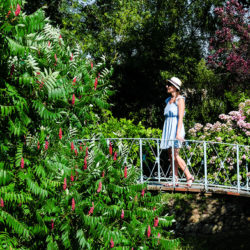
Today, the place has been redesigned and the kitchen garden abandoned, but I love walking there, especially in spring to admire its bright colours and lush vegetation!
Don’t hesitate to venture into the former laundry/swimming poolon the other bank!


FAQ: planning your visit to the Familistère de Guise
What is the Familistère de Guise?
It’s a complex of housing and social facilities designed in the 19th century by the industrialist Jean-Baptiste André Godin.
What can you see at the Familistère?
The social palace, the exhibition spaces, the gardens and other parts of the site, depending on access conditions.
How long should you allow for the visit?
Allow several hours to enjoy the open areas and exhibitions without rushing.
Can you visit the Familistère with kids?
The site is a good way to explore history and architecture as a family; check for suitable activities and tours.
How can I find out opening hours and prices?
Check the Familistère’s official website, as programming and access conditions may change.
Visiting the Familistère de Guise: opening hours, prices and access
- During your visit, don’t miss the sublime Théâtre Godin. My photos aren’t fit to publish, but the thought is there ^^!
- To see all the photos from our Instameet, go hereor here!
- We ate at the Buvette des Économats (maroilles tart, ficelle picarde… perfect if you want to try our local recipes!). When I worked in Guise, I also loved having lunch at the restaurant “Le Jardin”, a 5-minute walk away!
- Opening hours: check current visiting days and times on the Familistère’s official website.
- Prices: prices at the time of our visit in 2017 may have changed. Check current prices and any combined offers on the official website.
- See here for guided tours.
- 30 min from Saint-Quentin, 1 hr 10 from Reims, 1 hr 30 from Lille, 2 hrs 15 from Paris…