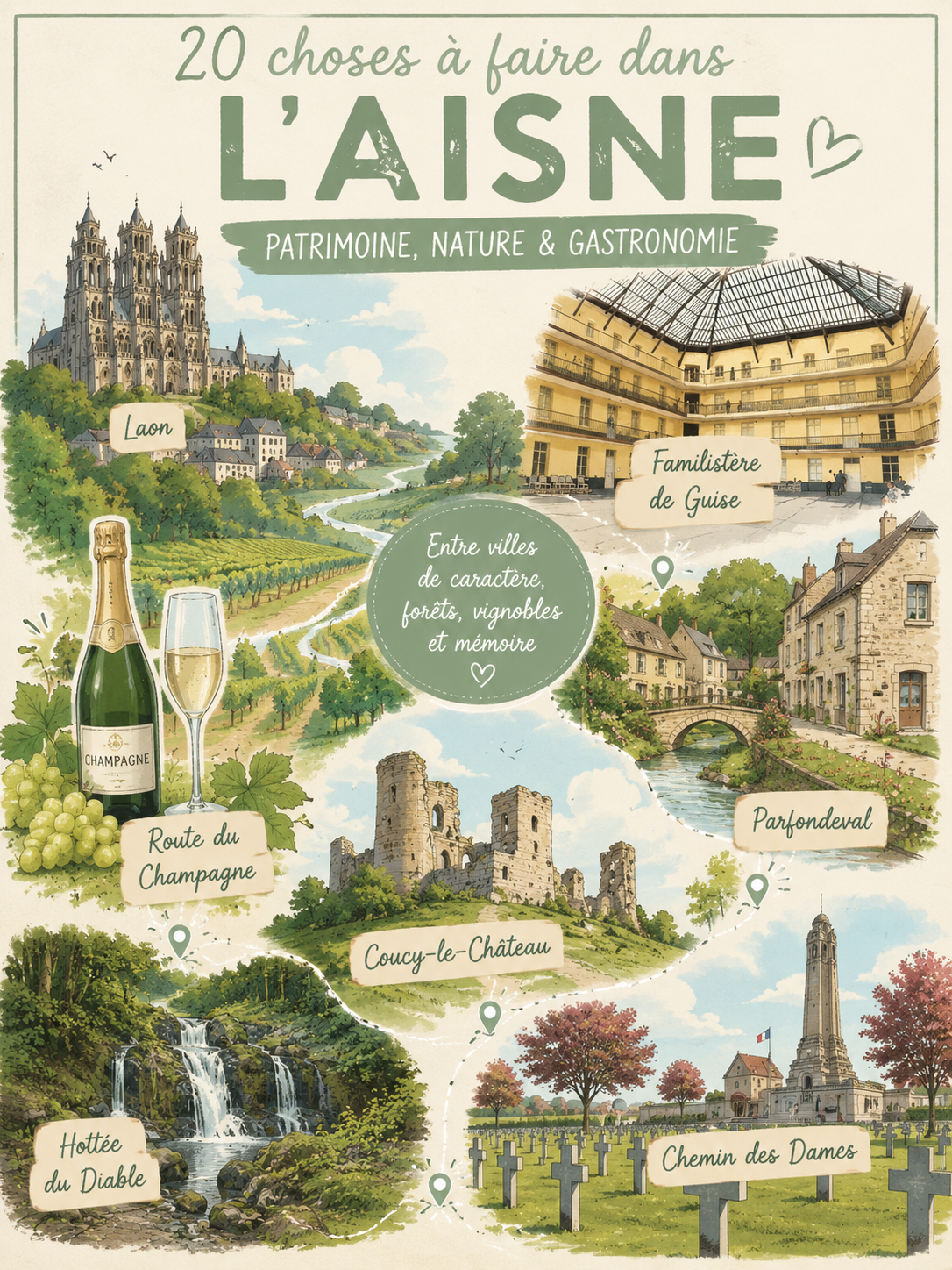
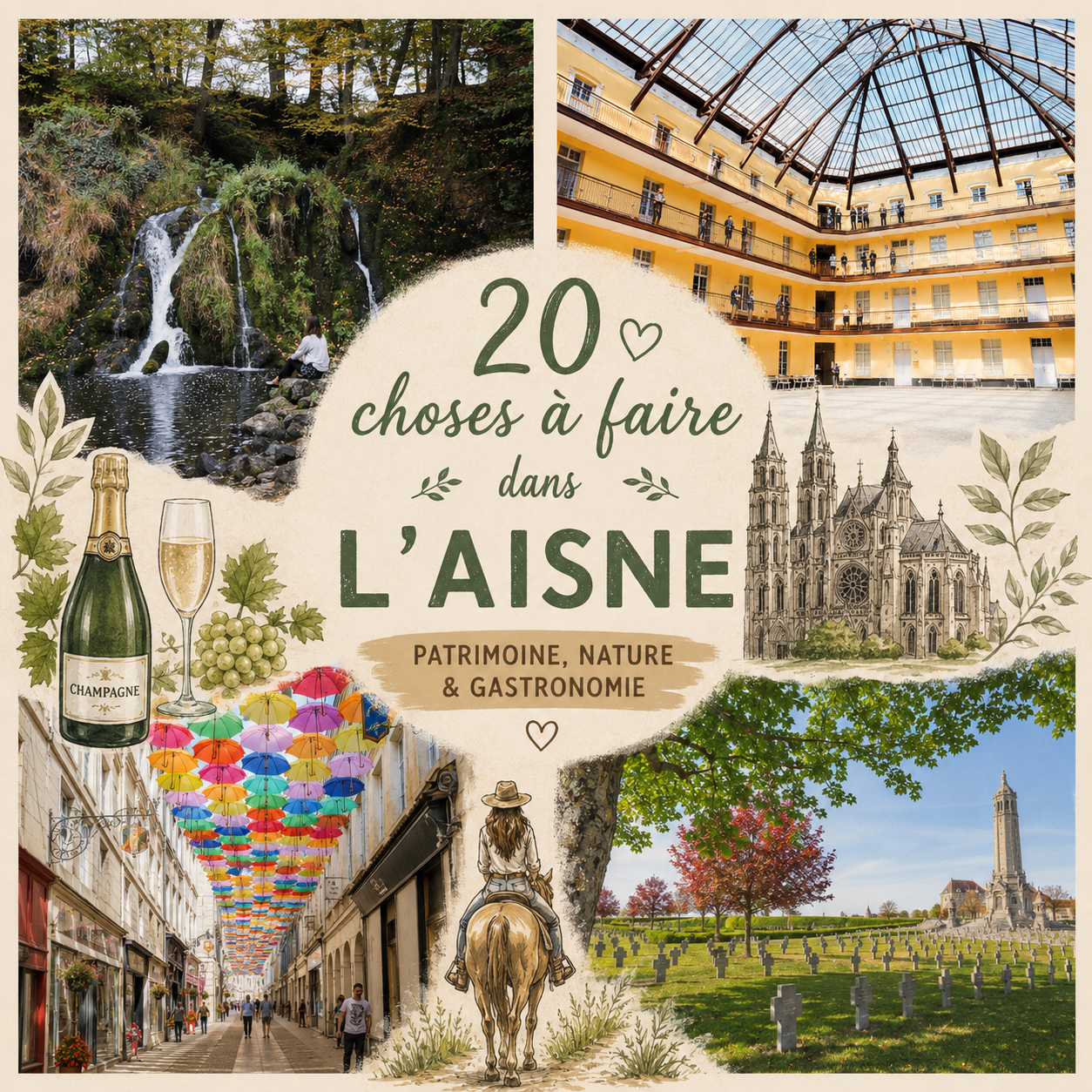
Article updated in 2026. Often driven through without stopping, the Aisne is nonetheless one of the most surprising départements in Hauts-de-France, northern France. Between medieval towns, Art Deco architecture, Champagne vineyards, forests, waterfalls and major remembrance sites, it has far more to discover than you might imagine.
After years of exploring my home département, here are the 20 must-sees I recommend to discover its full diversity. The list is far from exhaustive…
You can also find my 15 weekend ideas in Hauts-de-France here (in French).
Why visit the Aisne? Heritage, nature and getaway ideas
Often overshadowed by its neighbours, theAisne is well worth lingering in. Between the cobbled lanes of Laon, the elegance of Saint-Quentin’s Art Deco, the vineyards of the Champagne Tourist Route, the landscapes of Thiérache, major remembrance sites like the Chemin des Dames and the surprising Familistère de Guise, the département reveals incredible diversity.
Whether you love heritage, nature, food or hiking, you’re bound to find something to amaze you. And all less than two hours from Paris!
🌿 The Aisne at a glance 🌿
- 📍 Region: Hauts-de-France (northern France)
- 🚗 Getting there: about 2 hrs from Paris, 1 hr 30 from Lille and under 1 hr from Reims.
- 🏰 Must-sees: Laon, Saint-Quentin, the Familistère de Guise, Coucy castle, the Cité internationale de la langue française, Château-Thierry and the Chemin des Dames.
- 🌿 Ideal for: a weekend combining heritage, nature, hiking, food and history.
- 🍾 To taste: Champagne from the southern Aisne, Maroilles cheese, ficelle picarde, Thiérache cider and other local specialities.
- 📅 Best time to go: April to October, with a soft spot for spring and early autumn.
- ⏳ Ideal length: 3 days minimum, a week to discover the département’s different areas.
What to do in the Aisne? Planning your visits and stay
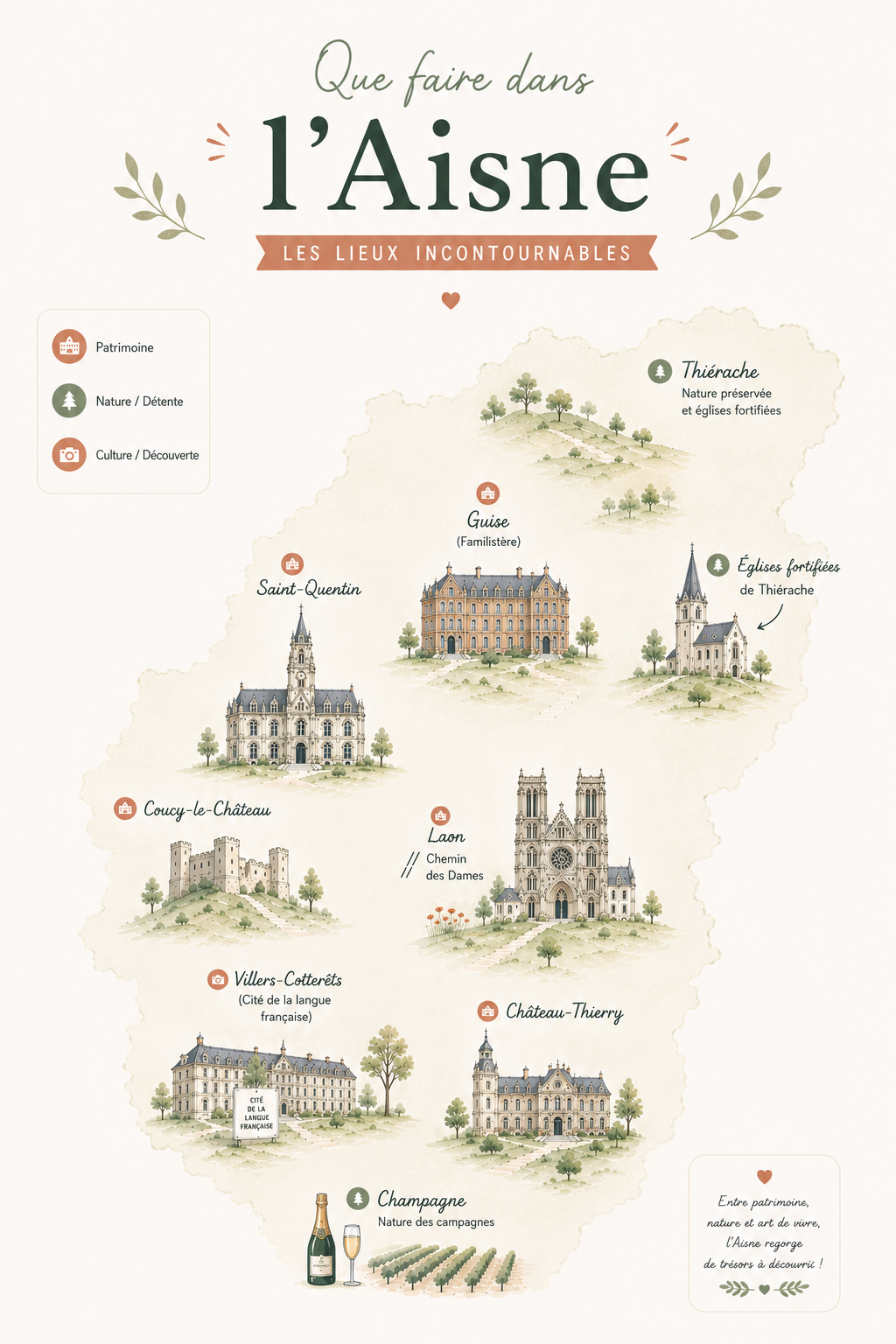
📍 The Aisne’s must-sees at a glance
❤️❤️❤️❤️❤️ = must-see • ❤️❤️❤️❤️🤍 = not to be missed • ❤️❤️❤️🤍🤍 = if you have time
Visiting the Aisne in 3 or 7 days: my itinerary ideas
Not sure how to plan your stay? Here are two itinerary ideas depending on how much time you have.
⏳ In 3 days
🏛️ Day 1
Saint-Quentin: Art Deco, basilica, Champs-Élysées park and Parc d’Isle.
🏰 Day 2
The Familistère de Guise, then the medieval town of Laon.
🌿 Day 3
The Chemin des Dames, Vauclair Abbey, the Septmonts keep, then Soissons.
🌞 In 7 days
Day 1
Saint-Quentin.
Day 2
Guise and the Familistère.
Day 3
Thiérache: fortified churches and villages.
Day 4
Laon and the Chemin des Dames.
Day 5
Soissons, Septmonts and Vauclair Abbey.
Day 6
Villers-Cotterêts, the Cité internationale de la langue française and the Forest of Retz.
Day 7
Château-Thierry and the Champagne Tourist Route.
20 must-sees in the Aisne
1. Visiting Laon: what to see in the medieval town?
Perched on its hill, Laon is without doubt one of the most beautiful medieval towns in Hauts-de-France. I’d been several times to visit friends or join Instagram meetups, but it was when I finally took the time to explore its historic centre that I truly fell for it.
Behind its ramparts lies a maze of cobbled lanes, old houses and remarkably well-preserved monuments. You can’t miss Notre-Dame de Laon cathedral, a Gothic masterpiece whose towers offer an exceptional panoramic view over the surrounding plain.
Take time, too, to stroll along the ramparts, discover the town’s mysterious underground passages and admire the many fortified gates that bear witness to the rich past of this former capital of the kingdom of France.
If you visit Laon in spring, don’t miss the Euromédiévales. For a whole weekend, the town travels back several centuries with camps, shows, craftspeople and activities that delight adults and children alike. It’s one of the most iconic medieval festivals in Hauts-de-France.
👉 Find my complete guide to visiting Laon, with the must-sees, my favourite addresses and all my tips for planning your day.
(free)
💚 My tip: if you’re feeling fit, walk up to the Upper Town. The cobbled lanes are full of charm and several viewpoints let you admire Laon’s rooftops and the surrounding countryside. If you’d rather skip the climb, there’s also a car park near the historic centre.


2. What to do in Saint-Quentin? Discover its Art Deco heritage
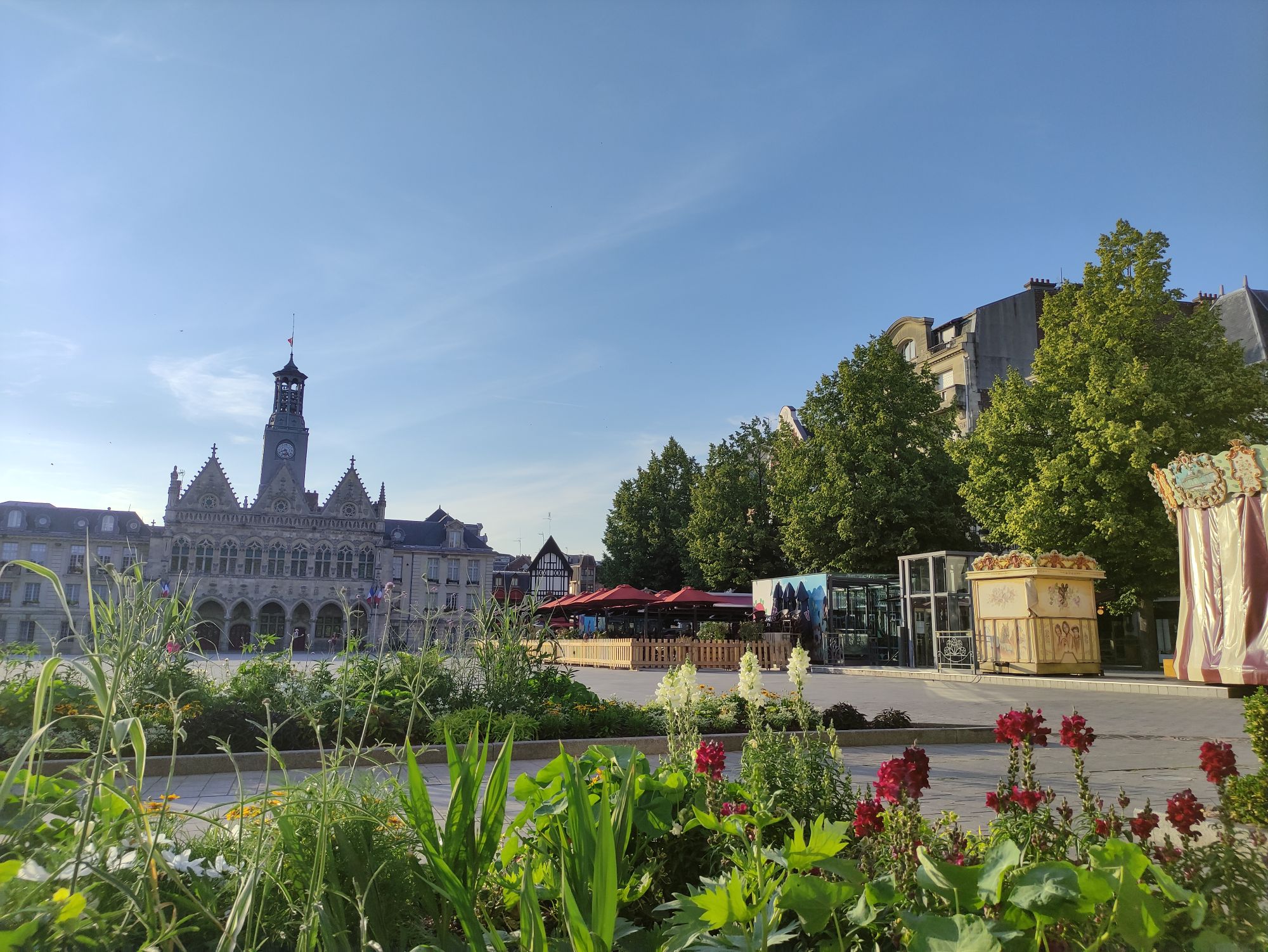
You can’t talk about the Aisne without mentioning Saint-Quentin, my hometown! Often overlooked, it nevertheless boasts one of the finest Art Deco ensembles in France, born of the rebuilding that followed the First World War.
The best way to discover it is to stroll around the historic centre, looking up regularly. Wrought-iron balconies, colourful mosaics, bay windows, geometric façades… the details are everywhere. Don’t miss theTown Hall, the Basilica of Saint-Quentin, the Théâtre Jean Vilar, the elegant shopping streets and the Musée Antoine Lécuyer, home to the largest collection of works by Maurice-Quentin de La Tour.
If you prefer green spaces, take a break at the Champs-Élysées park or the Parc d’Isle, the town’s true green lung. You can even hop aboard a bacôve, a traditional flat-bottomed boat that lets you see the marshes from another angle.
Finally, keep your eyes open: in recent years, street art has gradually been making its way onto Saint-Quentin’s streets, adding a contemporary touch to this rich heritage.
👉 To plan your visit, find my complete guide to Saint-Quentin, with the must-sees, an illustrated map and a ready-made weekend itinerary.
3. Visiting the Familistère de Guise, a unique place in the Aisne
If there’s one truly unique place in the Aisne, it’s the Familistère de Guise. Designed in the 19th century by the industrialist Jean-Baptiste André Godin, this “social palace” was a genuine ideal community intended to improve his workers’ living conditions.
As a history lover, I obviously couldn’t miss this visit! I was lucky enough to go back many times when I was teaching in Guise, right next to the Familistère.
Walking through the vast inner courtyards, the show apartments, the theatre, the cooperative stores and the gardens, you discover a project that was incredibly modern for its time. The Familistère had nearly 500 homes, as well as schools, a nursery, a swimming pool, shops… a real town within a town, designed to give working-class families better living conditions.
Today, the site has been beautifully restored and the visit helps you understand this extraordinary human adventure. Whether you love history, architecture or are simply curious, it’s in my view one of the must-see visits in the Aisne.
💚 My tip: if you get the chance, plan your visit for 1 May. Every year, the Familistère holds a big day of events with shows, demonstrations and tours. The atmosphere is particularly friendly, but expect it to be busier than usual.
👉 You can also find my complete guide to the Familistère de Guise, with all the practical information and my tips for planning your visit.
(€11 full price, several guided tours every day)

4. Discover Vauclair Abbey and its romantic ruins
Nestled in the heart of the Vauclair forest, Vauclair Abbey is one of those places with a very special atmosphere. We discovered it on a misty morning and I don’t think I could have dreamt of a more mysterious setting!
Founded in the 12th century by Cistercian monks, the abbey was almost entirely destroyed during the First World War. Today, its ruins are a moving testimony to its past and invite you on a pleasant walk between history and nature.
Don’t miss the medicinal herb garden, laid out on the site of the former apothecary, or theMonks’ Pond, whose calm contrasts with the site’s turbulent history. Between the old stones, the hundred-year-old trees and the birdsong, the place has a serenity that deeply moved me.
If you’re exploring the Chemin des Dames, I highly recommend a detour to Vauclair Abbey. It’s a peaceful, charming visit that perfectly complements the remembrance sites nearby.
(free)
💚 My tip: try to visit the abbey early in the morning or at the end of the day. The light is beautiful, the ruins are even more photogenic and the atmosphere is calmer and more mysterious.

 Here’s a little video I made at Vauclair Abbey… 🙂
.
5. Follow the Champagne Tourist Route in the Aisne
Did you know that the Aisne is part of the Champagne appellation? Around Château-Thierry, the Marne Valley reveals beautiful vine-covered hillsides, dotted with small wine villages and family cellars where winegrowers are happy to share their know-how.
Following the Champagne Tourist Route, you’ll discover a succession of views over the vineyards, charming villages and estates where you can taste the cuvées made on site. A chance to meet passionate producers and learn more about the different stages of Champagne-making.
Whether you’re a fine wine lover or just looking for a scenic drive, this route offers a lovely break combining heritage, food and rolling landscapes.
💚 My tip: make the most of this getaway to visit Château-Thierry, Jean de La Fontaine’s birthplace and a few winegrowers’ cellars. Some offer tours followed by a tasting, by reservation.
✨ Tips, itinerary and addresses for a weekend in the southern Aisne
.
6. Visit the Septmonts keep, near Soissons
A few kilometres from Soissons, the Septmonts keep is one of the most iconic medieval monuments in the Aisne. Standing 43 metres (141 ft)high, it is the main remnant of the former castle of the bishops of Soissons and still proudly towers over the village.
The site is pleasant to visit all year round. You can wander among the ruins, admire the Renaissance pavilion and, when the keep is open, climb its steps for a lovely view over the surrounding area.
But Septmonts is also known for hosting the Pic’Arts festival every summer, one of the must-attend music events in Hauts-de-France. Over several days, many artists perform at the foot of the keep in a truly original setting combining heritage and music. A great way to see the site in a different light!
💚 My tip: make the most of your visit to also discover Soissons, less than 10 minutes away by car. With its majestic cathedral, the Abbey of Saint-Jean-des-Vignes and its historic centre, the two visits complement each other perfectly.

7. Discover the fortified churches of Thiérache
With their imposing towers, arrow slits and fortress-like look, the fortified churches of Thiérache are among the most unusual sites in the Aisne.
Between the 16th and 17th centuries, this border region was regularly hit by invasions. With no castles to shelter in, the inhabitants turned their churches into real refuges. Fortified bell towers, watchtowers, shelter rooms and arrow slits allowed the population to protect themselves in the event of an attack.
Today, more than 70 fortified churches dot Thiérache. Among the most remarkable are those of Parfondeval, Prisces, Englancourt, La Bouteille, Flavigny-le-Grand-et-Beaurain and Montcornet. Each has its own architecture, mixing red brick, white stone and defensive features.
Following this route is a great way to discover Thiérache, its hedgerow landscapes and heritage that’s unique in France.
💚 My tip: allow a day to visit several fortified churches. You can easily combine this route with a stop at Parfondeval, one of the Most Beautiful Villages of France, or at the nearby Blangy waterfall.

8. Where to see the Blangy waterfall in the Aisne?
Nestled in the heart of the Hirson communal forest, the Blangy waterfall is one of the most photogenic nature spots in the Aisne. With its rocks, woodland and little bridge, the setting feels almost exotic, especially when the trees take on their autumn colours.
The waterfall is the starting point of a pleasant walk around the Blangy pond. Information boards tell you more about local wildlife and plants, making the walk just as enjoyable as a couple as with kids.
The site is easy to reach and the walk isn’t particularly difficult. In summer, the forest shade is welcome, while in autumn the foliage makes a beautiful backdrop for photos.
Access to the waterfall and trails is free.
💚 My tip: come after a spell of rain to see the waterfall in full flow. For photos, go in the morning or late afternoon, when the light is softer and the site is generally quieter.

—
9. Visit Parfondeval, one of the most beautiful villages in France
With its red-brick houses, half-timbering, slate roofs and pond in the heart of the village, Parfondeval is one of the most beautiful villages in the Aisne. Listed among the Most Beautiful Villages of France, it is one of the symbols of Thiérache.
I first discovered it in 2016 before returning a few years later for a guided tour organised by the association Les Amis de Parfondeval. A chance to learn more about its history, and about its superb fortified church of Saint-Médard.
Behind its impressive ramparts lies a warm interior, where brick, exposed beams and the many features restored by the villagers tell the village’s story. I learnt, for example, that the altar was once a drinking trough, a detail that really stuck with me!
👉 Also find my complete guide to a green weekend in Thiérache, with my ideas for visits and my favourite addresses.


—
10. In the footsteps of the Aisne’s famous figures
Many figures who left their mark on history, literature, the arts and politics were born or grew up in the Aisne.
It’s impossible not to mention Jean de La Fontaine, born in Château-Thierry, whose birthplace is now a museum devoted to his life and his famous Fables. Sculpture lovers can visit the Camille and Paul Claudel House in Villeneuve-sur-Fère, while Henri Matisse, who spent his childhood in Bohain-en-Vermandois, is celebrated at the Matisse museum.
The Aisne is also the land of Condorcet, born in Ribemont, Louis Antoine de Saint-Just, who lived in Blérancourt, and Gracchus Babeuf, a figure of the French Revolution born in Saint-Quentin.
These writers’ houses, museums and memorial sites offer another way to discover the département’s heritage and make great visits for history and culture lovers.
💚 My tip: if you love literature, combine a visit to Jean de La Fontaine’s house with Château-Thierry and the Champagne Tourist Route. It makes a great outing in the southern Aisne.
My detailed article and review of the Jean de La Fontaine Museum

—
11. Where to go for a walk in the Aisne? Forests and natural areas
Far from the big tourist destinations, the Aisne is home to some real natural gems. Between ancient forests, rock formations, waterfalls and shady trails, the département offers plenty of walking ideas for lovers of the great outdoors.
It’s impossible not to mention the Hottée du Diable, near Coincy. Listed as a Sensitive Natural Area, this surprising site is famous for its impressive sandstone boulders, some with unusual shapes. In autumn, when the leaves turn red and gold, the place takes on an almost magical atmosphere.
Hikers will also enjoy the Saint-Gobain forest, one of the largest in the département, the majestic Forest of Retz, and the Blangy waterfall, nestled in a pleasant wooded area in Thiérache. Each season reveals a different side of these landscapes: carpets of bluebells in spring, welcome coolness in summer, blazing colours in autumn and a peaceful atmosphere in winter.
Whether you’re a hiker, a photographer or simply after some fresh air, these are among the most beautiful natural spaces in the Aisne.
(free)
💚 My tip: autumn is probably my favourite season for exploring the Aisne’s forests. The colours are magnificent and it’s the perfect time to spot mushrooms… just remember to follow local regulations if you want to pick any.

—
12. Visit Coucy-le-Château and its impressive ruins
You can’t visit the Aisne without stopping at Coucy-le-Château-Auffrique. Overlooking the countryside from its rocky spur, this former fortress built in the 13th century by Enguerrand III was one of the most powerful castles in Europe.
Sadly, much of the castle was destroyed during the First World War. Walking through the remains, you can easily picture the huge keep, the four towers and the reception halls that once made the place famous. The visit is fascinating and the views over the valley are worth the detour on their own.
And if you keep your eyes peeled, you might come across the famous goats that naturally keep the ramparts trimmed… An encounter as unusual as it is photogenic!
👉 Find my complete guide to Coucy-le-Château, with its history, the must-sees and all my visiting tips.
🏙️ Nearby: just 15 minutes from Coucy-le-Château, stop off in Chauny. Its town centre is worth a visit, with its fully renovated Art Deco market hall, redesigned square, shops and Friday market, one of the liveliest in the area. If you’re visiting the Aisne in December, don’t miss its Christmas market, bringing together craftspeople, designers and activities in a warm atmosphere.
 —
13. What are the most beautiful gardens to visit in the Aisne?
The Aisne is full of remarkable gardens, often little-known, that will delight lovers of nature, photography and botany. From the romantic gardens of Viels-Maisons to the New World Gardens in Blérancourt, via the pleasure garden of the Familistère de Guise and the gardens of La Muette, each has its own identity. Some are listed as a “Remarkable Garden” and open their gates during events such as the Rendez-vous aux jardins.
Whether you love flowers, are looking for a peaceful stroll or simply want pretty places to photograph, you’re bound to find a garden to suit you.
👉 Find my full selection of the most beautiful gardens in the Aisne, with my favourites, flowering seasons and all the practical information.

—
14. Visit the Cité internationale de la langue française in Villers-Cotterêts
Housed in the magnificent Château de Villers-Cotterêts, the Cité internationale de la langue française is a recent and ambitious site.
This unique place celebrates the French language in all its forms through an interactive route combining history, literature, games, immersive installations and contemporary creations. The château itself is worth the detour: it was here that Francis I signed the Ordinance of Villers-Cotterêts in 1539, making French the language of the kingdom’s administrative and legal documents.
Whether you love history, heritage or are simply curious, the visit is accessible to all and particularly fun (some French will help you get the most out of it).
👉 Make the most of it to stroll around the centre of Villers-Cotterêts or walk in the Forest of Retz, one of the largest forests in France.
💚 My tip: allow at least half a day to make the most of the Cité internationale de la langue française. The exhibitions are rich, interactive and regularly updated.
My detailed article on the Cité internationale de la langue française

—
15. Discover the source of the Somme at Fonsommes
Most travellers know the Bay of the Somme, but few know that this famous river rises… in the Aisne! About fifteen kilometres from Saint-Quentin, the small village of Fonsomme (formerly Fonsommes) is home to the source of the Somme, in a green and peaceful setting.
It’s ideal for a nature break. You discover the first few metres of this river, which then flows for almost 250 kilometres (155 miles) before reaching the English Channel. History buffs will also note that the former Abbey of Fervaques, whose name means “gushing waters”, once stood nearby.
With its picnic tables, walking paths and peaceful atmosphere, it’s a pleasant stop to get some greenery before continuing your discovery of the département.
(free)
💚 My tip: combine this walk with a visit to Saint-Quentin, just fifteen minutes away by car. The source of the Somme makes a pleasant nature break before or after exploring the town.


—
16. What to do in the Aisne with kids? My day-out ideas
The Aisne is an ideal destination for families, with plenty of activities for children, whatever their interests.
For a stay of several days, Center Parcs Le Lac d’Ailette is a safe bet. Between its huge water park, lakeside cottages and many activities, young and old will be delighted.
In summer, head to Axo’Plage, on the shores of Lake Monampteuil, or the Isle beach in Saint-Quentin for a swim, playgrounds, water sports or simply a picnic by the water.
If the weather is less kind, several indoor spaces also offer plenty of fun. Little ones will love Palomano, an immersive play park where they can play at being grown-ups in a miniature town, while video game fans will enjoy Megadrive, with arcade machines, retro consoles and lots of activities.
Finally, sporty types can make the most of leisure centres such as La Frette, near Tergnier, to try canoeing, kayaking or paddleboarding.
💚 My tip: if you’re travelling with kids, alternate cultural visits with a more playful activity. A morning at the Familistère or in Laon followed by an afternoon at Axo’Plage, the Isle beach or a leisure park is often the right balance for the whole family.

—
17. Visit Soissons: breaking vases… and discovering its heritage
It’s impossible to mention Soissons without thinking of the famous Vase of Soissons and the legend of Clovis (a famous episode every French schoolchild learns). But the town is about much more than this episode of French history. The first capital of the Frankish kingdom, it has remarkable heritage that’s well worth lingering over.
Start by admiring the impressive ruins of the Abbey of Saint-Jean-des-Vignes, whose two towers dominate the town, before heading to Saint-Gervais-et-Saint-Protais Cathedral, one of the finest Gothic buildings in Hauts-de-France.
Then take time to stroll around the historic centre, walk along the river Aisne or take a break in one of the town’s many green spaces. Soissons is a pleasant destination, ideal for a day combining heritage, nature and food.
💚 My tip: combine your visit to Soissons with the Septmonts keep, just a few minutes away by car. The two sites are easy to see on the same day.

—
18. Discover the Chemin des Dames and remembrance sites
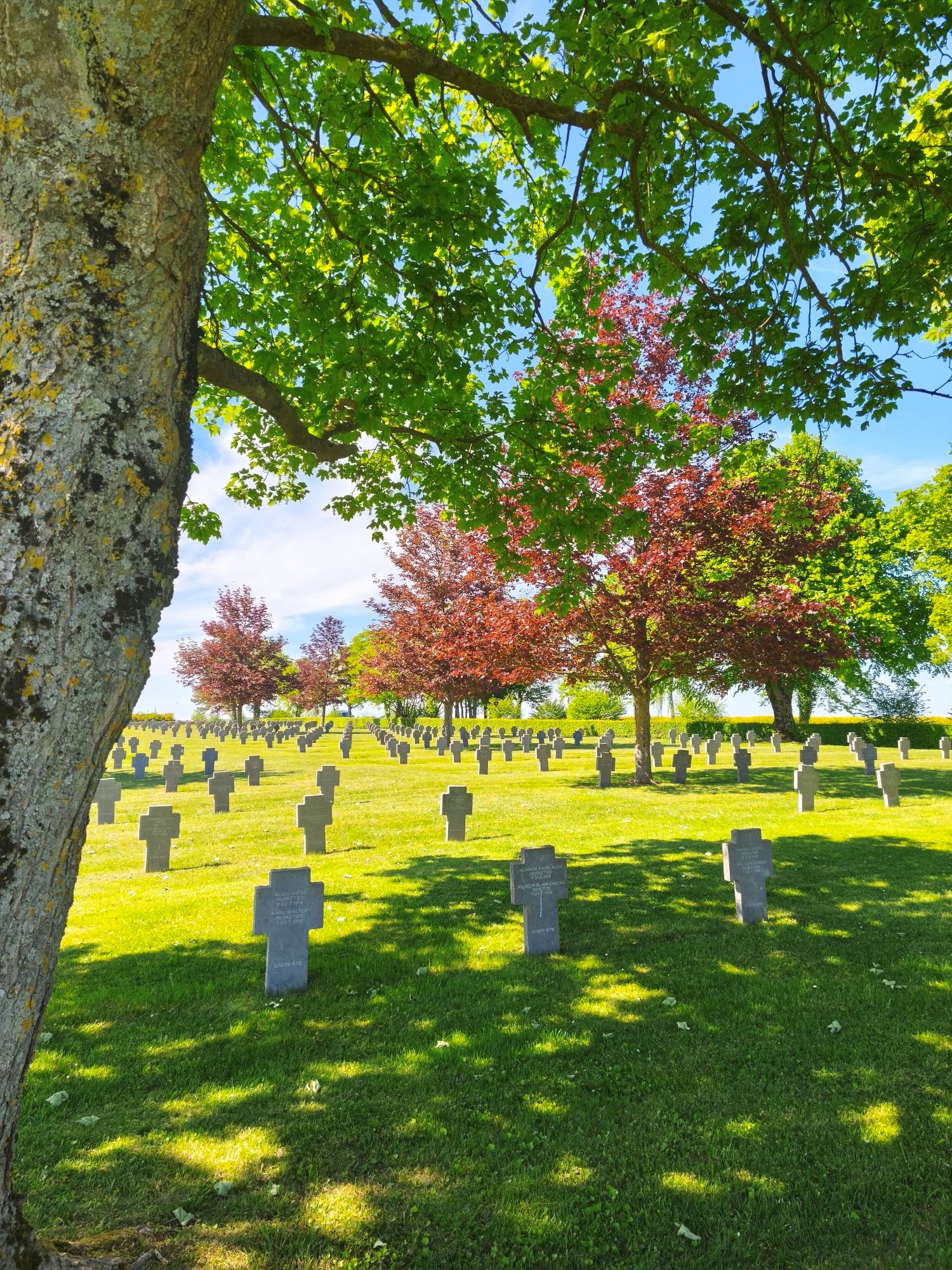
Behind its almost poetic name (literally “the Ladies’ Path”), the Chemin des Dames is one of the greatest remembrance sites of the First World War. This ridge, overlooking the Aisne and Ailette valleys, saw particularly deadly fighting, with hundreds of thousands of casualties.
Today, the area can be explored through several iconic sites. I particularly recommend the Caverne du Dragon, a former underground quarry occupied in turn by French and German soldiers, as well as the many memorials along the route: the Californie plateau, the Casemates plateau, the Basque monument and the monument to the Senegalese Tirailleurs. Not forgettingVauclair Abbey, whose ruins also bear witness to the devastation of the war.
Whether you’re passionate about history or simply curious, the visit is particularly moving and helps you understand what the soldiers went through in the trenches.
👉 Also find my complete guide to the Chemin des Dames, with the must-see sites and my itinerary for discovering this major place of remembrance.
💚 My tip: allow at least half a day to explore the Chemin des Dames. The sites are spread over several kilometres and deserve time to stop, understand their history and enjoy the views over the Aisne and Ailette valleys.
(Caverne du Dragon: full price €8, guided tour of about 1 hr 30)
19. Where to hike in the Aisne? Walks and bike rides
With its forests, valleys, marshes and characterful villages, the Aisne is a fantastic playground for hikers and cycle tourists.
Whether you prefer family walks or long hikes, you’ll find many waymarked trails through the Saint-Gobain forest, the Hottée du Diable, the Chemin des Dames, the Saint-Quentin marshes and the rolling landscapes of Thiérache.
Cyclists aren’t left out, as the Aisne is crossed by La Scandibérique (EuroVelo 3), one of the longest cycle routes in Europe. Over more than 110 km (68 miles), this cycle route links Belgium to the south of France along the Oise valley. It passes through Hirson, Guise, Ribemont, La Fère, Tergnier and Chauny, offering a route through hedgerows, canals, fortified churches and iconic sites of the département.
👉 Also find my selection of the best hikes in the Aisne, with walking ideas for all levels.
💚 My tip: even if you’re not very sporty, several stretches of the Scandibérique are suitable for families and offer a different way to discover the Aisne, along canals, forests and villages.

20. Discover the Château de Fère-en-Tardenois and its ruins
With its spectacular Renaissance covered bridge spanning the moat, the Château de Fère-en-Tardenois is one of the most unusual monuments in the Aisne. Although only ruins remain today, the site has a unique atmosphere that never fails to impress.
Walking through the ruins, you can easily imagine the might of this former fortress. The famous monumental bridge, rare in France, gives the place an almost medieval-series setting… Game of Thrones fans should love the atmosphere!
Away from the hustle and bustle, the château is a peaceful place to wander. Entry is free and lets you discover this little-known heritage while enjoying a lovely green setting.
💚 My tip: combine a visit to the château with the Cité internationale de la langue française, about thirty minutes’ drive away in Villers-Cotterêts. It’s a great way to discover the southern Aisne in a day.

🍽️ The Aisne’s food specialities
You can’t visit the Aisne without tasting a few local specialities! Here are the ones I recommend trying during your stay:
- 🥧 Ficelle picarde, a pancake filled with ham, mushrooms and cream, baked au gratin.
- 🧀 Maroilles, the iconic cheese of Hauts-de-France, used in many recipes.
- 🍰 Gâteau battu, a light, airy brioche typical of the region.
- 🥬 Soissons beans, famous for their large size and melting texture.
- 🍾 Champagne, produced in the southern Aisne, around Château-Thierry.
- 🍺 Craft beers, brewed in several microbreweries across the département.
- 🍯 Thiérache honey and local produce (cider, apple juice, jams…).
🍽️ Where to eat in the Aisne? My favourite addresses
After a day of sightseeing, here are a few restaurants I’ve tried and recommend all over the département.
📍 Area ❤️ My pick Why I love it Saint-Quentin L’Annexe Generous food, a pleasant setting and a perfect terrace on sunny days. Laon L’Estaminet Saint-Jean A friendly spot in the heart of the medieval town, ideal after visiting the cathedral. Chauny La Cantina A lovely surprise, with tasty food in a warm atmosphere. Thiérache (Marly-Gomont) L’Estaminet La Halle Set in the old station market hall, it’s the perfect place to try traditional cooking and local produce. 💚 This selection is based entirely on my own experiences and will grow as I make new discoveries in the Aisne.
Even more ideas for discovering the Aisne
- Watch the sunset at Séry-lès-Mézières
- For a lovely nature walk: the Bihécourt pond
- The Franco-American Museum in Blérancourt
- The Vermand oppidum
- Marie-Jeanne’s house in Alaincourt (all about objects from days gone by)
- The Riqueval Towing Museum
- The Château de Condé (near Château-Thierry)
- Prémontré Abbey
- The Dukes’ residence and castle of Guise
- Champagne tours (but I never drink, so for now I’m not very tempted, haha)
- The maize maze in Le Hérie-la-Viéville
- The creuttes (cave dwellings) of Laon
- Saint-Michel-en-Thiérache, the abbey with its baroque music festivals, its Boizard organ, its crafts museum…
- Margival-Laffaux, Hitler’s former HQ, later a NATO base and then a French army base
- Walks through the vineyards of the southern Aisne, such as in Essômes-sur-Marne
- The Deportation Museum in Tergnier
- The Saint-Denis fair in Saint-Quentin (well, I tried it… and sprained my ankle on the Saturday!)
- The buried castle of Saint-Gobain, an underground maze
- Villers-Cotterêts (its château, the Henri II pavilion, the Alexandre Dumas museum, its forest…)
- Longpont Abbey
- La Ferté-Milon (the Racine museum, the castle ruins…)
- The site where the “Big Bertha” gun that fired shells at Paris was positioned (in Crépy)
- The living history festival, every two years, in Marle, at the Musée des Temps Barbares
- Taste manicamp, a local cheese, in Quierzy
Where to stay in the Aisne? My accommodation ideas
Whether you’re planning a weekend or several days of exploring, the Aisne has accommodation for every kind of trip: charming hotels, B&Bs, country gîtes and even unusual places to stay. Ideally, choose your base according to the sites you want to visit.
🏛️ For visiting Saint-Quentin
TheHôtel Les Coulisses du Théâtre is ideally located right in the town centre, a few steps from the main Art Deco monuments. It’s a great base for exploring Saint-Quentin on foot.
🌿 For exploring the Chemin des Dames and Lake Ailette
TheHôtel du Golf de l’Ailette offers a peaceful lakeside setting, perfect for exploring the Chemin des Dames, Laon and the Caverne du Dragon.
🍇 For a romantic stay
The Domaine De La Ferme De Ribeaufontaine : set in a beautiful rural setting, the estate offers a peaceful, timeless break.
La Cressonnière – Gîte, B&B, gypsy caravan, cabin with spa & heated pool. Nestled in a small village near Soissons, this place offers guest rooms, a cabin and a gypsy caravan, as well as a wellness area with an indoor pool, spa, sauna and hammam. A real cocoon for a romantic getaway.
👑 For a treat
The Château de Barive is one of the most beautiful hotels in the département. Its elegant setting, restaurant and spa make it a great idea for a romantic weekend.
🌾 For an authentic atmosphere
If you love B&Bs, the Aisne is full of lovely characterful addresses. You’ll also find many rural gîtes across the département, perfect for exploring Thiérache, the Soissonnais or the Tardenois.
💚 My tip: the Aisne is a large département. If you’re planning several days here, I recommend changing accommodation during your stay. Spending a few nights around Saint-Quentin or Laon, then finishing near Soissons or Château-Thierry, will cut down driving time and let you make the most of each area.
❓ FAQ: visiting the Aisne
How many days do you need to visit the Aisne?
A weekend lets you discover must-sees like Laon, Saint-Quentin or the Familistère de Guise. To explore the département’s different landscapes, the villages of Thiérache and the Champagne Tourist Route, allow 4 to 7 days instead.
What is the most beautiful town in the Aisne?
Laon charms with its hilltop medieval town and cathedral, while Saint-Quentin is famous for its Art Deco heritage and lively town centre. Two very different but complementary towns.
What to do in the Aisne with kids?
The Parc d’Isle in Saint-Quentin, Axo’Plage, Center Parcs, the Familistère de Guise and walks in the forests or at the Hottée du Diable are great family day-out ideas.
When is the best time to visit the Aisne?
Spring and autumn are the ideal seasons for enjoying the landscapes, villages and hikes. Summer is perfect for outdoor activities and cellar visits along the Champagne Tourist Route.
Where to see the most beautiful landscapes in the Aisne?
The views from Laon, the hillsides of the Marne Valley, the Hottée du Diable, the hedgerows of Thiérache, Coucy-le-Château and the Saint-Gobain and Retz forests are among the département’s most beautiful landscapes.
What to do in the Aisne when it rains?
Make the most of it to discover the Familistère de Guise, the museums of Saint-Quentin, the Cité internationale de la langue française in Villers-Cotterêts or the collections of the Jean de La Fontaine Museum in Château-Thierry. Check opening days and times before you go.
Is the Aisne a good weekend destination?
Yes! Just a few hours from Paris, Lille, Brussels or Reims, the Aisne is ideal for a weekend combining heritage, nature, food and unusual discoveries.
Explore Hauts-de-France
Planning a road trip or several weekends in Hauts-de-France? You’ll also find all my guides to the neighbouring départements (in French), with charming villages, cliffs, gardens, historic towns and remembrance sites.