Planning a trip to Rhodes and wondering what to do in a week?
In this complete guide, I share my 7-day Rhodes itinerary, the must-sees, the most beautiful beaches, the villages worth discovering, where to stay, my budget and all my practical tips after a holiday on the island.
Rhodes is one of my favourite discoveries in Greece. Between the turquoise waters of the east coast, the whitewashed villages, the ancient ruins, the wild mountains of the west and the stunning UNESCO-listed old town, the island offers an incredible variety of landscapes.
TRAVELLING WITH KIDS
My printable Rhodes explorer’s booklet
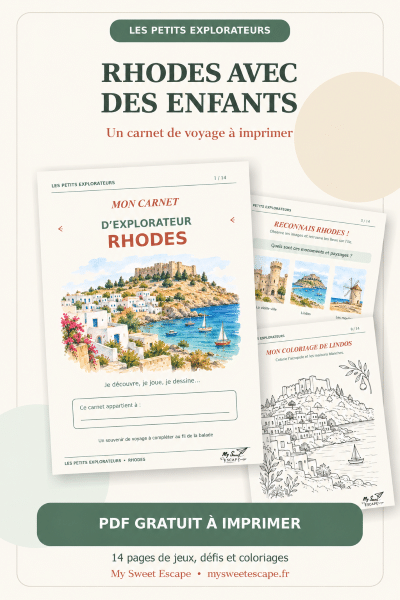
To explore Rhodes as a family, I’ve created a free activity booklet: the old town, Lindos, the butterflies, the beaches and the Colossus of Rhodes all become excuses to play, observe and draw. The booklet is in French, but most activities are visual and easy for kids to enjoy.
📖 Download the booklet for free (PDF, in French)
See also all my travel booklets for kids.
We spent a week driving around Rhodes to discover the best-known spots as well as a few lesser-known corners. This guide brings together everything I wish I’d known before leaving, to help you plan your trip.
Almost a year ago, I flew off to Rhodes.
Some trips answer a very specific craving. For this one, I was simply dreaming of the seaside, sunshine and a gentle pace. After a few road trips through inland landscapes and mountains, and a rather eventful year, I needed warmth, days set to the rhythm of swims, and sunsets on the beach. A simple, bright, stimulating break, but also a deeply restorative one.
Several destinations were floating around in my mind, but my heart longed for something new, and inevitably leaned towards Greece, backed by my stomach, which was crying out for tzatziki, feta and moussaka.
Of the cradle of Western civilisation, I only knew Athens, which I’d visited with my brother some fifteen years earlier. Since then, I’d seen countless photos of road trips in Crete, the Peloponnese and beyond, in friends’ and family’s albums and on social media… So many luminous landscapes that made me want to see more.
Then, almost at the last minute, Rhodes won out, for a summer week of coastline, villages and Greek heat.
For 7 days, we explored the island from our base in Faliraki, alternating between lazing around and sightseeing, quiet beaches and livelier spots.

Illustrated map of my trip to Rhodes 🤍
Rhodes at a glance
- ☀️ Ideal length: 7 days
- 🚗 Transport: renting a car is highly recommended
- 🏨 Where to stay: Faliraki is a great base for exploring the whole island
- 🏛️ Don’t miss: Rhodes Old Town, Lindos, Anthony Quinn Bay, Monolithos and Prasonisi
- 🌸 Best time to go: April to June and September to October
- ❤️ My favourite: the west coast, wilder and less touristy
Why go to Rhodes?
The landscapes, villages and beaches that made me want to discover the island.
Rhodes is a particularly appealing destination if you’re looking for a balance between relaxation and exploration.
Legend has it that the largest island in the Dodecanese was born of the love between the sun god Helios and the nymph Rhoda. Nicknamed the Island of the Sun, it enjoys generous sunshine for much of the year, so you can make the most of the sea from morning until sunset.
Its first asset is undoubtedly the diversity of its landscapes. The island offers a lovely variety of scenery: long sandy beaches, wilder coves (especially on the west coast), wooded valleys, and arid hills dotted with traditional villages.
Rhodes remains fairly easy to explore, and you can switch to a completely different atmosphere in just a few dozen minutes.
But what really makes the island so rich is the striking contrast between its different areas.
- The north: lively, urban and festive
- The east coast: gentle, accessible and very beach-oriented
- The south: wild, windswept and unspoilt
- The west coast: authentic, green and more off the beaten track
(I go into more detail about these areas and what to do there further down in this article.)
But Rhodes isn’t just about landscapes: it carries an ancient, almost tangible memory that slips between the warm stones and cobbled lanes, a truly remarkable cultural heritage, with genuine ancient treasures. You happily lose yourself here, as if to travel back in time, at the foot of imposing ramparts and ruins that still tell of the Crusader knights and the traces of the Ottoman Empire.
When the sun goes down, the island changes face. Summer brings out a more vibrant, almost carefree energy, especially around Faliraki, where the night stretches out between music, laughter and the lights of busy bars.
And then there are the flavours, simple yet so delicious, which accompany every moment. A sun-drenched cuisine where sun-ripened vegetables take centre stage, between Greek salads, mezze to share and freshly grilled fish…
Honestly, Rhodes gave me exactly everything I needed last summer.

Prasonisi Beach, Rhodes (south of the island)
Getting to Rhodes
We chose to fly. Rhodes Diagoras International Airport, about 14 km (9 miles) from Rhodes town, is the quickest way to reach the island. There are many direct flights from major UK and European cities, especially in high season.
Others prefer to arrive by sea, on a cruise or by ferry from the port of Piraeus in Athens.

What to do in Rhodes? The must-sees at a glance
The sights and landscapes not to miss on a first trip to the island.
| Place | Time | Why go? |
|---|---|---|
| Rhodes Old Town | 1 day | UNESCO-listed, the historic heart of the island. |
| Lindos | ½ day | The most beautiful village on Rhodes. |
| Anthony Quinn Bay | 2 hrs | One of the most beautiful coves on the island. |
| Monolithos | 2 hrs | Clifftop castle and a magnificent sunset. |
| Prasonisi | 2 hrs | The point where two seas meet. |
| Butterfly Valley | 2 hrs | A very pleasant nature walk. |
| Kamiros | 1 hr 30 | The finest ancient site on Rhodes. |
Where to stay in Rhodes?
My hotel
Booking at the last minute, the choice of hotels still available at reasonable prices had shrunk somewhat. I eventually found a deal at the Aloe Hotel.
I especially loved the setting: the sunsets there were absolutely stunning, and the terrace and pool area was really well done, so much so that I struggled to find somewhere as nice when planning this summer’s holiday.
The staff were very attentive and quick to sort out the slightest problem, which makes the stay even more enjoyable. Breakfast is generous and varied, perfect for starting the day right.
The rooms are fairly basic and lack a bit of polish, but some even have a private pool, which is a real bonus.
Finally, the hotel is well located and has a car park, which is always handy for exploring the island.


The sky at the end of the day 🤍 (photo taken in front of the hotel)
Which area to choose?
- Rhodes Town : ideal for combining culture and nightlife
- Around Lindos : postcard atmosphere and superb beaches
- Faliraki : perfect for beaches and a party atmosphere
- West of the island : wilder, quieter and unspoilt
Getting around the island
My choice: renting a car
To get around the island comfortably and freely, at any time of day or night, we opted for a rental car. We hired it at Rhodes airport through BSP-auto, the (French) comparison site I’ve used for every trip for years.
Rhodes is also well served by handy and affordable public transport, ideal for visiting the main sights, but it won’t take you beyond the tourist areas.
In practice
There aren’t many roads on the island, so it’s fairly easy to find your way around (even more so these days with GPS on your phone). Be careful: the roads are sometimes narrow, winding and in poor condition (though most of the time they’re actually in very good shape). You’ll occasionally come across little surprises: goats, cows or abandoned buses! 😂
Parking in Rhodes
We generally had no major trouble parking, except in Lindos. Parking there was rather expensive and limited, and we struggled for a good twenty minutes before miraculously finding a spot on a free patch of land above the town. Try to arrive early if you plan to visit.

The goats that often dot the landscape along the roads of Rhodes
My 7-day Rhodes itinerary
My one-week route to explore different parts of Rhodes.
If you have a week, here’s the route I recommend.
- Day 1: Rhodes Old Town
- Day 2: Anthony Quinn Bay, Traganou Beach and Faliraki
- Day 3: Lindos and the most beautiful beaches in the south-east
- Day 4: Monolithos, Siana and the west coast
- Day 5: towards Prasonisi, Lindos…
- Day 6: Kamiros and Butterfly Valley
- Day 7: relax on the best beaches or squeeze in some last visits, depending on your flight time
What to see in Rhodes? The must-sees
From towns and villages to beaches, across the east coast, the south and the west coast.
The north: history and easy beaches
The north of the island, around Rhodes Town, is probably the most accessible area… and also the busiest.
Rhodes Old Town, a UNESCO World Heritage Site, is a true must-see. Encircled by impressive ramparts, it reveals a maze of cobbled lanes, little shops and squares that are always buzzing. It’s a place to explore without a map, simply by letting yourself get lost. The Colossus that made it famous has been gone for centuries, but today a bronze stag and doe watch over its harbour. Let’s be honest: in high summer, the crowds are very much there. But you only need to stray a little from the main streets to find a gentler, almost timeless atmosphere, or come back in the evening, when the old town changes face again, becoming far more intimate and peaceful, whispering forgotten legends.


Another key spot in the area: Faliraki, where we stayed. Better known for its nightlife than for its scenery, the resort is still pleasant to stroll around in the evening, safely, with plenty of places to stop for dinner, party or simply soak up the atmosphere.
To sum up, in the north you’ll mainly find:
- a lively, festive atmosphere
- large, well-equipped beaches, without much charm but spacious, practical and nice for swimming, especially for families
- a high concentration of restaurants, bars and hotels
- the towns of Rhodes Town and Faliraki
👉 Be warned: this is the area that struck us as the dirtiest and least well kept.


Traganou Beach (east of the island)
The east coast of Rhodes and its must-sees
The east coast of Rhodes is often considered the best for swimming. Sheltered from the wind, it’s lined with a string of villages and beach resorts where the sea always seems within reach. Its coastline offers almost continuous access to calm beaches, some sandy, some with small pebbles. An obvious appeal… which also explains why this part of the island attracts most visitors.
But as soon as you move a little away from it, another side of Rhodes appears.
In the dry heart of the island, roads wind between olive groves and sun-scorched hills, where goats roam freely under a vast sky.
Here and there, around a bend, the sea suddenly appears on the horizon, a deep, intense blue that contrasts with the dry golden earth.


Among the must-sees:
- Anthony Quinn Bay : a small, sheltered cove with crystal-clear water, perfect for snorkelling. My favourite spot on the island. We arrived on the evening of our first day, as the light was starting to fade. The sea took on deep hues, and the last rays of sun caught the hills of Rhodes in the distance, outlining their silhouettes on the horizon. Everything felt slower, more suspended, as if the island were welcoming us in its own way.


- The Anthony Quinn Bay viewpoint, a stone’s throw from Faliraki, which takes in its whole palette of blues, from bright turquoise to almost indigo depths.

- Nearby, the chapel of Profitis Ilias overlooks Faliraki Bay. (On Rhodes, chapels are often perched on hilltops, as if to get closer to the sky and entrust prayers to the wind.)
- I didn’t get the chance to visit them, but the Kallithea Springs, former thermal baths built during the Italian era , seem to be a popular stop for a swim in a rather picture-postcard setting…
- The Tsambika Monastery : 300 steps (which sometimes feel like more in the heat) lead up to this place of prayer dedicated to the Virgin Mary, overlooking the Aegean Sea below
- Tsambika Beach : a large golden-sand beach, ideal for a day of swimming and lounging

- Lindos : probably one of the most beautiful villages on the island, with its houses clinging to the hillside, its whitewashed alleys, its acropolis overlooking the sea… and its crystal-clear bay. A real postcard!

- For a nature break, I recommend Seven Springs. We hesitated between this site and Butterfly Valley (in the west of the island) and went for the latter, but this natural site with its freshwater springs is said to be truly enchanting.
The south: wild and unspoilt
As you head south, the atmosphere gradually changes.
The region becomes wilder, semi-desert, less visited and, above all, more exposed to the wind. Villages become scarcer, and quiet roads stretch across dry scrubland. The beaches are bigger, sometimes rougher, and attract water sports fans in particular (windsurfing, kitesurfing…), especially around Prasonisi, a unique spot where two seas meet, forming a spectacular tongue of sand.
What to see:
- Prasonisi Beach: this is where two seas meet. Depending on the season, a sandbar links the island to a peninsula where the Aegean and the Mediterranean collide. A spectacular, truly unique place, popular with windsurfers.

The west coast: nature and authenticity
The west coast is probably the wildest and most unspoilt part of the island. We saved it for our last day and regretted not venturing there sooner.
More exposed to the wind (and therefore less stifling in summer), it shows a different face: greener, more rugged, almost untamed.
Here, the coastline becomes rockier, beaches are fewer and far between, and tourist infrastructure gradually fades away, giving way to raw, almost untouched landscapes.
This is the part of the island to explore if you want to get off the beaten track, slow down and discover a lesser-known Rhodes.
Places like Rhodes’ Butterfly Valley and Kamiros reflect this more natural, authentic side.


Interesting stops include:
- We stopped by chance at Limni Beach, a lovely surprise! (Unfortunately, several beaches on the south-west side seemed littered with rubbish ☹️… but as you head north, they become much cleaner.) A few rocks break the surface along the shore, adding character to the scenery and probably making swimming a little trickier when the wind picks up. But when we were there, the sea was perfectly calm, almost still. We took the opportunity to put on our masks and explore the seabed, the crystal-clear water revealing a multitude of little fish.

- Kamiros : the remains of an ancient city facing the sea, in a peaceful, light-filled setting.
- Kritinia Castle : a ruined medieval castle perched on a hill, with spectacular views over the west coast and neighbouring islands. It’s said to be one of the best places on the island to watch the sunset.
- Monolithos Castle : clinging to its rock, this impressive castle, defying wind and time, seems to watch over still-wild nature. At the end of the day, the light gilds the hills and stretches the horizon into infinity.


- Fourni Beach : a discreet cove nestled at the foot of the cliffs, perfect for a swim after the drive or a visit to the castles.
- Butterfly Valley : in the cool of an unspoilt valley, thousands of Panaxia quadripunctaria gather every summer, drawn by the shade and the scent of the trees. A truly surprising phenomenon! A path winds between streams and wooden bridges through a peaceful forest, where the silence is broken only by the beating of wings. 🌿 Read my guide to Butterfly Valley (in French)

Other things to do in Rhodes
More ideas for visits and experiences during your stay.
Beyond the beaches and sightseeing, Rhodes is also great for a few activities, especially at sea.
Diving and snorkelling are particularly enjoyable here, thanks to clear water and good visibility. Some coves, like Anthony Quinn Bay, are ideal for exploring the seabed, even without very technical gear. With just a mask and snorkel, you can already spot lots of little fish and make the most of the shades of blue.
Finally, you can also escape for a day by ferry to Symi, a small island not far from Rhodes, known for its colourful houses and picturesque harbour.
Where to eat in Rhodes? Local tavernas and foodie spots (homemade food)
In Rhodes Town:
- Ta Marasia: generous Greek cuisine full of flavour, with a particularly warm welcome. I wasn’t feeling great that evening, and when the waitress noticed, she offered us dessert on the house!
- (Just next door, To Stevo looked really lovely but was fully booked when we went. I still wanted to mention it.)
- Minos Roof Garden: tasty Greek food with, as a bonus, a breathtaking view over the town
In Faliraki:
- The Aloe Hotel restaurant: a nice surprise, simple but effective, perfect after a day at the beach.
- Tsittas Pizza Bar: Italian food. It’s very popular in summer, and you often have to wait a good quarter of an hour at the bar before getting a table
- Kantas Taverna: an unpretentious taverna serving a simply incredible moussaka: a real classic, perfectly done! My mouth is still watering!
In Lindos:
Marios’s Restaurant: delicious homemade pittas at bargain prices, in a warm and welcoming setting.
West coast:
Petrokavaro : a completely unplanned find by the roadside, just as hunger was really starting to kick in. And what a surprise! Generous food, almost oversized plates, and that feeling of having stumbled upon the kind of local spot we love.

FAQ: a week in Rhodes, my practical tips
My favourite spots on the island
- Anthony Quinn Bay : the sheltered coves, the surrounding hills and the shades of blue are simply incredible. The viewpoint of the same name, just above, is also not to be missed… absolutely breathtaking!


- The west coast of the island as a whole, with its raw, wild, greener landscapes. Everything I love! Between Limni Beach, Monolithos castle at golden hour, and Butterfly Valley, I was won over again and again by this more authentic side of the island.
- Rhodes Town: despite the summer crowds, I really enjoyed slipping away from the main streets to travel back in time within the city walls.
- Lindos: probably one of the most beautiful villages on the island, with its white houses clinging to the hillside, its acropolis overlooking the sea and its crystal-clear bay below… a real postcard.
- Nightlife in Faliraki : safe and good-natured; I had some great evenings between bars, clubs and relaxed wanders through the lively streets.
- The food : I’d been warned that Greek food never disappoints. Despite my doubts, I simply feasted for a week and can’t wait to taste it again!


A few snapshots of Lindos 🤍
When is the best time to visit Rhodes?
- As you can imagine, July and August are the busiest months. You can feel it in some towns, like Rhodes and Lindos. But if you stray off the beaten track, for example by exploring more of the centre or west of the island, you’d almost forget it’s peak season. The heat, however, can sometimes be hard to bear. Swim breaks do you a world of good! (And the water is very warm, which I personally loved.)
- For all these reasons, May, June and September are, in my view, the ideal time… (Being a primary school teacher, that will never be possible for me ^^’)
Beaches
- Some beaches are covered in pebbles, so you might want to bring water shoes.
- Pack a mask and snorkelif you like snorkelling! You won’t be disappointed!
- Sunbeds are in high demand and fill up quickly, so arrive early if you plan to rent one… (especially as they’re not cheap, so you might as well make the most of it!)
- My favourite beaches: Limni Beach and Traganou Beach
Budget / Payment
Cards are accepted almost everywhere. You might want to bring a little cash “just in case”, for example to buy a drink or an ice cream from a beach food truck.
As for the budget, booking at the last minute, it was clearly higher than I’d have liked. The flight and hotel came to around €850 per person… (which blew my usual budget!!) However, costs on the island were much lower. You can eat really well for €10–15 per person (main course + drink), and none of the sights charged admission except Butterfly Valley (€6).
What to pack
Sunscreen!!