What to do in Seville in a weekend? Planning a 2- or 3-day trip to the Andalusian capital? Here you’ll find my must-sees, my itinerary, my favourite spots and all my tips for visiting Seville without missing the essentials.
From the Real Alcázar to the Plaza de España, via the narrow streets of Santa Cruz, the cathedral, the Giralda, Triana and the Setas, Seville is very easy to explore over a weekend. Here I share the places that left the biggest impression on me during my trips, along with my tips for planning your days and making the most of the city.
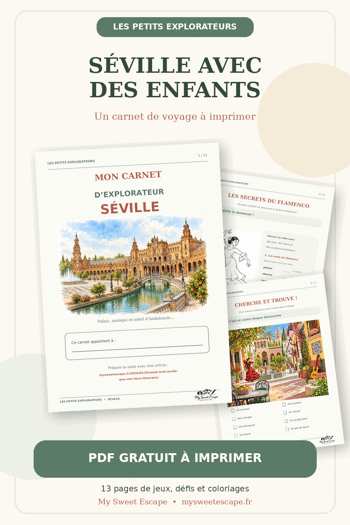
🌞 Seville with kids: my free explorer’s booklet
To make discovering Seville fun, I’ve put together a printable booklet: observation games, azulejos to complete, a flamenco dancer to decorate, seek-and-find and colouring pages. The booklet is in French, but most activities are visual and easy for kids to enjoy.
📖 Download the Seville booklet (free PDF, in French)
13 A5 pages · Printable · Ages 6+
—
Seville, Sevilla… The name alone conjures up sunshine, orange trees in bloom, flamenco, ochre façades and colourful azulejos.
I first visited more than ten years ago, on a mother-daughter trip to Andalusia. We explored Málaga and Granada… and ended our journey in Seville. I remembered it as a bright, vibrant, deeply Spanish city. But memories fade, and I wanted to rediscover Seville with a calmer, more curious, more foodie eye… and perhaps a slightly nostalgic one, too.
At the end of March, after a winter in Picardy, in northern France (translation: a rather long winter), I was badly in need of light and warmth. Of sunshine. The real thing. Not the kind that shows up for 12 minutes between two downpours. With spring around the corner, I was also craving that Spanish atmosphere: tapas on a terrace, lively streets at night, that unique easy-going way of life you only find in Andalusia.
So, with a long weekend ahead, I booked a flight and a small flat right in the centre… and off I flew to southern Spain.
The moment I landed at the airport, I was wrapped in the scent of orange blossom. A sweet, almost hypnotic fragrance that stayed with me all weekend, and that still takes me straight back to that Sevillian interlude today.
The scent of holidays, of spring reawakening, and of a simple joy floating in the air.


Here are my tips for visiting Seville over a weekend.
☀️ Weekend in Seville: at a glance
- 📅 Ideal length: 2 to 3 days
- ✈️ Getting there: direct flights from many UK and European cities
- 🚶 Getting around: everything can be done on foot or by bike
- 🏛️ Don’t miss: the Alcázar, the Cathedral, the Giralda, the Plaza de España, Triana and the Setas
- ❤️ My favourite: the streets of Santa Cruz at sunset
- 🌸 Best time to go: March, April, October and November
- 🥵 Avoid: July and August if you don’t cope well with heat
Why visit Seville for a weekend?
A city of palaces, patios and narrow streets to explore on foot.
For the sunshine (and the mood boost that comes with it)
Seville is one of the sunniest cities in Europe. And at the end of March, that was exactly what I needed. Mild temperatures, near-constant blue skies, terraces already packed… After weeks of grey, it felt like I’d changed seasons in a two-hour flight.
It was 24°C (75°F). Twenty-four. In March.
I think my brain took a few minutes to process that I could get my summer clothes back out. And above all… go out in the evening in a light jacket. No scarf. No puffer coat. None of that little winter misery we put up with out of resignation. The kind of temperature shock you actually enjoy, for once!
👉 My tip: avoid summer if you don’t cope well with heat. Seville is one of the sunniest cities in Europe and can turn into an oven…

For its incredible architecture and monuments
Seville is a city that takes your breath away.
Not just because the weather’s good, but because you literally look up every three minutes: your eye caught by a wrought-iron balcony, an ochre façade glowing almost gold in the sun, or suddenly spellbound by a monument appearing around a corner.
Between its Real Alcázar and its almost unreal, delicate Mudéjar architecture, its immense Cathedral, its Giralda towering over the city’s rooftops, its majestic Plaza de España and its palaces hidden behind understated façades… Seville is a feast for the eyes.
The mix of influences (Islamic, Gothic, Renaissance, Baroque) makes you feel a world away, and tells, street after street, the dense, rich and sometimes complex history of the city…
A history you don’t just read in books, but in the stone, in the carved details, in the light catching the walls at the end of the day.

For the atmosphere
Seville isn’t just about monuments. It’s an atmosphere, a cleverly laid-back vibe. Here, life happens outdoors, following the sun and the shade, which you either seek out or escape depending on the season.
In spring, the light wakes up the streets and squares, which fill with lively terraces. In summer, the heat slows everyone down, but the city stays alive, set to the rhythm of cooler evenings. In autumn or winter, you’ll almost certainly find yourself chasing the rays of sun on your face, like little doses of happiness.
But whatever the season, one thing stays constant: voices rising in the streets, church bells ringing, heels clicking on the cobblestones, glasses clinking together… a joyful hubbub that keeps the city’s heart beating.

To rediscover a city differently
Coming back ten years later let me see Seville differently.
Less rushing. More watching, more Coke breaks (I’m not a sangria fan).

Torre del Oro
What to see in Seville? The must-sees at a glance
An overview of the main sights to plan for during your stay.
Not sure where to start? Here are the main sights to see on a weekend in Seville.
| Place | Time needed | Why go? | My verdict |
|---|---|---|---|
| Real Alcázar | 2–3 hrs | Seville’s most beautiful palace and its gardens | ⭐⭐⭐⭐⭐ |
| Cathedral & Giralda | 2 hrs | An iconic monument with a superb view | ⭐⭐⭐⭐⭐ |
| Santa Cruz quarter | 2 hrs | Flower-filled streets and an Andalusian atmosphere | My favourite neighbourhood ❤️ |
| Plaza de España | 1 hr | One of the most beautiful squares in Spain | ⭐⭐⭐⭐⭐ |
| María Luisa Park | 1 hr | A pleasant green break | Very pleasant |
| Triana | 2 hrs | Authentic neighbourhood and cradle of flamenco | Not to be missed |
| Metropol Parasol (Las Setas) | 45 min | Panoramic view at sunset | Superb panorama |
| Flamenco show | 1 hr 30 | A typically Andalusian evening | An unmissable experience |
Where to stay in Seville?
When I started looking for accommodation, one criterion was non-negotiable for me: location.
I absolutely wanted a place a stone’s throw from the historic centre, so I could do everything on foot. In Seville, life happens in the narrow streets, on the lively squares and along the Guadalquivir, and I didn’t want to rely on public transport or taxis…
So I chose a small apartment, the Natural Suite Sevilla Center, ideally located in the old town. Within a few minutes’ walk, we could reach the main monuments, as well as countless cafés and restaurants.
The place was clean and well equipped, but the layout was a bit unusual, with no natural ventilation or window to the outside. For 2–3 days, it’s perfectly fine. For a longer stay, though, I wouldn’t recommend it.

What to do in Seville? Must-sees by neighbourhood
Sights and walks, neighbourhood by neighbourhood.
Seville is easy to explore on foot (or by bike, if like me you take to the bike-share scheme). What a time-saver, and what a joy to pedal along with the sun and breeze on your skin! The city is fairly compact, but each neighbourhood has its own personality.
Here’s a little practical guide, neighbourhood by neighbourhood.
❤️ Short on time…
If you only have one day in Seville, here are the five places I absolutely recommend:
- 🏰 The Real Alcázar
- ⛪ The Cathedral and the Giralda
- 🌺 The Santa Cruz quarter
- 🏛️ The Plaza de España
- 💃 A flamenco evening in Triana or El Arenal
My all-time favourite? Getting lost in the streets of Santa Cruz when the orange blossom fills the whole city with its scent.

Santa Cruz, the historic heart
Once the Jewish quarter, Santa Cruz is the beating heart of Seville. This is where you’ll find the most famous monuments.
-
The Real Alcázar
This royal palace of Moorish origin, built, extended and refurbished over the centuries by the rulers who lived in it, is still used by the Spanish royal family on official visits.
It completely won me over ten years ago. Its Mudéjar architecture is breathtakingly delicate: finely carved patios, colourful azulejos, ceilings worked like lace, lush gardens you could get lost in for hours…
I actually wrote about it here (in French, and beware, it’s an archive!).
That article is old. Very old.
(I am officially a dino-blogger.)
Please forgive the graphic eccentricities of the time: it was another era of the internet, or at least of my life.
👉 (Very) important tip: book your tickets several days in advance, especially for weekends.
I thought I could buy my ticket on the spot, like ten years ago.
Spoiler: no.
Everything was sold out.
So we had to skip the daytime visit.

The Catalina de Ribera fountain, just outside the Alcázar Gardens
-
Naturaleza Encendida, a consolation prize for rediscovering the Real Alcázar gardens
Since I hadn’t booked a regular visit to the Real Alcázar (I naively thought I could wing it…), I had to resign myself to finding an alternative, a “consolation prize”. As luck would have it, several posters around the palace were advertising Naturaleza Encendida, a sound and light show held in the palace gardens. And in the end, fate sometimes works things out beautifully.
Perhaps it had simply decided to surprise me, and to move me in a different way. The walk takes place at night, in gardens transformed by light. The trees are draped in shifting colours, the façades come alive, music gently fills the space. You move slowly, almost weightlessly. A magnificent night-time stroll in which nature and architecture light up in dreamlike harmony. A moment suspended in the beauty of the place and the moment.
👉 The show runs every winter (usually from late October to March), with a new theme each year. Time slots go fast, especially at weekends, so it’s best to book ahead.


-
Seville Cathedral and the Giralda
The sheer size of Seville Cathedral is hard to take in. The carved doors look tiny against the imposing façade. Inside, the vaults soar so high that you end up walking with your head tilted back (careful not to bump into a pillar).
Built on the site of a former Almohad mosque, it still retains a few features from that era, including its iconic former minaret, now the bell tower: the Giralda. It offers a unique panoramic view over Seville’s ochre rooftops, hidden patios and bell towers, and in the distance, the Guadalquivir river lazily winding its way.
I told you about it in this dino-article (in French), with an equally haphazard layout, which mostly taught me one thing: ticket prices have almost doubled in ten years. Expect to pay €14 at the ticket office today… if there are any tickets left.
Because yes, needless to say, I drew a blank there too.
I promise, this time I’ve learnt my lesson.
👉 Booking ahead is essential!
Even outside summer.
Even on weekdays.
Even if you think “it should be fine”.


-
Getting lost in the streets of Santa Cruz
Just steps from the cathedral, Seville’s old judería (Jewish quarter) is a true maze of winding lanes and romantic squares. The little houses are sometimes whitewashed, sometimes painted in bright colours, with wrought-iron balconies, overflowing flowerpots, and that very special light that shifts with the time of day and the shadows of the walls.
This is where you truly feel the city’s historic soul.
Santa Cruz isn’t just a neighbourhood to tick off: it’s a place to wander, soak up Seville’s atmosphere and let yourself be swept along by its lively buzz.
👉 I also wrote a rather pointless article about it (in French), but its photos illustrate what I’m describing here: https://mysweetescape.fr/2013/06/27/intermede-seville-promenade-dans-les-rues-de-la-ville/.


María Luisa Park , the city’s green lung.
* María Luisa Park
A vast, shady park, perfect for a stroll or a bike ride. Fountains, ceramic benches, palm trees… a place where you can slow down, breathe, and almost forget you’re in a city. It’s one of my favourite places in Seville. I still remember my mother’s naps here ten years ago, lulled by birdsong and the scent of flowers. In spring, the park is especially vibrant, almost magical.

* Plaza de España
Built for the 1929 Ibero-American Exposition, this semicircular square is spectacular, majestic… and highly symbolic! 13 years ago, I explained why here (in French).
The bridges, the canal, the azulejos depicting the Spanish provinces… to me, they make this square one of the most fascinating places in Spain.
My only regret: I’ve still never seen it at night!


El Arenal – Between the bullring and the river
Just south of the cathedral, El Arenal gets its name from the word “arena”, meaning sand in Spanish, which once piled up on the banks of the Guadalquivir. Until the 17th century, this was the site of the city’s shipyard. Today, the neighbourhood combines elegance and Andalusian charm, with its bullring, lively riverside and tapas bars…
Plaza de Toros de la Maestranza
Even if you’re not into bullfighting, this historic bullring is said to be worth a look. Its delicately ornate architecture and its role in Spanish bullfighting culture are impressive. If you want to go inside, remember to book!
A stroll along the Guadalquivir
Nothing beats a walk along the riverbanks to breathe in the mild river air, watch the boats and feel the city’s slower pace.
I decided to do it by bike, heading for the Monasterio de la Cartuja, a former monastery turned contemporary art museum.
Spoiler alert: I arrived… just as they were closing the doors. At 3:30pm on Sundays, versus 9pm the rest of the week. Third fail of the trip, you might say! I had to settle for an ice cream and a drink on a terrace. Poor me!
See a flamenco show in a tablao
El Arenal is home to several renowned tablaos (flamenco venues). Even if you don’t think you’re “flamenco-compatible”, let yourself be surprised: the show is intense and rhythmic, and you’ll feel the whole city pulsing with it.


Encarnación, contemporary Seville
A neighbourhood that shows another side of the city, more modern and dynamic.
Metropol Parasol (the “Setas”), the giant waffle
This very contemporary wooden structure, with its roof made of thousands of honeycomb cells, has a panoramic walkway over Seville. The view is said to be especially beautiful at sunset, as the city gently lights up.
Markets and local shops
Encarnación has a covered market and more local shopping streets. It’s not really my favourite part of Seville, but I still gave in to a bit of shopping at the end of the day.

Triana – Seville’s working-class soul
Located across the Guadalquivir, on the other side of the Isabel II bridge, Triana is often considered the most local and authentic neighbourhood in Seville.
This is where you can discover Sevillian craftsmanship, especially ceramics. Between workshops, shops and façades decorated with colourful azulejos, you dive into a traditional craft that is the city’s pride and joy.
Weekend itinerary idea
A route to plan two days in the city.
Day 1 – The historic heart: Santa Cruz and El Arenal
Morning: Santa Cruz
- Real Alcázar (booking essential, or the Naturaleza Encendida evening show if you can’t get tickets)
- Seville Cathedral and the Giralda (booking essential)
- Wander through the streets of Santa Cruz to admire the façades, balconies and hidden patios
Afternoon: María Luisa Park and Plaza de España
- Stroll or cycle through the park, enjoying the fountains, palm trees and ceramic benches
- Prepare to be blown away as you arrive at the Plaza de España, monumental and colourful
Evening: El Arenal
- Walk along the Guadalquivir to soak up the city’s laid-back rhythm
- Flamenco show in one of the neighbourhood’s tablaos
Day 2 – Seville by the water and its working-class neighbourhoods
Morning: Triana
- Bike ride along the Guadalquivir towards Triana
- Wander through this authentic, working-class neighbourhood
- Browse the workshops and shops selling local ceramics
Afternoon: Encarnación, contemporary Seville
- Metropol Parasol (the “Setas”), for the panoramic view over the city
- Markets and small shops for a bit of shopping (best enjoyed at the end of the day)
Day 3 – Bonus and extra discoveries
- Casa de Pilatos – a sumptuous palace with stunning patios and azulejos, often less crowded than the Alcázar but just as charming
- Mirador de la Torre del Oro : a nice little view over the Guadalquivir and the Triana neighbourhood, ideal for a late-afternoon photo.
- Parque del Alamillo : a less touristy park for a quiet walk or a riverside picnic.
- Free time as you please: a last wander through Santa Cruz, a return to a favourite square, a coffee or ice cream break
- Monasterio de la Cartuja, now a contemporary art museum

👉 Leave your luggage at a left-luggage service such as Lock & Enjoy if you’re leaving late. (Tried and tested: when you rent an apartment, there’s no luggage room like at a hotel… and I approve ^^!)
etc.
👉 Practical tips for this itinerary:
- I recommend tackling the must-sees (Alcázar, Cathedral, Giralda) in the morning to avoid the crowds.
- Parks and bike rides are perfect for the afternoon, when it’s a bit warmer and you want to relax.
- Encarnación and Triana are more fun at the end of the day, to enjoy the light and the local rhythm.
- Always leave a little “free” slot for the unexpected, ice creams and drinks on a terrace…

My Seville favourites
The places and moments I loved most in Seville.
- Wandering the streets of Seville, wrapped in the scent of orange blossom, a real treat for the senses.
- Being welcomed at the airport by that same scent, which stayed with me all weekend and still takes me back to this trip today.
- The Plaza de España, monumental and majestic, a must-see that amazes me every time.
- Rediscovering the city by bike, thanks to the many cycle lanes that make every ride pleasant and safe.
- Reliving the Alcázar in fairytale mode thanks to Naturaleza Encendida, a sound and light show that turns the gardens into a dreamlike world.
- The little impromptu flamenco performances you stumble upon around a corner, which make the whole city come alive.
- The Spanish atmosphere, that easy-going way of life you see on the terraces, in the lively conversations and the balmy Sevillian evenings.
- Don’t hesitate to step inside Spanish churches. Some are tiny, almost unnoticeable from the street, but they often hide treasures of ornamentation and light: real surprises to discover.

Where to eat in Seville?
In the evenings, restaurants and tapas bars are packed, and we only tried two places, both a little disappointing. And there I was, licking my lips at the thought of tucking into a whole spread of delicious tapas to celebrate my return to Spain! So I didn’t bother writing down their names. I did, however, have lunch at two small places that were very decent:
- Le Betis 7, Calle Betis (no. 7), in Triana: a contemporary restaurant putting a new spin on Andalusian cuisine. Its rooftop offers an unbeatable view over the Guadalquivir and Seville’s historic centre. Friendly welcome, tempting menu and good-quality food.

- Brunch Milk Away, 5B Calle Carlos Cañal, Casco Antiguo: for breakfast or brunch in a bright, relaxed setting. On the menu: açaí and smoothie bowls, salads, artisan sandwiches, porridge, pancakes… all made with fresh produce. 🤍

Can you visit Seville with kids?
Yes. Seville is a great family destination thanks to its pedestrian-friendly historic centre, wide-open spaces like the Plaza de España and María Luisa Park, boat trips on the Guadalquivir and plenty of gardens where kids can let off steam.
Day trips from Seville
A few ideas for extending your stay around Seville.
- Carmona, a small medieval town.
- Écija, the “city of towers”, with spectacular Baroque architecture and picturesque squares.
- Italica, a Roman archaeological site with an amphitheatre and mosaics.
- Ronda, with its spectacular bridge and clifftop houses.
- Córdoba and its Mosque-Cathedral.
- Osuna: a small historic town with a monastery and palaces.
❓ FAQ: planning a weekend in Seville
How many days do you need to visit Seville?
I’d recommend allowing at least two days to see Seville’s main highlights. With three days, you’ll have time to visit the main monuments, wander through the different neighbourhoods and enjoy the Andalusian atmosphere without rushing.
When is the best time to visit Seville?
Spring and autumn are the ideal seasons. Temperatures are pleasant and the city is stunning when the orange trees are in bloom. In summer, the heat can easily top 40°C (104°F).
Can you explore Seville on foot?
Yes, the historic centre is fairly compact. We got around almost entirely on foot. In my opinion, it’s the best way to discover the streets of Santa Cruz, Triana and the lively squares of the city centre.
Do you need to book the Real Alcázar in advance?
Yes, especially if you’re travelling during school holidays, in spring or in autumn. Tickets sell out fast, so it’s best to book your time slot several days, or even several weeks, in advance.
Where should you stay in Seville?
I recommend staying in the historic centre or near Santa Cruz so you can visit most of the sights on foot. Triana is also an excellent choice if you’re after a more local feel.
What is the most beautiful neighbourhood in Seville?
I absolutely fell for Santa Cruz, with its flower-filled lanes, its patios and its typically Andalusian atmosphere. I also loved Triana for its authenticity and its ties to flamenco.
What to do in Seville in two days?
In two days, I’d suggest visiting the Real Alcázar, the Cathedral and the Giralda, wandering through Santa Cruz, discovering the Plaza de España, crossing over to Triana and catching a flamenco show in the evening.
Is Seville worth visiting?
Absolutely! With its palaces, gardens, monumental squares, Mudéjar architecture, friendly atmosphere and food, Seville is one of the most beautiful cities in Spain and an ideal weekend destination.