
Where to see Art Deco in Saint-Quentin? In the streets of the town centre, on façades and in some public buildings, this heritage from the rebuilding after the First World War reveals itself to anyone who takes the time to look up. Let me take you to discover the details that struck me on this architectural walk in Saint-Quentin, northern France.
Almost two years ago, the famous Lonely Planet published a list of the ten most stylish cities in France, including Troyes, Le Havre and Nancy, already featured on the blog, Bordeaux, Les Arcs… and Saint-Quentin’s Art Deco architecture! At the top of the list ! Classy, right?
Art Deco, what’s that? I’ll come back to it in much more detail in this article, but roughly speaking it’s an architecture and decoration movement born in the early 20th century, which boomed after the First World War until its consecration in 1925 at the International Exhibition of Modern Decorative and Industrial Arts in Paris.

Like many towns along the Hindenburg Line, Saint-Quentin was almost 80% destroyedby the end of the First World War. In the aftermath of the armistice, cobblestones and rubble littered the streets of a ghost town that had been evacuated a few months earlier.
As residents gradually reclaimed what was left of their homes, an incredible field of possibilities opened up to the architects and town planners in charge of rebuilding these devastated towns, at a time marked by a new spirit: one of euphoria, ferment, joy and excitement, of never wanting to go through such a devastating conflict again, and of LIVING. The Roaring Twenties.
The Art Deco movement found its home in Saint-Quentin: today, the town has more than 3,000 listed buildings, 277 of them entirely Art Deco.
Yes, in Saint-Quentin, Art Deco is everywhere. Along the streets, at crossroads, in imposing buildings, on shops, and in the stained-glass windows of the basilica too. You just need to open your eyes and look up to notice it.

But to be completely honest, I think most passers-by and residents no longer really pay attention to this style that has always surrounded them and seemed less unusual than it is. Me first. I’d taken an Art Deco guided tour of Saint-Quentin at secondary school, years ago now, and started noticing some of its details on the town-centre façades. But as the years went by and memories faded, I have to admit I’d forgotten most of what I’d been told that day.
This year’s exhibition devoted to Art Deco gave us an excuse to finally take a closer look at the subject and join one of the weekly guided tours run by the tourist office to discover the little secrets of the town’s façades (and more).

Say what you like, nothing beats the descriptions, anecdotes and tips of enthusiasts like our guide, Christine, who led us all over the town centre to study the rebuilt buildings in a lively, insightful way, pointing out little gems we’d never paid attention to before, hidden in balconies, windows, balusters, colonnades… I love it! I think from now on we’ll never look at some buildings the same way on our walks!
My photos aren’t exceptional, as the light wasn’t great on the day of our visit, and the cold, work and tiredness are rather putting me off getting my camera out and going on long walks at weekends at the moment. I promise I’ll give you a nicer overview in spring!
However, I wanted to publish this article before the end of the exhibition, in case you were thinking of going 😉

Art Deco in Saint-Quentin at a glance
| To discover | Façades, architectural details and buildings in the town centre |
| Background | The rebuilding after the First World War |
| Visit | A self-guided walk or a guided tour, depending on the programme |
| Tip | Check current tours and openings with the tourist office |
To discover Saint-Quentin differently
What to do in Saint-Quentin?Saint-Quentin and the Great War (in French)Street art in Saint-Quentin (in French)
Art Deco in Saint-Quentin: recognising its façades and décor
Art Deco is often confused with Art Nouveau… wrongly, since it was born as a reaction against it! Funnily enough, we’d had a little glimpse of Art Nouveau work two weeks earlier in Alsace, at the Lalique museum! Our visits to the exhibition and the town here helped us brush up our knowledge on the subject, haha 😉
It’s hard to define Art Deco precisely, as it has so many influences, and not being an art expert, I’ll avoid going into too many tedious and possibly inaccurate details! Here’s simply what I gathered from our guides 😉
Born before the First World War, its emergence was slowed by the war and then given a real boost by the Reconstruction. That’s why it’s so present in the towns of Picardy that were so badly scarred by the war…
But Art Deco isn’t just the art of the Reconstruction, far from it! You’ll find fabulous examples all over the world, even in New York (the Chrysler Building).
Art Deco also covers different fields, including architecture, design, the interior decoration of buildings and even ocean liners (the Île de France, the famous Normandie), and even stained glass.


Much more streamlined than Art Nouveau, which it often mocks but sometimes draws on, for example by borrowing its scrolls and arabesques, Art Deco is the art of modernism, order, geometry, symmetry, colour and, of course, restraint.

How to recognise Art Deco architecture?

– Letting in the light, with the appearance of bay windows for that purpose
– Height! It’s an art to admire on façades when you take the time to look up from your phone 😉 (hey, Aymeric!)
– Highlighting geometric shapes of all kinds (triangles, squares with cut corners, arabesques, diamonds…)
– The use of materials that had been less showcased until then, such as brick (white or red), concrete, which regained its prestige, wrought iron and wood.
– The importance of flowers, especially the rose, and fruit baskets… stylised, of course.
– Classical inspiration (colonnades, mythological scenes in bas-reliefs…)
– The movement’s own lettering (“big belly, little legs”)
– The number 3, a factor of balance, everywhere (three windows, three doors, three bay windows…)

Our visit to an Art Deco exhibition in 2016
Cameras weren’t allowed inside the building, so I’ll only share iPhone photos here.
An exhibition devoted to Art Deco is currently being held, until 20 March only, in the town’s former Nouvelles Galeries department store (above Monoprix, for locals). The building itself, usually closed to the public but open for the event, is worth the trip! It was the first time in 26 years I’d been able to see it, so I wasn’t going to miss the opportunity. What a shame it hasn’t been permanently restored :)!


The exhibition looks at the principles of Art Deco, its artists, how it evolved and its consecration at the 1925 Exhibition of Decorative Arts, as well as the various advances made during the Roaring Twenties and the place of women in that decade. A real plunge into history, in a very 1920s atmosphere!!


—
Discover Saint-Quentin’s council chamber
The Town Hall is home to the only Art Deco council chamber in France, designed by Louis Guindez, a famous Art Deco artist and a key figure in Saint-Quentin’s rebuilding. You’ll see his name on a few house façades in the very centre of town, by the way!


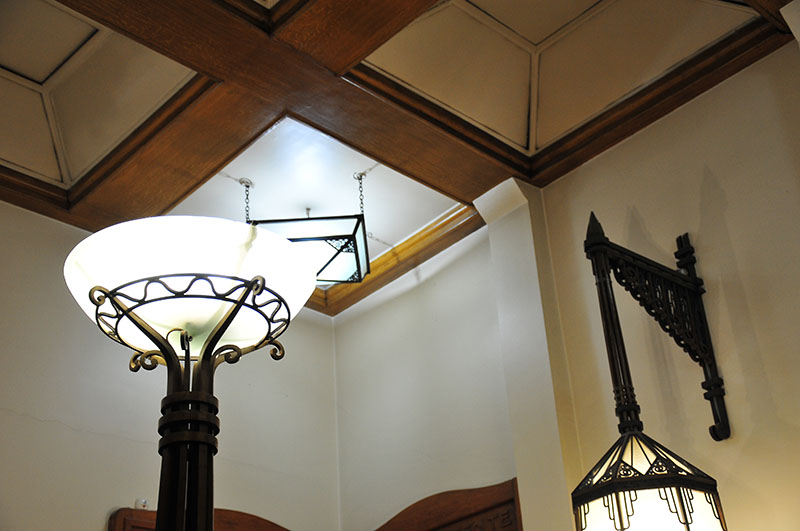
Visiting it alone could take hours (trust me, you’re talking to the girl on her third visit to the Town Hall, haha!). Between its wrought-iron balustrade, its wall panels depicting the different trades involved in rebuilding the town, its little lamps where wrought iron and opaline seem to set the tone, its subdued atmosphere and its seats adorned with the town’s history summed up in a simple coat of arms…


A real little Art Deco gem that’s impossible to present in a few words!




Where to see Art Deco in the streets of Saint-Quentin?


FAQ: discovering Art Deco in Saint-Quentin
Why does Saint-Quentin have so many Art Deco buildings?
Much of the town was destroyed during the First World War, and its rebuilding coincided with the rise of this architectural style.
Where can you see Art Deco in Saint-Quentin?
The town centre is full of façades and decorative details. A walk is ideal for looking up.
How do you recognise an Art Deco building?
Look for geometric shapes, stylised lines, ironwork and decorative motifs.
Can you take an Art Deco guided tour?
Tours may be offered depending on the tourist office’s programme. Check dates and details.
What else to visit in Saint-Quentin?
The town also has heritage linked to the Great War and several artistic and cultural trails.
Practical information for discovering Saint-Quentin
- Saint-Quentin: a weekend getaway 1 hr 15 from Paris
- More walking ideas here: Things to do in Saint-Quentin, Saint-Quentin in the heart of the Great War (in French), street art in Saint-Quentin (in French)
- The exhibition mentioned in this article was temporary, in 2016, and has now ended. Check current exhibitions before you go.
- Guided tours: contact the tourist office for the current programme and prices.